admin

Reed Copper Deposit — 2012 Pre-Feasibility Study

The 2012 Pre-Feasibility Study outlines the recovery methods for the Reed Copper Deposit, detailing the processing plan at the Flin Flon Concentrator. Run of mine material will be transported by truck to Flin Flon, crushed to less than 150mm, and then further crushed to 20mm in a two-stage closed circuit plant. Due to the relatively low zinc grade of the Reed deposit, the plan is to produce a copper concentrate with gold and silver credits rather than a zinc concentrate.

Reed Copper Deposit — 2012 Pre-Feasibility Study Read Post »

Taviche Project — 2011 Technical Report

This technical report outlines the recovery methods for the Taviche Project, conducted by Broad Oak Associates in 1993. The assessment assumes that the mineralization present at the site is amenable to standard mineral processing techniques, specifically crushing, grinding, and flotation. Based on comparable operations in the region, the expected recovery rate for silver is estimated to be in the 80% range.

Taviche Project — 2011 Technical Report Read Post »

Meadowbank Mine Technical Report — 2012

This technical report details the recovery methods and processing plant operations at the Meadowbank Mine as of February 2012. The facility utilizes a conventional gold plant flowsheet originally designed by Hatch Engineering after Agnico-Eagle acquired the project in 2007. The process includes primary and secondary crushing, grinding via a semi-autogenous mill and ball mill (SABC circuit), gravity concentration, and gold recovery using a carbon-in-pulp (CIP) circuit. The plant achieved commercial production in March 2010 and has undergone capacity upgrades, including the addition of a secondary crusher in 2011, increasing throughput to 9,840 tonnes per day.

Meadowbank Mine Technical Report — 2012 Read Post »

Choco 10 Gold Recovery Plant — 2010 Feasibility Study

This Feasibility Study outlines the expansion of the Choco 10 gold recovery plant operated by Rusoro. The existing facility, commissioned in 2005, currently treats saprolitic material at a throughput of 5,000 t/d. The proposed expansion aims to increase total capacity to 20,000 t/d by adding a new 15,000 t/d processing line while retaining the existing 5,000 t/d circuit. The new design focuses on treating hard rock ore with a target annual production of 500,000 oz of gold.

Choco 10 Gold Recovery Plant — 2010 Feasibility Study Read Post »

AZOD PFS Pairs Waelz Kilns With a Zinc Refinery to Turn Peruvian Zinc Oxide Ore Into Slab Zinc

This NI 43-101 Technical Report outlines the Preliminary Economic Assessment (PEA) for the AZOD Zinc Oxide Project located in Cusco, Peru. The project focuses on the recovery of zinc and lead from oxide mineralization using a combined pyrometallurgical and hydrometallurgical processing route. The proposed facility includes a crushing plant, a Waelz rotary kiln for reductive roasting, and a conventional hydrometallurgical refinery for fume processing.

AZOD PFS Pairs Waelz Kilns With a Zinc Refinery to Turn Peruvian Zinc Oxide Ore Into Slab Zinc Read Post »

La Preciosa Silver Property — 2011 Technical Report

This Preliminary Economic Assessment Technical Report outlines the processing and recovery methods for the La Preciosa Silver Property located in Durango, México. The report details a metallurgical testing program confirming that conventional cyanide leaching technology is suitable for recovering silver and gold from the feed material. The design basis for the concentrator facility is established at 5,000 dry metric tonnes per day, with a projected annual throughput of 1.8 million dry metric tonnes.

La Preciosa Silver Property — 2011 Technical Report Read Post »

Timmins Talc-Magnesite PEA Floats Talc, Then Leaches the Flotation Tails to Make Dead-Burned Magnesia

This section of the technical report details the recovery methods for the Timmins Talc-Magnesite project. The process facilities are designed to treat 500,000 tonnes per year of talc-magnesite ore. The plant operates continuously with 85% availability to exceed 310 days per year. The production process involves crushing, grinding, flotation for talc recovery, and leaching for magnesium oxide production.

Timmins Talc-Magnesite PEA Floats Talc, Then Leaches the Flotation Tails to Make Dead-Burned Magnesia Read Post »

Figure 1.6: Simplified process flow diagram.

Lac Jeannine Fe Tailings Project — NI 43-101 Technical Report

This NI 43-101 Technical Report details the process design for the Lac Jeannine Fe Tailings Project in Québec, Canada. The plant is designed to process 7.0 Mtpa of tailings material with a feed grade of 7.0% total Fe. The processing circuit utilizes hydraulic classifiers, high-frequency screens, jigs, and spirals to upgrade the iron content to a target concentrate grade of 65-67% Fe. The design is based on COREM testwork and similar projects in the Labrador Trough.

Lac Jeannine Fe Tailings Project — NI 43-101 Technical Report Read Post »

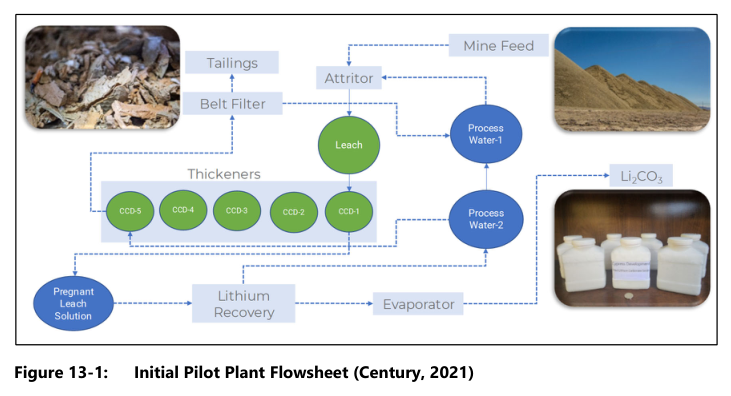
Figure 13-1: Initial Pilot Plant Flowsheet (Century, 2021)

Clayton Valley 2026 Feasibility Update Leaches Attrition-Scrubbed Claystone With Hydrochloric Acid and Recovers Lithium by DLE, With a Chlor-Alkali Plant Recycling the Reagents

The 2024 Technical Report for the Clayton Valley Lithium Project outlines the recovery methods for a feasibility study focused on lithium carbonate production. The process design is optimized for a phased approach, with Project Phase 1 targeting an initial throughput of 7,500 t/d and Project Phase 2 expanding to 15,000 t/d, ultimately yielding up to 71.2 t/d of lithium carbonate. The plant design integrates a chlor-alkali facility to produce necessary reagents, specifically hydrochloric acid and sodium hydroxide, ensuring a closed-loop system for water and chemical management.

Clayton Valley 2026 Feasibility Update Leaches Attrition-Scrubbed Claystone With Hydrochloric Acid and Recovers Lithium by DLE, With a Chlor-Alkali Plant Recycling the Reagents Read Post »

La Plata Project — 2026 Technical Report

The 2026 NI 43-101 Technical Report for the La Plata Project, specifically focusing on the Allard Cu-Ag Porphyry Deposit, outlines conceptual metallurgical studies regarding recovery methods. The proposed flowsheet suggests sequential recovery techniques, starting with copper sulfide flotation, followed by magnetic separation for magnetite, flotation for apatite, and gravity concentration for heavy minerals like zircon. These pathways are noted as commonly employed in similar mining operations targeting specific mineral concentrates.

La Plata Project — 2026 Technical Report Read Post »

Scroll to Top