admin

Updated Preliminary Economic Assessment — Coles Hill Uranium Property

This Preliminary Economic Assessment (PEA) outlines the recovery methods for the Coles Hill Uranium Property, focusing on an alkaline processing circuit designed to extract uranium from underground ore resources. The project utilizes a standard mill and yellowcake facility configuration, employing carbonate reagents for leaching to maximize internal water recycling and conserve reagents. The design assumes a 35-year mine life with an average head grade of 0.098% U3O8 and a mill leach recovery of 85%.

Updated Preliminary Economic Assessment — Coles Hill Uranium Property Read Post »

Magistral Project — 2022 Technical Report

This section of the NI 43-101 Technical Report details the recovery methods for the Magistral Project, focusing on the modification and operation of an existing processing plant. The plant is designed to treat the Magistral tailings deposit with a nominal throughput of 1,000 tonnes per day. The flowsheet includes grinding, cyanide leaching, countercurrent decantation (CCD), SART (Sulfidation, Acidification, Recycling and Thickening), Merrill-Crowe precipitation, and cyanide destruction circuits.

Magistral Project — 2022 Technical Report Read Post »

South Deep — 2021 Technical Report

The South Deep processing facility is designed to treat 330,000 tonnes of ore per month, with a name plate capacity of approximately 4 million tonnes per annum. The plant currently treats a combination of underground ore and reclaimed tailings, utilizing a semi-autogenous grinding (SAG) and ball mill circuit integrated with gravity recovery, thickening, leaching, CIP, elution, and electrowinning technology.

South Deep — 2021 Technical Report Read Post »

Figure 1-1: Overall Process Flowsheet

Boa Esperança Project — 2021 Technical Report

The Boa Esperança Project Feasibility Study outlines the design for a mineral processing plant capable of treating 4 Mtpa of ore from an open pit mine over a 12-year mine life. The facility is designed to operate three shifts per day with high availability, producing copper concentrate and managing pyrite tailings through a dry stack facility. The process plant design relies on extensive metallurgical testwork and Ausenco’s modelling programs to ensure optimal recovery and operational efficiency.

Boa Esperança Project — 2021 Technical Report Read Post »

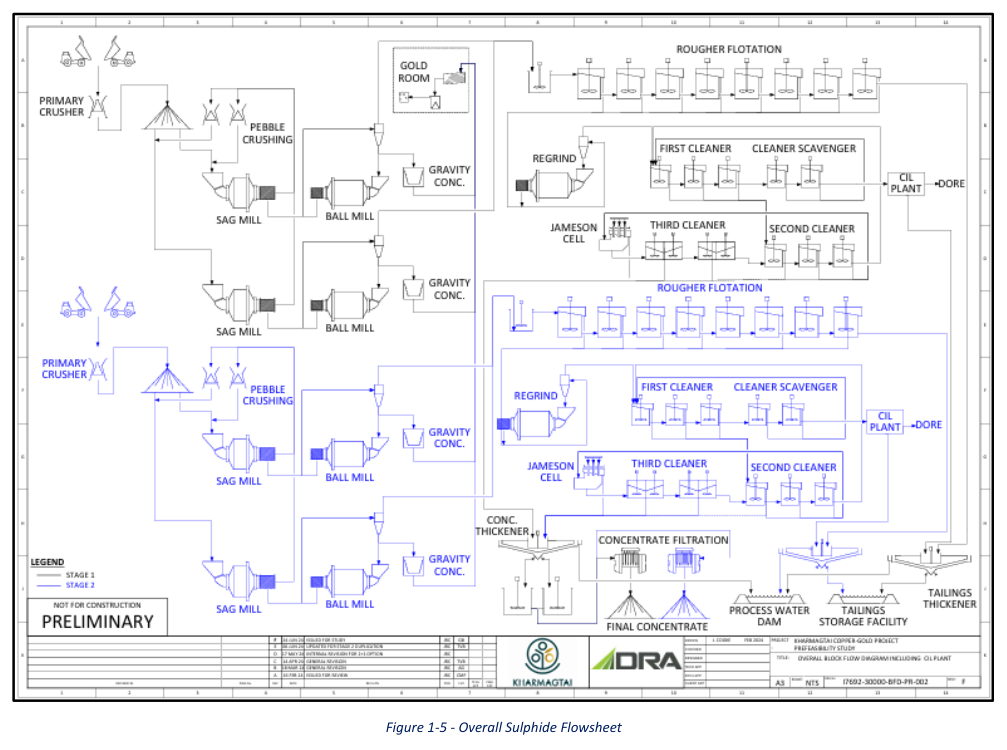
Figure 1-5 - Overall Sulphide Flowsheet

Kharmagtai Project — 2025 Technical Report

This NI 43-101 Technical Report outlines the Pre-Feasibility Study (PFS) for the Kharmagtai Project, a development-stage open-pit mine operated by Xanadu. The project design focuses on a staged production strategy targeting a peak milled tonnage of 52 Mt/y over a 26-year mine life. The processing plant is designed to handle both sulphide and oxide ore types, utilizing a comprehensive flowsheet that includes comminution, flotation, gravity concentration, and carbon-in-leach (CIL) circuits. The design incorporates significant contingency measures, such as parallel trains for Stage 2 expansion, to ensure operational robustness and economic viability.

Kharmagtai Project — 2025 Technical Report Read Post »

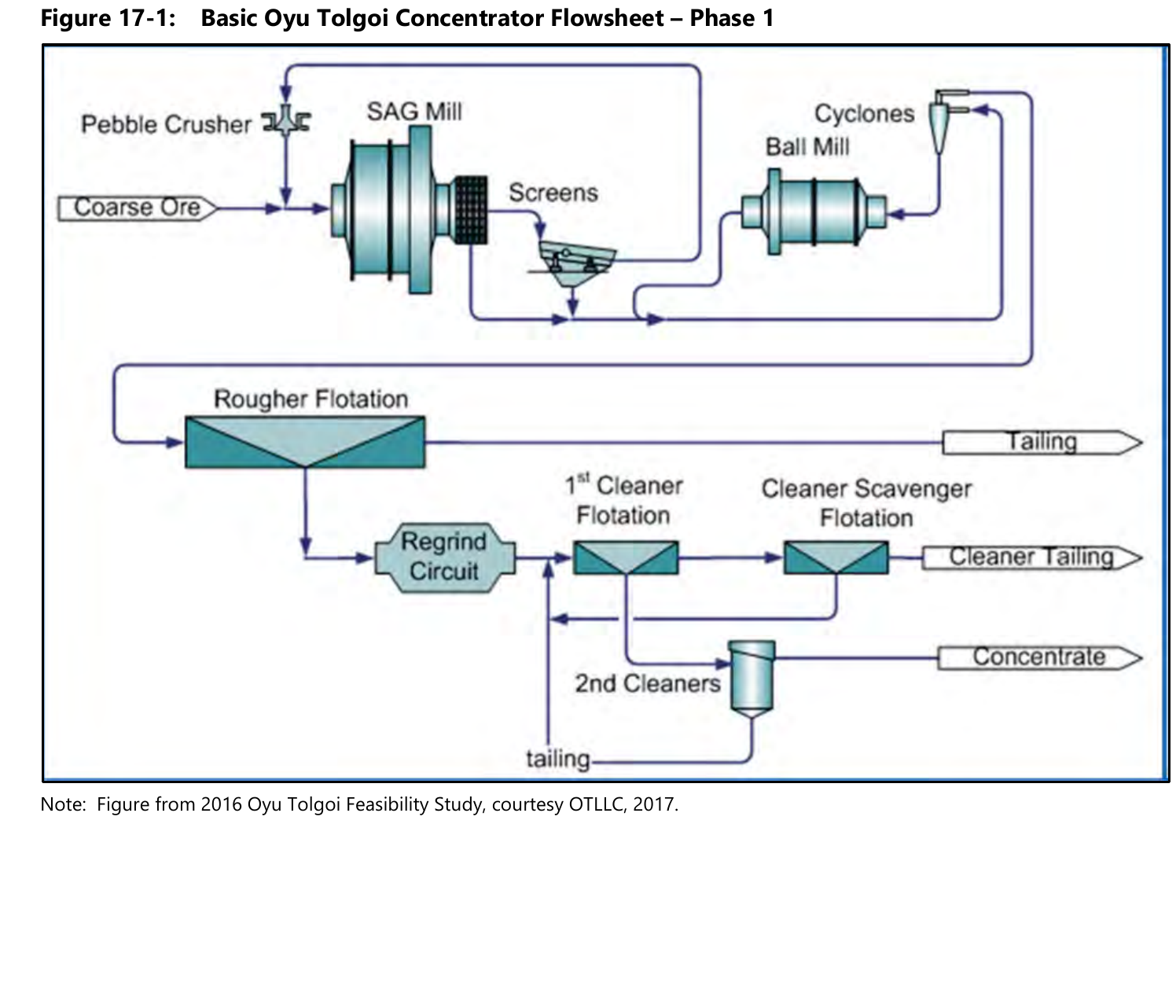
Oyu Tolgoi process flowsheet: Basic Oyu Tolgoi Concentrator Flowsheet – Phase 1

Oyu Tolgoi — 2021 Technical Report

This NI 43-101 Technical Report details the development and operational status of the Oyu Tolgoi project in Mongolia, managed by the Oyu Tolgoi Joint Venture (OTLLC). The project is currently in a phased development stage, with Phase 1 commissioned in 2013 and Phase 2 focused on integrating underground feed from the Hugo North deposit. The concentrator facilities are designed to process ore from both the Oyut open pit and the Hugo North underground mine, utilizing a conventional semi-autogenous grind (SAG) mill and ball mill circuit followed by flotation.

Oyu Tolgoi — 2021 Technical Report Read Post »

Kingash — Preliminary Economic Assessment 2011

This report details the Hatch scoping study conducted in 2011 for the Kingash project, evaluating beneficiation, smelting, and refining options for the Kingashsky, Verkhnekingashsky, and Kuyovsky deposits. Three beneficiation options were analyzed: the Gipronikel flow sheet, the Valleriite Regrind flow sheet, and the Sulphidisation flow sheet. The study utilized mass and energy balances developed through METSIM™ modeling to assess capital and operating costs, ultimately selecting Option 2 (Valleriite Regrind) for the financial assessment due to its balance of recovery and cost.

Kingash — Preliminary Economic Assessment 2011 Read Post »

Goldex Mine — 2012 Technical Report

The Goldex Mine Technical Report dated October 14, 2012, outlines the recovery methods and processing plant status for the Goldex Mine. The plant was commissioned in 2008 and operated until October 2011, when mining was suspended and the facility entered care and maintenance. The report details a feasibility study proposing a reopening in 2013 with a design throughput of 5,100 tonnes per day.

Goldex Mine — 2012 Technical Report Read Post »

Figure 13-5: Flowsheet of the mill process at San Martin Mine

San Martin Mine — 2024 Technical Report

This section of the NI 43-101 Technical Report details the recovery methods employed at the San Martin Mill. The facility utilizes a conventional cyanidation process combined with the Merrill Crowe recovery method. The mill has a rated capacity of 1,100 tpd, though current operations average around 650 tpd based on data from April 2017 to April 2024. During this period, the mill achieved average recoveries of 86% for gold and 55% for silver.

San Martin Mine — 2024 Technical Report Read Post »

Old Nic Mine — 2012 Technical Report

The Old Nic Mine processing plant is designed to achieve an overall gold recovery rate of 90%, utilizing a combination of gravity concentration and carbon-in-pulp (CIP) leaching. Approximately 70% of the gold is recovered as free gold in gravity concentrators, specifically Knelson concentrators and James Tables, while the remaining gold is processed through a conventional CIP circuit. This hybrid approach targets the high proportion of free-milling gold (60-70%) found in the Old Nic ore.

Old Nic Mine — 2012 Technical Report Read Post »

Scroll to Top