

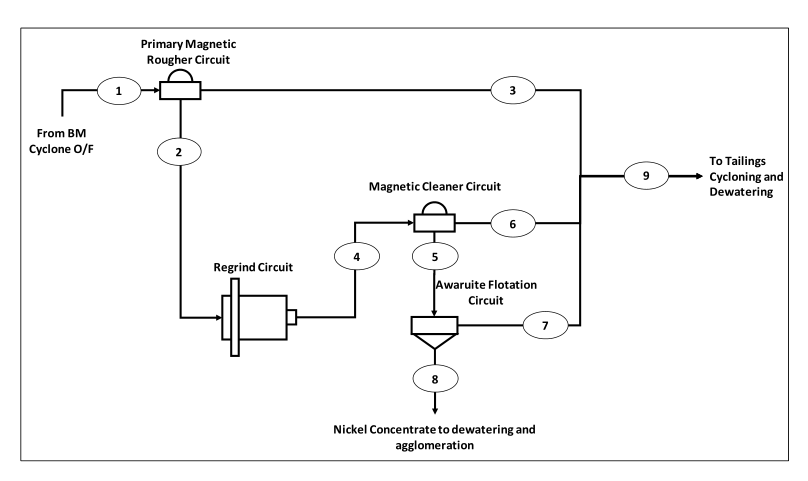
This PEA outlines a 120,000 tpd mineral processing flowsheet using crushing, HPGR, ball milling, magnetic separation, and flotation to produce a 63.4% Ni concentrate from the Baptiste Deposit.
Report context
This technical report, dated September 2020, presents a preliminary economic assessment (PEA) for the Baptiste Nickel Project. The processing design is based on testwork performed using samples from the Baptiste Deposit, as described in Chapter 13 of the report.
Processing route
Primary and secondary crushing
The process flowsheet begins with primary and secondary crushing with screening, followed by stockpiling. The primary and secondary crushing plant utilization has been assumed at 70%.
HPGR and ball milling
Crushed product is fed to HPGR (high-pressure grinding roll) crushing with screening and ball milling to achieve the primary grind size. The initial primary grind size is 300 µm, dictated by the tailings deposition strategy and the tailings storage facility (TSF) design. For the first 21 years of operation (Phase 1), this grind size is the finest that will generate sufficient sand tailings to accommodate the tailings deposition plan.
Starting in Year 22 (Phase 2), process tailings will be disposed of using an in-pit deposition strategy, removing the grind size constraint. BBA performed a high-level analysis indicating that a 170 µm primary grind size should be targeted for improved DTR Ni recovery in Phase 2.
The concentrator and ancillary facilities are designed for 24 h/d, 7 d/w, 365 d/y operation. Plant utilization downstream of the crushed product stockpile has been assumed at 92%. Most equipment incorporates a design factor of 15% above nominal to account for operational variability.
Magnetic separation and regrind
Following ball milling, the ground material undergoes a primary magnetic separation step. The magnetic concentrate is then reground to the final grind size of P80 25 µm, which is required to achieve proper awaruite liberation. A further magnetic separation step processes the reground material.
Flotation and product dewatering
The fine magnetic concentrate is subjected to flotation. Based on testwork, a final flotation concentrate grade of 63.4% Ni can be achieved. The final concentrate is dewatered and briquetted into the final saleable product.
Ramp-up considerations
The first year of operation is assumed to be a ramp-up year with mill throughput at 75% of nominal capacity. Year 22 is also assumed at 75% of nominal throughput to account for construction and tie-ins to incorporate the added grinding capacity for Phase 2.
Key reported parameters
| Parameter | Value | Basis |
|---|---|---|
| Nominal processing capacity | 120,000 tpd (43.8 Mtpa) | PEA design |
| Primary grind size (Phase 1, Years 1-21) | 300 µm | Dictated by TSF design |
| Primary grind size (Phase 2, Year 22+) | 170 µm | BBA high-level analysis |
| Final flotation concentrate grade | 63.4% Ni | Testwork |
| Final grind size (P80) | 25 µm | Required for awaruite liberation |
| Crushing plant utilization | 70% | Design assumption |
| Downstream plant utilization | 92% | Design assumption |
| Equipment design factor | 15% above nominal | Design assumption |
| Ramp-up throughput (Year 1 and Year 22) | 75% of nominal | PEA assumption |
| DTR Ni recovery equation | DTR Ni Rec % = (-0.0376 × Primary grind size µm) + 95.93 | Developed from testwork |
Project website: https://fpxnickel.com/projects-overview/baptiste-nickel-project/
Technical qualifications
The recovery equation for DTR (Davis Tube Recoverable) Ni recovery was developed from testwork performed using samples from the Baptiste Deposit. The final flotation concentrate weight recovery is calculated based on the targeted final grade of 63.4% Ni, which is assumed for this PEA. The 170 µm primary grind size target for Phase 2 is based on a high-level analysis by BBA that estimated increased capital and operating costs for improved DTR Ni recovery.
—
Source: NI 43-101 Technical Report, PEA of the Baptiste Nickel Project, September 2020. Processing sections as cited.
