

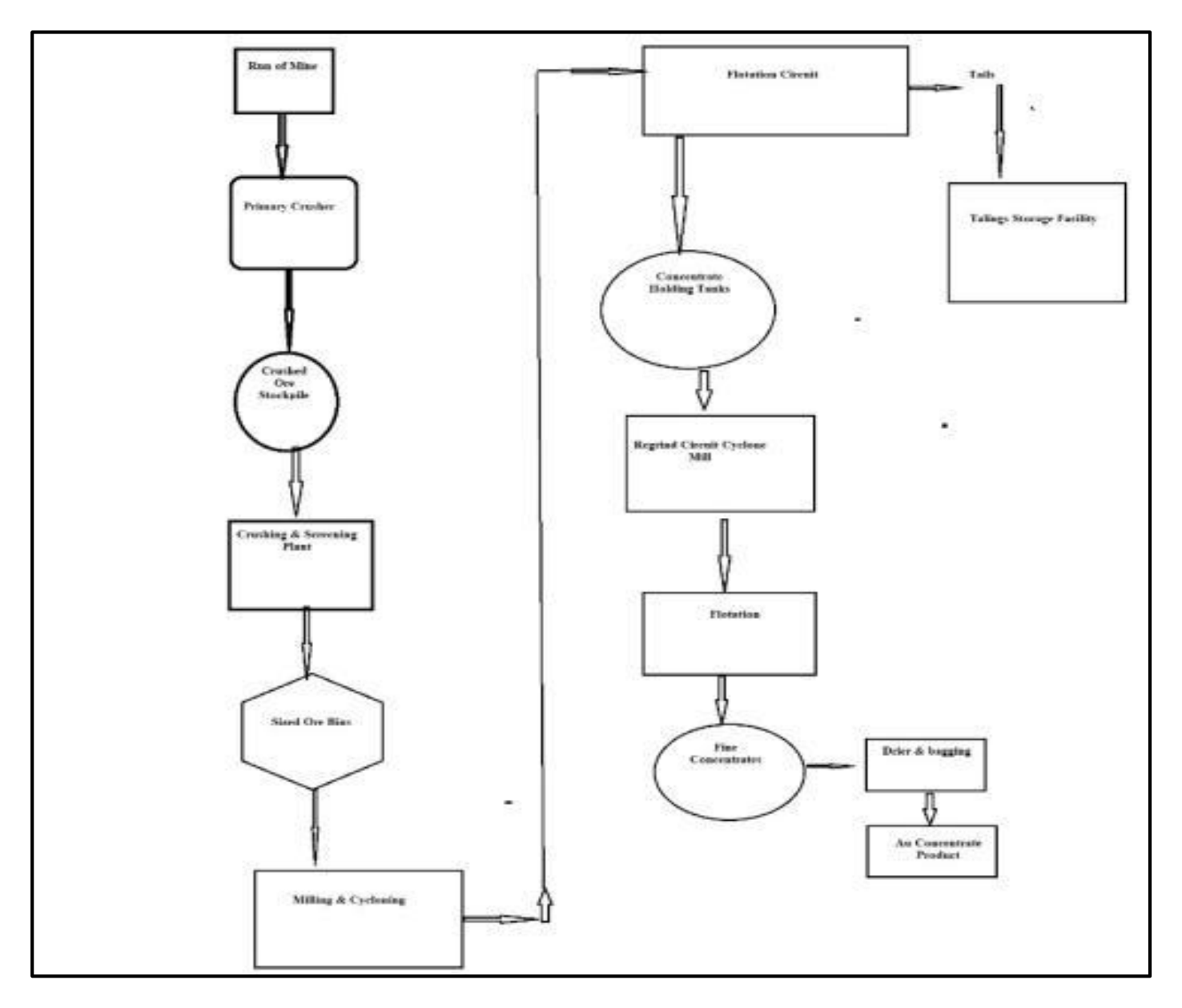
The 2022 preliminary economic assessment for the Belvedere gold project near Zvishavane describes crushing, closed circuit ball milling, four-stage rougher-scavenger and cleaner flotation, and a gold concentrate sold to a smelter or a roasting plant.
Belvedere is a gold project near Zvishavane in Zimbabwe, about 18 km from the town. The NI 43-101 independent technical report is a preliminary economic assessment (PEA) compiled by Edelrod Consulting for Poplar Creek Resources Inc., with an effective date of April 24, 2022 and reference number ED_ZRM_01-2022. Preliminary metallurgical test work on oxide and sulphide ores showed that oxide ore leaches easily by standard cyanidation, while sulphide ore gave very good recoveries by standard flotation. The author's considered view is that a single process route, a flotation concentrator, is adequate for the small proportion of oxide and the bulk of sulphide ore. The plant is designed to treat about 1,000 t/d, or 300,000 tonnes of ore for each year of operation.
Critical Data
| Parameter | Value | Unit | Notes |
|---|---|---|---|
| Plant throughput | 1,000 | t/d | About 300,000 t/y maximum |
| Nominal throughput | 30 | t/h | Design |
| Feed grade | 3.6 | g/t Au | Design |
| Gold recovery | 92.7 | % | Flotation |
| Primary grind | 75 | µm P80 | Ball mill with cyclones |
| Concentrate regrind | 45 | µm P80 | Design |
| Rougher and scavenger stages | 4 | Not applicable | Flotation |
| Cleaner stages | 4 | Not applicable | Flotation |
| Final concentrate grade | 23.8 | g/t Au | Design |
| Bond mill work index | 15.81 | kWh/t | Ore specific |
| Life of mine ore | 2,654,263 | t | Plan |
| Design availability | 82 | % | Standby equipment in critical areas |
| Plant operating time | 85 | % | Estimated |
| Fine ore bin | 2,000 | t | Between crushing and grinding |
| Tailings thickener underflow | 60 | % w/w solids minimum | To the TSF |
Overview
The Belvedere process plant takes run-of-mine ore and produces a gold-bearing concentrate for shipment to a smelter overseas, or to the roasting plant in Kwekwe, Zimbabwe. The report notes that the roasting plant was not operating at the time of reporting, though plans to resuscitate it were underway. The process covers crushing and grinding of the ore, followed by froth flotation. Tailings are thickened to a density that allows deposition in a tailings storage facility (TSF) to be built within the project area. The design rests on unit operations the report describes as well proven worldwide, chosen for suitability for duty, reliability and ease of maintenance.
Key Process Stages
Oxide and sulphide strategy
The oxide ore and transition ore would be carefully blended into the sulphide ore for flotation. The proportion of oxide is small compared with sulphide in the deposits. If more oxide ore is found as drilling progresses, a conventional cyanidation plant could be designed to handle it during the first phase of production, say one to three years. The second stage would focus on sulphide concentrate production, and both routes would share the crushing, screening, grinding and classification facilities. The base assumption for the mine plan and plant design is a flotation concentrator for predominantly sulphide ore, possibly mixed with small proportions of oxide ore in the early years.
Crushing, screening and grinding
The major unit operations are jaw crushing, screening, and grinding with a ball mill in closed circuit with hydrocyclones. A 2,000 t fine ore bin provides surge capacity between crushing and grinding. The primary grind target is 75 µm P80. The ore has a Bond mill work index of 15.81 kWh/t.
Flotation
The classified product goes through two stages of flotation, rougher-scavenger and cleaner, each with four stages in the design. Concentrate is reground to 45 µm P80. The design gold recovery is 92.7%, and the final concentrate grade is 23.8 g/t gold from a feed grade of 3.6 g/t.
Concentrate and tailings handling
Concentrate is dewatered in a thickener, filtered and bagged, and shipped in sealed containers. Rougher-scavenger discharge is pumped to a tailings thickener that produces an underflow of at least 60% w/w solids, which is pumped to the TSF. Thickener overflow returns to the reclaim water tank for reuse in the grinding and flotation circuits.
Additional Interesting Data and Summary
The design assumes sufficient automated plant control to limit the need for continuous operator interface, with manual override. The plant layout aims at easy access to equipment and a compact footprint.
Existing infrastructure at the site is limited and not suitable to support redevelopment. Most of it serves subsistence farmers and small-scale miners. The project site is about 18 km from Zvishavane and the Zvishavane to Bulawayo highway passes about 3 to 3.5 km away. A 3.5 km link road and a bridge over a tributary of the Ngezi River would have to be built, with the crossing designed to pass a 25-year, 24-hour storm event through a low-lying bridge. Internal roads would be unsealed gravel, and the mine property would be fenced with gates and cattle guards to keep villagers' livestock out.
The report's mineral processing section sits ahead of its infrastructure chapter, and describes the site layout principles as minimizing movement of bulk materials, minimizing light vehicles and heavy trucks including delivery trucks, and minimizing pedestrian and heavy truck interaction. Dust on regularly used roads would be suppressed by water spraying, and the operator plans site maintenance programs to keep roads and other infrastructure in good condition. The report states that a conventional cyanidation plant is only a contingency and is not part of the base case flowsheet.
The primary access to the site is described as a sealed highway between Zvishavane and Bulawayo that passes within 3.5 km of the proposed site area. Flows above the design storm would overtop the access road and could limit site access for short periods, so erosion at the crossing would be controlled with rip rap or rock protection. Signage inside the mine area would be regulatory, preventative and informative.
Key Processes
- Jaw crushing and screening with a fine ore bin
- Closed circuit ball milling with hydrocyclones
- Rougher-scavenger flotation in four stages
- Four-stage cleaner flotation with concentrate regrinding
- Concentrate thickening, filtration and bagging
- Tailings thickening to 60% solids and disposal in a tailings storage facility
Source: NI 43-101 Independent Technical Report, Preliminary Economic Assessment of the Belvedere Gold Project, Zvishavane, Zimbabwe, April 24, 2022.
