

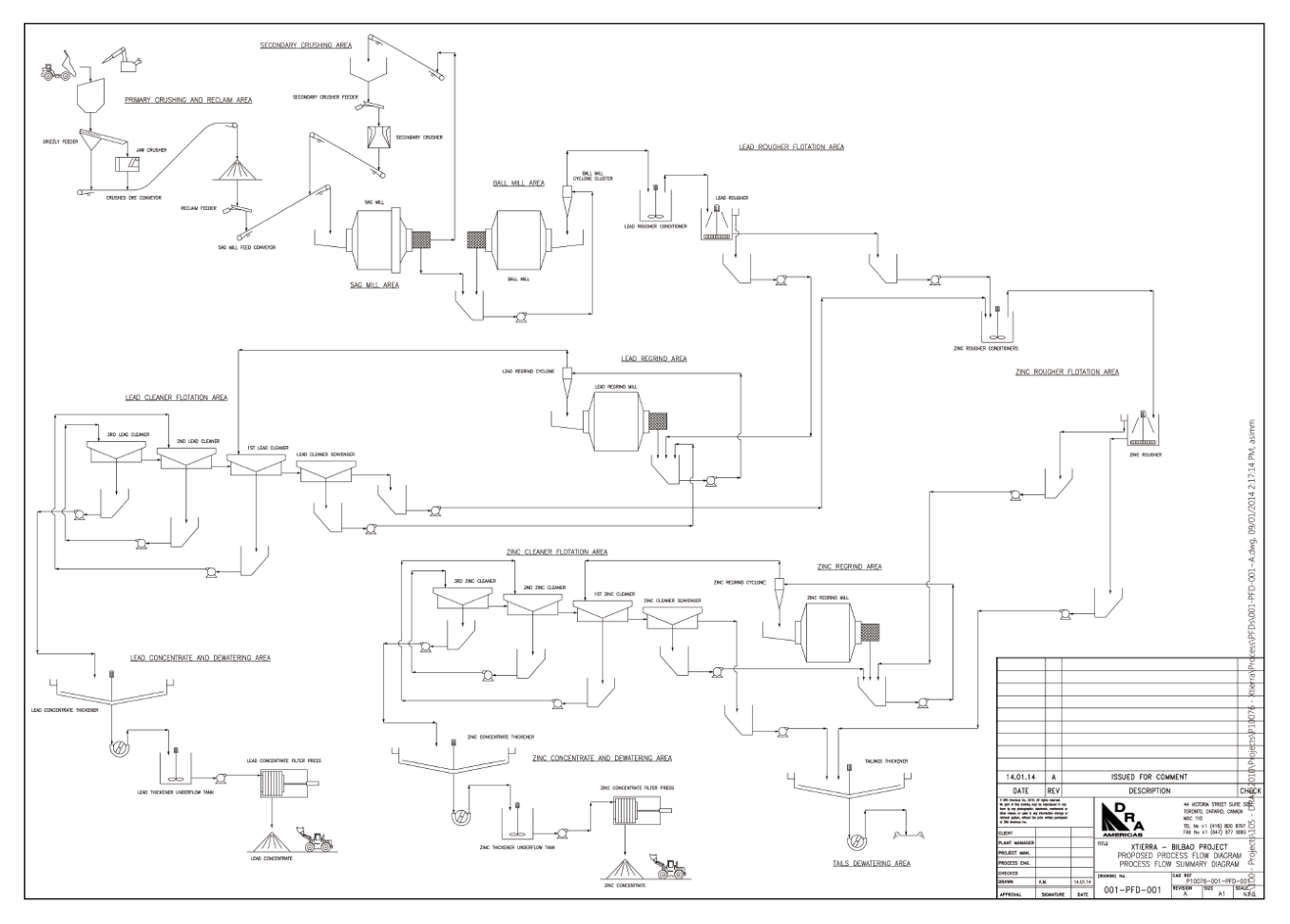
The 2014 preliminary economic assessment for Xtierra's Bilbao silver-lead-zinc project in Mexico describes a 720,000 t/y plant with a jaw crusher, SAG and ball milling, regrinding of both rougher concentrates, three-stage cleaning and filtered concentrates.
Bilbao is a silver-lead-zinc project in the district of Panfilo Natera in Zacatecas State, Mexico. Xtierra Inc. retained RungePincockMinarco (Canada) Ltd. to prepare the NI 43-101 preliminary economic assessment (PEA), dated April 28, 2014 under report number ADV-TO-00011. DRA Americas analyzed the metallurgical testing and designed the process plant. The plant is sized to treat a silver-lead-zinc sulphide ore at 2,000 t/d, or 720,000 t/y, and to produce a lead-silver concentrate and a zinc concentrate for off-site shipment.
Critical Data
| Parameter | Value | Unit | Notes |
|---|---|---|---|
| Plant capacity | 2,000 | t/d | 720,000 t/y |
| Head grade, silver | 63.96 | g/t | Design |
| Head grade, lead | 1.40 | % | Design |
| Head grade, zinc | 2.10 | % | Design |
| Crush size | 95,000 | µm P80 | Jaw crusher, 70 mm closed side setting |
| SAG mill product | 3.1 | mm P80 | 91 t/h |
| Primary grind | 100 | µm P80 | Ball mill with cyclones |
| Lead regrind | 43 | µm P80 | Closed circuit with cyclones |
| Zinc regrind | 37 | µm P80 | Closed circuit with cyclones |
| Lead concentrate grade | 54.0 | % Pb | 1,335 g/t silver |
| Zinc concentrate grade | 43.0 | % Zn | 91.4 g/t silver |
| Lead circuit recovery | 73.4 / 90.6 | % Ag / % Pb | To lead concentrate |
| Zinc circuit recovery | 76.7 | % Zn | To zinc concentrate |
| Lead concentrate output | 16,913 | dry t/y | 726 koz contained silver |
| Zinc concentrate output | 26,966 | dry t/y | 25.6 Mlb contained zinc |
| Filter cake moisture | 7 / 8 | % | Lead / zinc |
Overview
The Bilbao plant uses a SAG and ball mill circuit followed by sequential flotation. Lead floats first, and the lead rougher tailings go on to zinc flotation. Each concentrate is reground in closed circuit with cyclones and cleaned in three stages with a cleaner-scavenger step. Concentrates are thickened to 76% solids and pressure filtered. Zinc flotation tailings are thickened to 65% solids and sent to the tailings treatment facility.
Key Process Stages
Crushing and SAG milling
Haul trucks tip into a 125 t dump hopper, equipped with a remotely operated rock-breaker, which feeds a jaw crusher through a grizzly feeder. The jaw crusher takes ore up to 600 mm and runs at a closed side setting of 70 mm, making a P80 of about 95 mm at 105 t/h. Crushed ore goes to a stockpile with 24 hours of live capacity, and four vibrating pan feeders feed the SAG mill. The SAG mill makes a P80 of about 3.1 mm at 91 t/h with 70% solids discharge. A 9.5 mm trommel sends oversize to a cone crusher with a 9 mm closed side setting, which makes about 24 t/h of P80 10 mm material for return to the SAG mill.
Ball milling
A ball mill runs in closed circuit with a cyclone cluster, and overflow at 100 µm P80 and 35% solids becomes lead rougher flotation feed. Lime, sodium cyanide, zinc sulphate and process water join in the pumpbox, and lime holds the flotation feed pH at 7.7.
Lead flotation
Cyclone overflow is conditioned for 2.5 minutes at pH 8.0 with lime, MIBC and Aerophine 3418A, then floated in a stepped bank of roughers. Rougher concentrate goes to a regrind ball mill in closed circuit with cyclones, making 43 µm P80 at pH 8.4. Cleaning has three steps: a two-stage first cleaner at pH 8.7 to 9.0, a three-stage second cleaner at pH 9.5 to 10.5 and a three-stage third cleaner at pH 9.0 to 10.0. The third cleaner concentrate is the final lead concentrate. First cleaner tails go to a single-stage cleaner-scavenger, whose concentrate returns to the regrind and whose tails go to zinc flotation.
Zinc flotation
Lead circuit tails are conditioned in two stages, with lime to pH 10.5 and then copper sulphate, before zinc rougher flotation. Rougher concentrate is reground to 37 µm P80 with lime at pH 10.1 and cleaned in three steps: two stages at pH 10.5, three stages at pH 11.3 and two stages at pH 12.0. A cleaner-scavenger returns its concentrate to the regrind and sends its tails to the tailings. Zinc rougher tails go to the tailings thickener.
Dewatering and tailings
High-rate thickeners with flocculant bring each concentrate to 76% solids. Pressure filters make a lead cake at 7% moisture and a zinc cake at 8% moisture, which a front-end loader carries to the loadout areas. Tailings are thickened to 65% solids and pumped to the tailings treatment facility.
Additional Interesting Data and Summary
The reagent suite includes lime at 3.06 kg/t of ore, copper sulphate at 0.525 kg/t, zinc sulphate at 0.385 kg/t and sodium cyanide at 0.055 kg/t. Flotation reagents include A211, Aerophine 3418A, MIBC, Unifroth 250 and Aero 3894.
Laboratory flotation times used in the design were six minutes for each rougher, and three, six and six minutes for the lead cleaners with three minutes for the lead cleaner-scavenger. The zinc cleaners used three, six and three minutes, plus three minutes for the cleaner-scavenger. The tailings treatment facility is a sulphide tailings area shown on the general site layout.
The design recoveries are 73.4% of the silver and 90.6% of the lead to the lead concentrate, with 5.7% of the zinc reporting there. The zinc concentrate carries 6.7% of the silver and 0.8% of the lead. At design throughput the plant would make about 16,913 dry tonnes of lead concentrate and 26,966 dry tonnes of zinc concentrate a year, containing 726 thousand ounces and 79 thousand ounces of silver respectively.
Key Processes
- Jaw crushing with a remotely controlled rock-breaker
- SAG milling with pebble crushing
- Ball milling in closed circuit with cyclones
- Lead rougher flotation, regrinding and three-stage cleaning
- Zinc activation, rougher flotation, regrinding and three-stage cleaning
- Thickening and pressure filtration of concentrates
- Tailings thickening to 65% solids
Source: NI 43-101 Technical Report, Preliminary Economic Assessment of the Bilbao Silver-Lead-Zinc Project, Zacatecas State, Mexico, April 28, 2014.
