

Gowest Gold's 2015 study for the Bradshaw deposit planned to sort crushed ore at the mine, roughly double its gold grade, and float an arsenopyrite concentrate in an existing Timmins-area mill.
The Bradshaw gold deposit, formerly Frankfield East, lies about 32 km northeast of Timmins in Tully Township, Ontario, some 15 km east-northeast of the Kidd Creek mine. Gowest Gold Limited was its sole owner. The technical report and prefeasibility study by Stantec, dated 15 July 2015, covers an underground development project with a planned mining rate of 675 tonnes a day. The report does not set a construction date. The study draws only on indicated resources of 2.122 Mt at 6.19 g/t gold. Gowest was looking for a cheaper and quicker route to production through toll milling, and much of the recovery chapter compares mill options.
Critical Data
| Parameter | Value | Unit | Notes |
|---|---|---|---|
| Mining rate | 675 | t/d | Underground |
| Sorting plant capacity | 800 to 900 | t/d | Portable, contractor operated |
| Sorting mass recovery | About 53 | % | Pilot sorting test |
| Gold recovery in sorting | 98 | % | Pilot sorting test |
| ROM gold grade | 4.82 | g/t | Average at the portal |
| Sorted feed grade | Up to 9 | g/t | Expected |
| Toll milling rate | 180,700 | t/a | 500 t/d average |
| Toll mill feed grade | 7.61 | g/t | Average |
| Gold production | 40,500 | oz/a | Average over 7 year LOM |
| Primary grind | 75 | µm P80 | Rougher flotation feed |
| Regrind | 25 | µm P80 | Cleaner feed |
| Bond ball mill work index | 15.3 | kWh/t | Rod mill index 16.6 kWh/t |
| Flotation gold recovery | 96 | % | Estimate for toll option |
| Arsenopyrite concentrate grade | 90 | g/t Au | Estimate for toll option |
| Indicated resource | 2.122 | Mt | 6.19 g/t gold |
Overview
The study describes two processing routes. The standard flowsheet would grind the ore, float arsenopyrite and pyrite concentrates, oxidize them in an autoclave and leach the residue in a carbon-in-leach (CIL) circuit, for overall gold recovery of about 93%. The toll milling options stop at flotation. They make an arsenopyrite gold concentrate that is filtered and trucked to a third party for gold recovery.
In 2012 Gowest and Xstrata, now Glencore, signed a memorandum of understanding to study toll milling in the dormant D-division circuit at the Kidd concentrator. In late 2014, AMEC Foster Wheeler carried out a prefeasibility level assessment of that option. It also ran a conceptual study of a second Timmins-area mill, called Mill B, and of a new plant on a Timmins brownfield site.
All options begin with the same crushing and sorting plant at the mine.
Key Process Stages
Crushing and ore sorting
A contractor runs a portable, diesel-powered crushing, screening and sorting plant at the mine site. A front-end loader feeds run-of-mine ore, averaging 400 mm and up to 600 mm, from two stockpiles. One holds ore from the blasthole stopes. The other holds mixed development muck below the 3 g/t cut-off that would normally be waste but contains gold the sorter can recover.
A jaw crusher feeds a double deck screen at 75 mm and 25 mm. Oversize goes to a cone crusher that returns its product to the screen at 80% passing 50 mm. The 25 to 75 mm fraction feeds a coarse dual energy X-ray transmission sorter. Fines below 25 mm pass a 10 mm screen, and the 10 to 25 mm fraction feeds a fine sorter. Material finer than 10 mm and both sorter concentrates go to the mill. Sorter rejects are stockpiled for use as backfill aggregate in mined-out stopes. In pilot tests, about 53% of the mass reported to sorter concentrate with 98% of the gold. That would lift the shipped grade from 4.82 g/t to as much as 9 g/t.
Standard flowsheet
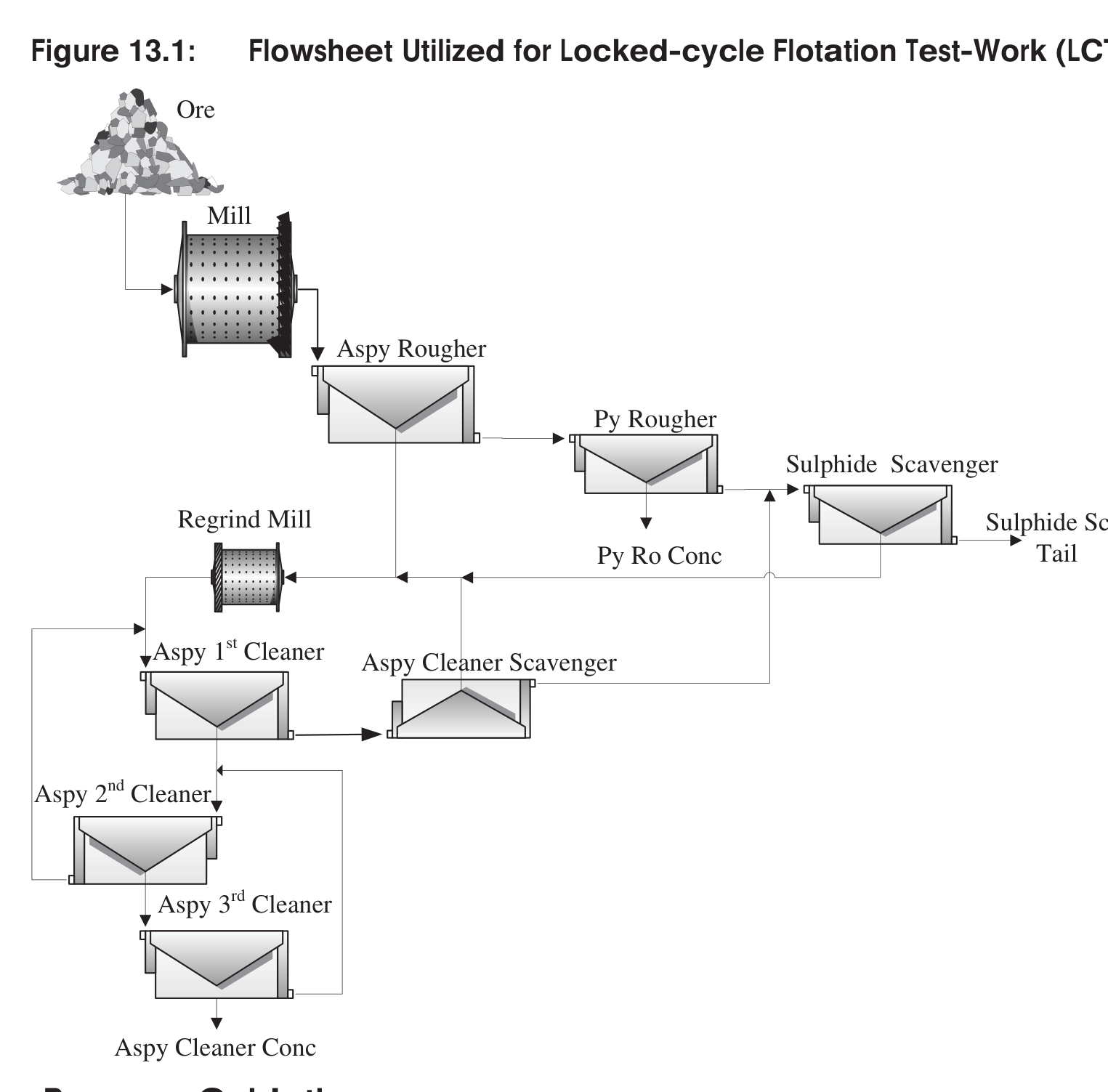
Highway trucks of about 34 t would carry crushed ore to a mill bin. A ball mill would grind to 80% passing 75 µm. Rougher flotation would recover arsenopyrite, which would be reground to 25 µm and cleaned in three stages, and rougher tailings would go to pyrite flotation if needed. Locked cycle tests gave an arsenopyrite concentrate with 6.4% of the mass and 93% of the gold, and a pyrite concentrate with 4.8% of the mass and 3% of the gold.
The concentrates would go to a continuous autoclave at more than 200 °C with oxygen. After about 60 minutes, 98% to 99% of the arsenopyrite and pyrite would break down, and the arsenic would precipitate as scorodite. The thickened residue would be neutralized and leached in CIL, with gold extraction above 98%. Pressure stripping and refining would follow, then SO2/air cyanide destruction ahead of the tailings area.
Toll milling at the Kidd D circuit
Under Option 1, 40 t trucks deliver ore of less than 25 mm to the Kidd mill. It goes to coarse ore bins with 3,200 t of active capacity. A 3.5 m by 5.3 m rod mill with an 800 hp motor feeds two 3.7 m by 5.5 m ball mills in parallel. The existing cyclones, fitted with larger vortex finders, cut at 75 µm. Lime is added to the ball mills to bring the pH to about 11.
The ore is conditioned with CMC talc depressant, copper sulphate, MIBC and promoter 3894 and fed to 18 Wemco rougher cells of 5.8 m3. Five 2.8 m3 Denver cells act as rougher scavengers, since test work called for 17 minutes of rougher time. Rougher concentrate is reground to 25 µm and cleaned in three stages of Denver DR 24 cells, with a first cleaner scavenger. An existing 18.3 m nickel concentrate thickener and a new filter press dewater the concentrate. The press runs eight hours a day, and two to three trucks a day load the concentrate.
Option 2 mill
Mill B was toll treating other material when visited in 2014. It was about ten years old, had a capacity of up to 1,500 tpd and has a flowsheet close to Bradshaw's: grinding, flotation and filtration. Because this mill has less grinding capacity, its secondary crushing circuit would target a finer product of about 8 mm.
Additional Interesting Data and Summary
The crusher work index is 14.5 kWh/t and the abrasion index 0.135 g. Flotation mass pull for the toll milling flowsheet is estimated at 8% to 10%, and these figures were still to be confirmed in the next phase of work.
The reserve design used a 3.0 g/t cut-off over a minimum 2 m width to a depth of 495 m, with 15% unplanned dilution and 95% mining recovery.
The report says the sequential flotation circuit offers flexibility if the mineralogy changes and makes it easier to treat the ore at different mills. Filtering the autoclave residue before cyanidation was under study, which would be needed if the POX product were treated at a different site.
Key Processes
- Portable jaw and cone crushing at the mine site
- Dual energy X-ray transmission sorting of coarse and fine fractions
- Rod and ball milling to 75 µm
- Arsenopyrite rougher flotation and regrinding to 25 µm
- Three-stage arsenopyrite cleaner flotation
- Thickening and pressure filtration of gold concentrate
- Pressure oxidation and CIL in the standard flowsheet
Source: Bradshaw Gold Deposit, NI 43-101 Technical Report and Prefeasibility Study, 15 July 2015.
Project website: Bradshaw Gold Deposit
