Mineral Processing Circuit

Figure 17-1. Crushing Plant Flowsheet

Soledad Mountain Project — 2024 Technical Report

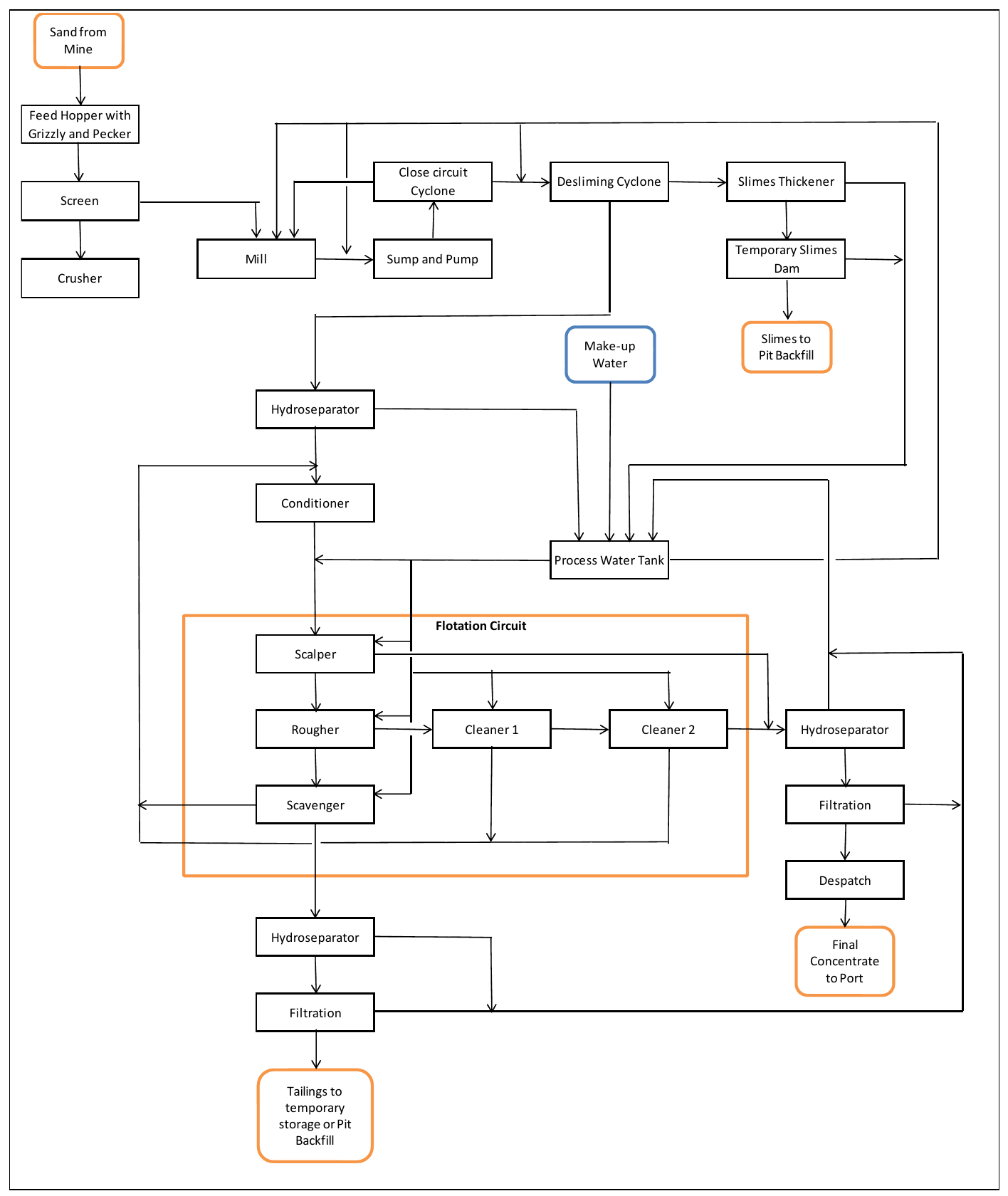
The 2024 Technical Report for the Soledad Mountain Project outlines the operational details of the recovery methods employed at the facility located in Kern County, California. The project utilizes a heap leach process for gold and silver recovery, with a crushing plant designed to handle an average throughput of 375,000 dry tons of ore per month. The crushing circuit is a three-stage system comprising a primary jaw crusher, a secondary cone crusher, and a tertiary High Pressure Grinding Roll (HPGR).

Soledad Mountain Project — 2024 Technical Report Read Post »
São Vicente Mine — NI 43-101 Technical Report

This NI 43-101 Technical Report outlines the recovery methods and metallurgical design criteria for the São Vicente Mine. The project targets an overall metallurgical recovery of 76%, with expected production of approximately 50,000 oz of saleable gold based on average mine feed grades. The processing strategy involves two distinct ore streams, DLO and CGO, which are treated differently to maximize gold recovery.

São Vicente Mine — NI 43-101 Technical Report Read Post »

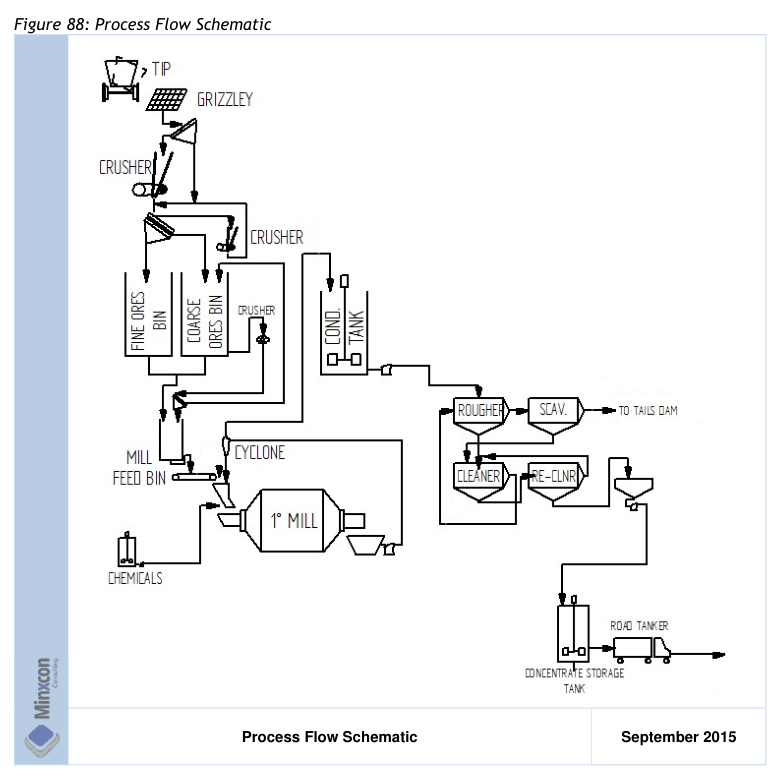
Figure 88: Process Flow Schematic

Galaxy Gold Mine — 2013 Technical Report (Item 17)

This section of the Technical Report details the recovery methods and plant design for the Galaxy Gold Mine. The processing plant is currently on care and maintenance, with some equipment dismantled or corroded, requiring upgrades before commissioning. The proposed ramp-up plan involves treating both Run-of-Mine (RoM) material and historic tailings from the Hostel tailings dumps. The target throughput for this phase is 15 kilotonnes per month (ktpm), with the mill polishing tailings and crushing RoM to 80% passing 75 µm prior to flotation.

Galaxy Gold Mine — 2013 Technical Report (Item 17) Read Post »

Duyker Eiland Project process flowsheet: Process Flow Diagram

Duyker Eiland Project — 2012 PEA Technical Report

This Pre-Feasibility Study (PEA) Technical Report outlines the mineral processing design for the Duyker Eiland Project in the Western Cape, South Africa. The processing design is based on experience from similar operations and exploratory test work conducted at the University of Cape Town Chemical Engineering Department. The proposed circuit aims to achieve a phosphate concentrate grade of 33% P2O5 or better with an estimated overall recovery of 85%.

Duyker Eiland Project — 2012 PEA Technical Report Read Post »

El Mochito — 2018 Technical Report

The El Mochito mine is an underground operation located in Honduras, utilizing Shaft #2 for ore hoisting. The processing facility has a nameplate capacity of 2,300 t/d, with normal throughput frequently achieving 2,450 t/d or more. The mine operates on a 3-shift daily basis with a staff of 124 persons at the mill and crushing facilities. The facility was observed to be in reasonably good operating condition during the February 2018 P&E visit, with generally good housekeeping and worker safety standards.

El Mochito — 2018 Technical Report Read Post »

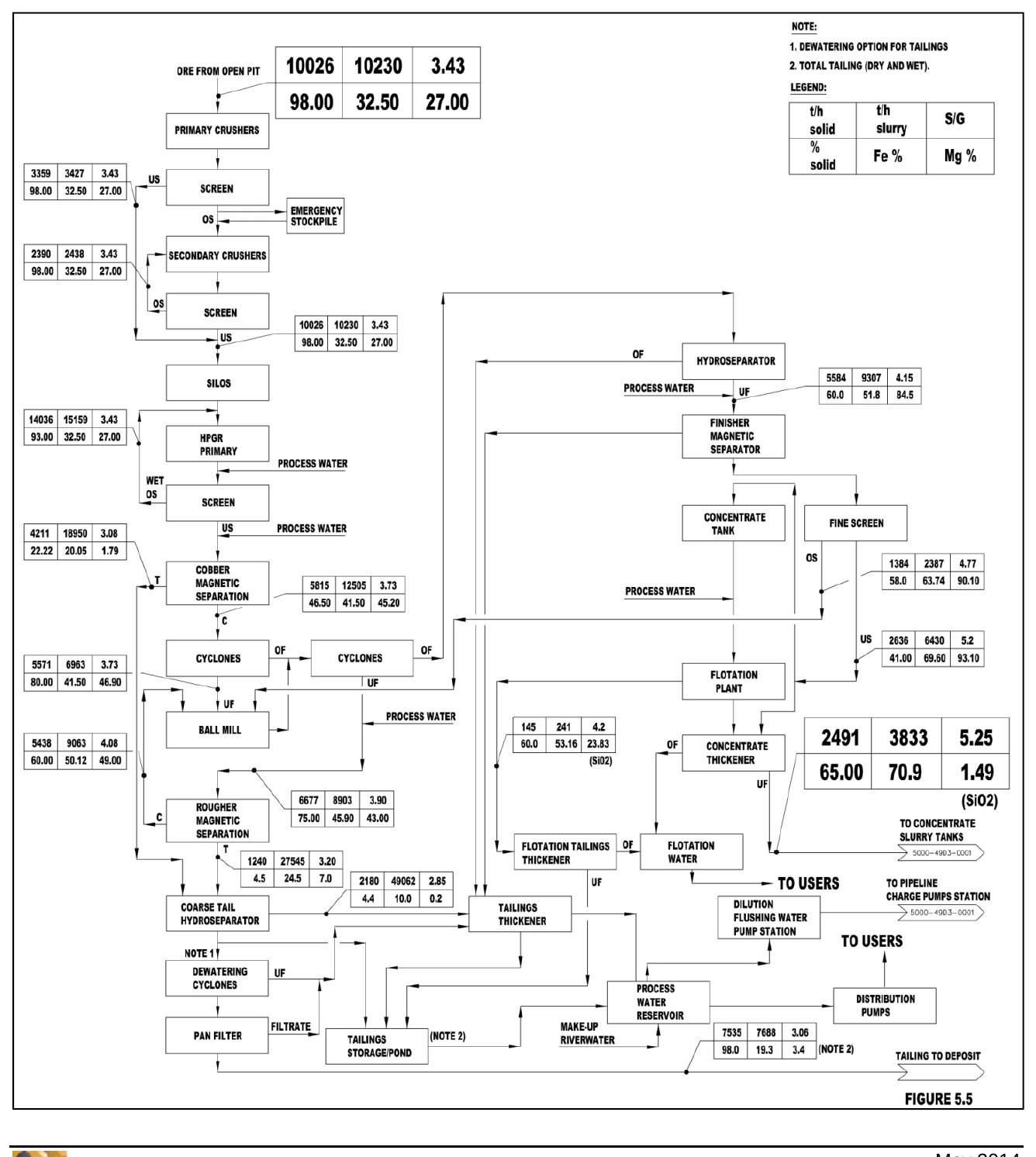
LabMag Taconite Project process flowsheet: Process Plant Process Block Flow Diagram

LabMag Taconite Project — 2014 Technical Report

This NI 43-101 Technical Report outlines the Feasibility Study for the LabMag Taconite Project, developed by New Millennium Iron Corp. The project is located in the Labrador Trough, south of the Quebec border, and focuses on the extraction and processing of magnetite-bearing taconite ore. The design is based on extensive laboratory and pilot plant test work conducted between 2005 and 2013, ensuring the viability of the proposed processing circuit. The project aims to produce high-grade iron ore pellets and concentrate for the global steel market, with a strategic off-take agreement anticipated with Tata Steel Europe.

LabMag Taconite Project — 2014 Technical Report Read Post »

Figure 17-3 shows a simplified flowsheet indicative of the process. The mineral processing facility

2025 Feasibility Study for the Matawinie Graphite Mine

The 2025 Feasibility Study for the Matawinie Graphite Mine outlines the design of a mineral processing facility capable of producing 105,882 dry tonnes of graphite concentrate annually. The concentrator is designed to upgrade ore containing 4.23% C(g) to a final concentrate grade of 97.5% C(t) with an average recovery of 93%. The facility operates at a nominal throughput of 7,804 dry tonnes per day, running 24 hours per day, 7 days a week, with an operating availability of 90%.

2025 Feasibility Study for the Matawinie Graphite Mine Read Post »

Wind Mountain — 2022 Technical Report Update

This NI 43-101 Technical Report Update outlines the recovery methods for the Wind Mountain project, focusing on a conventional Run of Mine (ROM) Cyanidation Heap Leaching process followed by Merrill Crowe solution processing. The design basis targets a daily production rate of 20,000 tons per day (tpd) with head grades of 0.011 opt Au and 0.254 opt Ag. The process is designed to achieve metal recoveries of 62 percent for gold and 15 percent for silver, utilizing a leach pad with HDPE lining and drip irrigation systems for solution application.

Wind Mountain — 2022 Technical Report Update Read Post »

El Bagre Gold Mining Complex — 2023 Technical Report

This technical report details the recovery methods and processing plant operations for the El Bagre Gold Mining Complex operated by Soma Gold Corp. The plant is designed to process ore at a rate of 1,000 tonnes per day (tpd). The recovery circuit involves a three-stage crushing process reducing ore from 203 mm to 7 mm, followed by grinding in a ball mill circuit. The process integrates flash flotation, intensive cyanide leaching, and conventional flotation to maximize gold and silver recovery.

El Bagre Gold Mining Complex — 2023 Technical Report Read Post »

3Q Project — 2018 Technical Report

The 3Q Project is a lithium brine extraction and processing facility designed to produce 20,000 tonnes per year of Battery Grade Lithium Carbonate (Li2CO3) over a 35-year mine life. The project utilizes a multi-site approach involving brine extraction at the 3Q Salar, intermediate processing at the Fiambalá Site, and final product manufacturing at the Recreo Site. Production is staged across three phases to accommodate declining lithium grades in the brine over time.

3Q Project — 2018 Technical Report Read Post »

Scroll to Top