

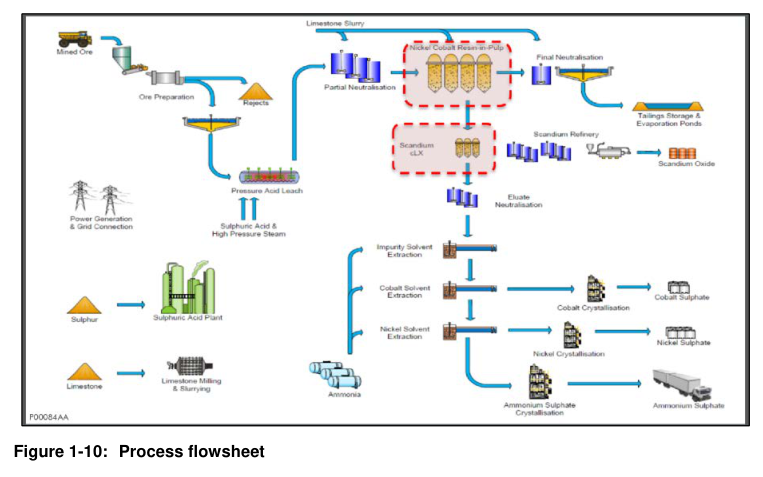
The 2018 Definitive Feasibility Study describes a 2.5 Mtpa high-pressure acid leach (HPAL) operation with continuous resin-in-pulp (cRIP) technology for recovery of nickel, cobalt and scandium as high-purity sulphate and oxide products.
Report context
The Clean TeQ Sunrise Nickel Cobalt Project has been under development since the late 1990s, with the original Preliminary Feasibility Study completed in 1998 by Fluor Daniel Pty Ltd, followed by feasibility studies in 2000 and 2005, and a Definitive Feasibility Study completed in June 2018 by Clean TeQ. The technical report, dated 7 August 2018, documents the process design criteria, metallurgical recovery estimates and plant configuration for the 2018 DFS, with historical operating data drawn from earlier studies and recent testwork.
Processing route
Process development history
The project has been in development over an extended period. The original Preliminary Feasibility Study was completed in 1998 by Fluor Daniel Pty Ltd, followed by a Feasibility Study undertaken by SNC-Lavalin for Black Range Minerals in 2000, and an updated FS completed in 2005 for Ivanplats Syerston Pty Ltd by a SNC-Lavalin – JGC Corporation joint venture for a 2.5 Mtpa HPAL operation. Clean TeQ acquired the project in November 2014 and completed a PFS in October 2016 and a DFS in June 2018.
Clean TeQ has been developing a nickel, cobalt and scandium continuous Resin in Pulp (cRIP) process since 2002, including three large scale piloting operations on laterite ore. A separate FS for a small-scale scandium project at Sunrise was completed in August 2016. The 2018 DFS focuses on the larger nickel, cobalt and scandium operation as the development priority.
Feed preparation and milling
The ore preparation area supplies the pressure acid leach autoclaves with feed at 45-48% solids, P₁₀₀ of 500 μm and slurry temperature of 84°C. ROM ore passes over a 600 mm grizzly into the ROM bin, discharges via an apron feeder to a sizer producing a product size P₁₀₀ of 150 mm, and is conveyed to a ball mill. The ball mill trommel undersize is discharged to a rejects screen, with oversize transferred to a rejects stockpile. Product screen undersize is pumped to the ore preparation blending tank, with contents distributed to two feed thickeners to produce hot dense slurry.
The densified slurry is stored in pressure acid leach feed tanks with a combined capacity of 18 hours production equivalent. Sulphur slurry is fed to the suction of the feed pumps as a reductant to control chromium(VI) formation. For ores generating chromium(VI), sulphur addition is controlled so approximately 85% of chromium in the autoclave discharge liquor exists in the trivalent form, with supplementary reduction downstream using sodium metabisulphite.
High pressure acid leaching
The proposed HPAL circuit consists of two separate operating trains, each comprising a three-stage direct contact heater system, a pressure leach autoclave, and three stages of flash tanks. Thickened slurry is heated to approximately 239°C in three stages using direct contact steam heaters, with the first two heaters using steam recovered from flash tanks and the final heater using fresh 6,000 kPa high-pressure steam. The heated slurry is fed into a high-pressure autoclave with six agitated compartments. Sulphuric acid at 98.5% concentration is added to compartment one, and the target operating temperature of 250°C is obtained through the exothermic reaction.
Slurry exits the autoclave through a controlled pressure letdown circuit, with high operating pressure let down in three stages of flash tanks. Steam released in the first two stages preheats incoming slurry, while steam from the final atmospheric flash stage heats process water. The design parameters target maximum nickel, cobalt and scandium extraction while minimising co-extraction of impurities, particularly iron and alumina, and minimising steam and acid usage.
Partial neutralisation
Neutralisation of the leach liquor to pH 4.0-4.2 is required before nickel/cobalt cRIP to allow high selectivity on the resin for nickel and cobalt over impurities. Iron, aluminium and chromium are precipitated in this stage. Sodium metabisulphite is added to reduce any residual chromium(VI) to chromium(III). Neutralisation uses limestone sourced from a local quarry, producing a precipitate of gypsum and metal hydroxides. The circuit comprises six agitated partial neutralisation tanks with low-pressure air sparged into each tank to promote oxidation of ferrous to ferric ions and strip heat and carbon dioxide.
Nickel/cobalt continuous resin-in-pulp (cRIP)
The cRIP process, while adopted by other metal processing flowsheets including uranium and gold and developed for nickel laterites to a pilot level of operation, is not yet fully commercialised for the latter application. The process includes two stages: adsorption and desorption.
Following partial neutralisation, the slurry is screened to remove oversize material before contacting with resin. Nickel and cobalt are selectively recovered onto the resin in a 10-stage counter current cRIP circuit using air-agitated Pachuca tanks, with recovery from solution of over 99%. Limestone is used to maintain slurry pH of 4 in each Pachuca. Barren pulp exits the final adsorption Pachuca and passes over two safety screens, with screen undersize pumped to tailings neutralisation.
Loaded resin is screened, washed, and undergoes desorption using weak sulphuric acid, generating a pregnant liquor (nickel, cobalt and scandium sulphate). The desorption system uses U-shaped continuous counter-current ion exchange columns with external airlifts. The pregnant solution accumulates at the bottom of the U-shaped desorption column and advances to scandium continuous liquid ion exchange. Barren resin is washed, neutralised with limestone and recycled.
Scandium recovery and refining
The scandium continuous liquid ion exchange (cLX) process consists of adsorption and desorption. The nickel/cobalt/scandium eluate from cRIP desorption is pumped to a scandium adsorption column where resin selectively extracts scandium. Loaded resin is washed, scrubbed with dilute sulphuric acid, and neutralised from pH 2 to pH 7.5-8.0. Scandium is desorbed from the resin with sodium carbonate solution.
In the scandium refinery, the pregnant eluate is batch processed. Sodium hydroxide solution precipitates scandium hydroxide, which is filtered and either stockpiled as an intermediate product or processed through sequential leach, precipitation and washing. The final material is calcined to produce 99.9% Sc₂O₃ product. Forecast initial production is 80 tonnes per year with sales of 10 tonnes per year.
Nickel/cobalt sulphate purification and recovery
The neutralised nickel/cobalt eluate is purified in three sequential solvent extraction circuits. The impurity circuit removes zinc, iron, aluminium, manganese and some copper. The cobalt circuit extracts cobalt, leaving nickel in the raffinate. Cobalt-bearing organic is scrubbed and stripped using dilute sulphuric acid. The cobalt strip liquor undergoes purification to remove minor manganese, copper and zinc before crystallisation to produce high purity hydrated cobalt sulphate (CoSO₄.7H₂O).
The nickel-bearing raffinate is fed to nickel solvent extraction, extracted, scrubbed and stripped to produce concentrated nickel sulphate solution, which is crystallised to produce high purity hydrated nickel sulphate (NiSO₄.6H₂O). The raffinate from nickel solvent extraction is sent to an Amsul crystalliser to produce ammonium sulphate by-product for the fertiliser market.
Tailings neutralisation and storage
Tailings are neutralised with lime slurry and air to remove free acid and precipitate metal ions as stable hydroxides. The discharge slurry is thickened to 42% solids in a Tailings Thickener before being pumped to the tailings storage facility. The proposed TSF is located approximately 500 metres from the processing plant, with tailings disposal in three cells, one cell at a time, with spigot take-offs every 10 metres. Decant water flows to a water transfer pond, with excess solution pumped to a water storage dam. Streams with high dissolved chlorides are directed to a chloride evaporation pond.
Reagents and utilities
Sulphur is delivered via ship to Port of Newcastle and transported to site by rail and road. Sulphur is burned in a sulphuric acid plant, with the combustion gas transformed to sulphur trioxide in a three-stage converter and absorbed to produce sulphuric acid. The acid plant also produces high-pressure steam exported to a cogeneration plant. Sulphuric acid production can be supplemented by imported acid for plant start-up and periods when consumption exceeds production.
Limestone is mined by a contractor, crushed to 100% passing 200 mm, and ground to P₈₀ of 45 μm in a limestone plant. Other reagents include slaked lime, sodium metabisulphite, sodium carbonate, ammonia, sodium hydroxide, hydrogen peroxide, solvent extraction reagents (D2EHPA, CYANEX 272, VERSATIC 10), filter aid, boiler and water treatment chemicals, and flocculant.
Key reported parameters
| Parameter | Value | Basis |
|---|---|---|
| Autoclave throughput | 2,500,000 tpa | Design |
| Operating hours | 7,670 hours pa | Design |
| Availability (leach plant) | 87.5% | Design |
| Mine life | 25 years | Design |
| Nickel product (NiSO₄.6H₂O) | 21,780 tpa | Average post ramp-up (Year 2-6) |
| Cobalt product (CoSO₄.7H₂O) | 4,640 tpa | Average post ramp-up (Year 2-6) |
| Scandium oxide (Sc₂O₃) | ~80 tpa | Forecast initial production |
| Nickel grade (HPAL feed) | 0.985% | Design |
| Cobalt grade (HPAL feed) | 0.312% | Design |
| Scandium grade (HPAL feed) | 53 ppm | Design |
| Autoclave operating temperature | 250°C | Design |
| Autoclave residence time (minimum) | 79 minutes | Design |
| Sulphuric acid addition | 150-350 kg/t ore | Design |
| Nickel leach extraction | 95.7% | Design |
| Cobalt leach extraction | 95.0% | Design |
| Scandium leach extraction | 91% | Design |
| Nickel cRIP recovery | 96.9% | Design |
| Cobalt cRIP recovery | 96.4% | Design |
| Scandium cRIP recovery | 40.0% | Design |
| Overall nickel recovery | 92.6% | Design |
| Overall cobalt recovery | 91.2% | Design |
| Overall scandium recovery | 31.5% | Design |
| Feed preparation recovery | 100% (Ni, Co, Sc) | Design |
| Partial neutralisation/cRIP (Ni/Co) | 96.9% Ni, 96.4% Co | Design |
| Scandium cLX recovery | 99.9% | Design |
| Ni/Co refinery recovery | 99.9% Ni, 99.6% Co | Design |
| Scandium refinery recovery | 86.7% | Design |
Project website: https://sunriseem.com/our-projects/sunrise-nickel-cobalt-project/
Technical qualifications
- The cRIP process, while adopted by other metal processing flowsheets and developed for nickel laterites to a pilot level, is not yet fully commercialised for this application.
- Process design criteria were based on historical data from the 2005 Nickel/Cobalt Feasibility Study Update, the 2016 Scandium Feasibility Study, the 2018 Definitive Feasibility Study, and Clean TeQ's internal database of nickel and cobalt recovery using cRIP.
- The equipment and piping sizing used an OST of 83.8%, not the 87.5% FEED value, meaning all equipment remains slightly over-sized.
- The DFS nominal mass balance uses a 45% w/w solids feed slurry, which is more conservative than the 48% solids used in the original DFS mass balance.
- Stage recoveries, especially partial neutralisation, may be affected by recycle streams.
- The plant has a two-year ramp-up from 40% of design throughput in Year 1 to 100% (2.5 Mtpa) by the end of Year 2.
*Source: Clean TeQ Sunrise Technical Report_Rev1, 7 August 2018, Section 17 Recovery Methods.*
