

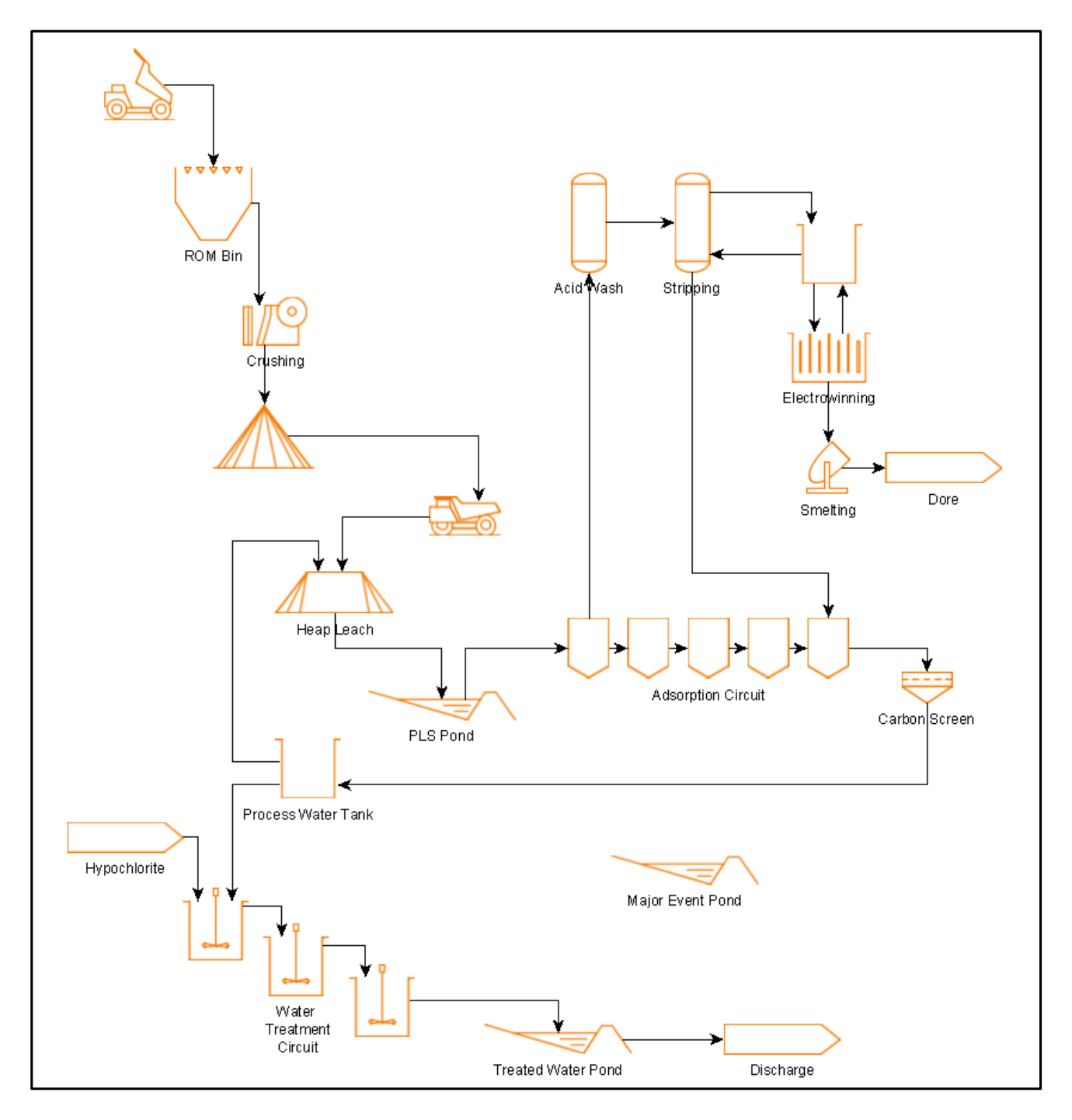
Minera IRL's Corihuarmi mine has leached ore averaging under 0.3 g/t gold since 2008 on a single-use pad, recovering the gold in carbon columns and a 2 t Zadra elution circuit.
Corihuarmi is an operating open pit gold mine high in the Andes of central Peru, about 160 km southeast of Lima, where the regions of Lima, Junín and Huancavelica meet. Minera IRL Limited runs the operation, which covers 14 concessions totalling about 9,830 hectares, some held under an agreement with Minera Andes Exploration. The updated technical report by Mining Plus, effective May 2nd, 2018, covers a high-sulphidation epithermal deposit worked from several small pits. Heap leaching began in January 2008. In 2018 the mine moved about 9,000 t/d of ore at around 0.28 g/t gold. Proven and probable reserves of 8,742,800 t at 0.28 g/t, containing 77,700 oz, supported about 2.8 more years of operation.
Critical Data
| Parameter | Value | Unit | Notes |
|---|---|---|---|
| Start of heap irrigation | January 2008 | Not applicable | Processing start |
| Ore mining rate | 9,000 | t/d | Waste 5,000 t/d |
| Expected head grade | 0.28 | g/t Au | 2018 to 2020 |
| Grizzly gap | 100 | mm | Scalping ahead of the jaw crusher |
| Leach pad area | 9 | ha | Designed for 6,000 tpd |
| Lift height | 8 | m | Dozer-levelled |
| Cell size | About 3,000 | m2 | 40,000 t per cell |
| Irrigation rate | 10 | L/h/m2 | Drip irrigation |
| Barren solution cyanide | 250 | ppm | pH 10.0 to 10.5 |
| Leach cycle | 90 | days | Per cell |
| Adsorption capacity | 250 | m3/h | Two trains of 5 columns |
| Carbon loading at transfer | About 8,000 | g/t Au | First column |
| Elution temperature | 135 | °C | 2 t Zadra circuit |
| Cumulative gold recovery | 77 | % | To end of 2017 |
| Processing cost | 1.33 | US$/t | Plant total |
Overview
Corihuarmi is a simple heap leach operation. Ore gets a single stage of crushing, and lime is added on the conveyor. The ore is trucked to a multiple-lift, single-use pad and irrigated with dilute cyanide. Pregnant solution passes through carbon columns, and the loaded carbon is stripped in a Zadra circuit. Gold is electrowon onto steel cathodes, and the sludge is retorted to remove mercury before smelting to doré. Ore that does not need crushing can go straight from the pit to the pad.
Column tests reported in the earlier 2010 technical report gave 70% gold recovery after 83 days of leaching. Plant records show recovery easing slightly over the years, with a cumulative 77% to the end of 2017.
Key Process Stages
Crushing
Trucks haul ore at 4% to 5% moisture to the run-of-mine pad. They tip either straight into the coarse ore bin or onto the pad, where a front-end loader feeds the bin. A vibrating grizzly feeder with a 100 mm gap passes oversize to the primary jaw crusher. Grizzly undersize and crusher product fall onto the discharge conveyor, where the ore is weighed and lime is added. A stacking conveyor builds a stockpile, and a loader fills trucks for the leach pad.
Heap leach pad
The current pad covers nine hectares and is designed for 6,000 tpd. Trucks climb a ramp and tip within one to two metres of the heap edge, and a bulldozer pushes the ore over to build an even 8 m lift. A polyethylene geomembrane lines the base, and the pad is divided into cells of about 3,000 m2 that each hold 40,000 t.
A 250 HP pump sends barren solution from a tank through a 10 inch HDPE line in a lined channel to a manifold at the top of the heap. From there, 4 inch lay-flat pipes run down each cell, with drip hoses branching off them. Solution goes on at 10 L/h/m2. Caustic soda keeps the barren solution at pH 10.0 to 10.5 to limit cyanide loss, and cyanide is held at 250 ppm. Anti-scalant protects the pipes, the heap surface and the carbon. Underdrain pipes collect the pregnant solution and send it through two HDPE lines to the pregnant pond. Each cell completes its leach in 90 days. A storm pond holds excess solution, which later returns to the barren tank as make-up water.
Carbon adsorption
The adsorption plant treats up to 250 m3/h in two trains of five cascade columns, each column holding 2 t of activated carbon. When the first column reaches about 8,000 g/t gold, its carbon goes to elution. The next column is then loaded to the same level, and the columns rotate through the series so that any of them can take the lead position. The last column always holds freshly stripped and reactivated carbon. Barren solution leaving the columns flows by gravity back to the barren tank.
Elution and electrowinning
Elution runs in a 2 t Zadra circuit at 135 °C. Barren eluate passes a secondary and a primary heat exchanger before entering the column. Solution leaving the column goes back through the secondary exchanger and a cooling exchanger to drop to 65 °C before the electrowinning cell. The spent solution returns to the desorption tank for reuse. Each strip takes 14 to 16 hours. The carbon is reactivated in a kiln and then acid washed before returning to the columns.
Harvesting and smelting
The electrowinning cell has 18 stainless steel cathodes and 19 anodes. High pressure water washes the gold and silver off the cathodes. The precious metal is filtered and retorted to capture mercury, and the mercury-free product is smelted to doré in a tilting furnace.
Additional Interesting Data and Summary
Processing cost US$1.33 per tonne in total. The heap leach area accounts for US$0.92/t, of which cyanide and lime make up US$0.49/t. Lime and cyanide represent 52% of leaching costs and 36% of total processing costs. The cost projections assumed cyanide at US$2,750/t, lime at US$230/t and power at US$85/MWh. Cyanide destruction adds US$0.03/t.
A budget of US$2,152,481 was set for the Phase 5C sector 2 pad expansion, adding 4 hectares of leach area in 2018.
The mine plan covered seven small pits over three years, mined on 5 m benches with trucks and excavators. Measured and indicated resources stood at 13.56 Mt at 0.27 g/t gold at a 0.09 g/t cut-off. The reserve has a waste to ore ratio of 0.50 to 1.
Key Processes
- Vibrating grizzly scalping and single-stage jaw crushing
- Lime addition on the crusher discharge conveyor
- Truck and dozer placement of 8 m lifts on a lined, single-use pad
- Drip irrigation with cyanide at pH 10.0 to 10.5
- Carbon adsorption in two trains of cascade columns
- Zadra elution at 135 °C with electrowinning
- Mercury retorting and doré smelting
Source: Updated NI 43-101 Technical Report, Minera IRL Limited Corihuarmi Mine, Central Peru, May 2nd, 2018.
Project website: Corihuarmi Gold Mine
