

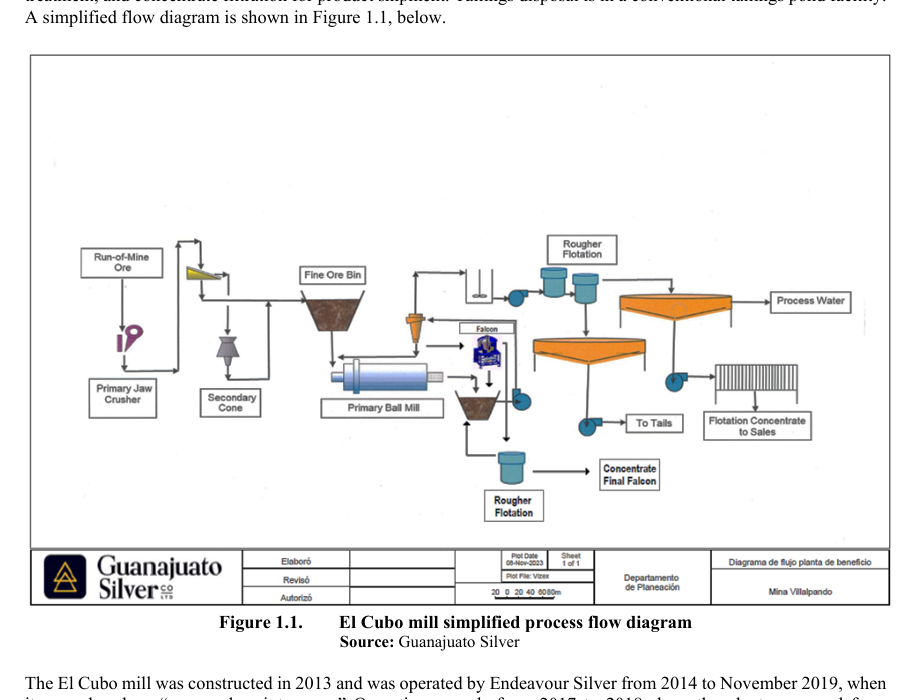
The El Cubo processing plant, constructed in 2013, applies a two-stage crushing, ball mill grinding, gravity, and flotation flowsheet to treat feed from the El Cubo/El Pingüico Silver Gold Complex.
Report context
This technical report is dated August 1, 2024. The mineralized material produced from El Cubo and from surface stockpiles at El Pingüico is processed at the El Cubo processing plant, located within the El Cubo/El Pingüico Silver Gold Complex. The plant was constructed in 2013 and operated by Endeavour Silver from 2013 to 2019.
Processing route
Plant capacity and historical operations
Historical operating records from 2017 to 2018 indicate a processing rate of 1,500 to 2,000 tonnes per day during that period. Since refurbishment of the plant by GSilver and modifications to the secondary crushing area and grinding discharge crates, the plant operates at a capacity of 1,350 tonnes per day. The report states there is potential to increase capacity to 1,584 tonnes per day by reconfiguring the crushing area, installing pumping equipment with higher capacity in the grinding, clarification, and filtration areas, and making tailings dam adjustments.
Crushing and grinding
Feed material from the El Cubo underground operations and mineralized material from other sources is placed in a storage area with capacity of up to 3,000 tonnes. Mill feed is reclaimed using a front-end loader and fed to a primary crusher grizzly, which feeds a primary crusher at 40 tonnes per hour. Crusher product moves by conveyor to a rail car dump hopper, discharging at a single point. Material is withdrawn via clam shell feeders onto belts to a vibrating screen. Screen oversize goes to a secondary cone crusher; screen undersize at minus 5/8-inch joins secondary crusher product on a conveyor to a 650-tonne mill feed storage bin.
Minus 5/8-inch material is fed from the storage bin by slot feeder to a single-stage ball mill at 37.5 tonnes per hour. The 12-foot diameter by 14-foot EGL ball mill operates in closed circuit with hydro-cyclones, grinding to a 200 mesh (75 μm) product size. Cyclone overflow passes through a Falcon gravity circuit before returning to the ball mills. Gravity recovery targets native silver, gold, and electrum from the hydrocyclone underflow stream.
Flotation and concentrate handling
Cyclone overflow flows by gravity to a conditioning tank where flotation reagents are added. Conditioned slurry feeds a 5-stage, 30 m³ tank cell rougher flotation circuit. Rougher concentrate advances to a two-stage cleaner circuit; rougher tails discharge to a tailings thickener circuit.
The first cleaner stage consists of a 4-stage, 50 ft³ Denver flotation cell circuit. First cleaner concentrate advances to the second cleaner circuit, which consists of a 2-stage, 50 ft³ Denver flotation cell circuit. Concentrate from the second cleaner circuit is pumped to an 8-metre diameter high rate thickener.
Concentrate thickener underflow at approximately 55% solids is pumped to a 1.5 m × 1.5 m Diemme plate and frame filter press for dewatering. The filter press has 3.4 m³ of filtration volume, equivalent to approximately 6 to 8 tonnes of concentrate. Filtered concentrate is dumped to the cement floor below, reclaimed with a front-end loader, and loaded into trucks for shipment to a refinery. Flotation concentrate is filtered for shipment at approximately 12 tonnes per day.
Tailings
Rougher flotation tails are pumped to a 21-metre diameter high rate Outotec thickener. Tailings are thickened to approximately 60% solids, filtered, and stored in a dry tailings stack facility.
Crushing circuit operation mode
The crusher and screening circuits are designed to run at approximately 100 tonnes per hour until the fine feed bin that feeds the ball mill is full, then shut down.
Major equipment
Major crushing equipment includes a primary jaw crusher (150 horsepower), a grizzly vibratory feeder measuring 46 inches by 16 feet (30 hp), a secondary crusher feed screen (150 hp), and a tertiary crusher (200 hp). Major grinding equipment includes three ball mills: Mill 1 measures 9 by 9 feet; Mill 2 measures 9 by 10 feet; and Mill 3 measures 12 by 14 feet. Major flotation equipment includes 5 rougher circuit 30 ft³ Outotec cells (60 hp), 6 Tipo Wemco 11 ft³ cells (15 hp; 20 hp), and 2 kaiser blowers (100 hp). The plant is located at an elevation of approximately 2,200 metres above sea level, which was considered in equipment and motor design.
Utilities
Electricity is sourced from Distribution Line No. 60 of the Federal Electricity Commission (CFE) supplying 13.8 kV, covering a contracted power of 6.5 MW. On average the plant uses approximately 1,420,000 kilowatt-hours per month. Water is sourced from existing underground workings and recirculated water from the tailings basins; as of the effective date of the report, sufficient water is available for the processing plant and other requirements.
Key reported parameters
| Parameter | Value | Basis |
|---|---|---|
| Historical processing rate (2017 to 2018 records) | 1,500 to 2,000 t/d | Historical operating data |
| Current plant capacity | 1,350 t/d | Reported post-refurbishment capacity |
| Potential increased capacity | 1,584 t/d | Proposed, subject to modifications |
| Primary crusher feed rate | 40 t/h | Design |
| Ball mill feed rate | 37.5 t/h | Design |
| Grind size | 200 mesh (75 μm) | Design |
| Crushing product size | 14,000 microns | Key process design criteria |
| Ball mill feed F80 | 16,000 microns | Key process design criteria |
| Product size P80 | 74 microns | Key process design criteria |
| Bond Work Index (BWi) | 16–21 kWh/t | Key process design criteria |
| Bulk density | 1,800 kg/m³ | Key process design criteria |
| Specific gravity | 2.8 kg/m³ | Key process design criteria |
| Moisture content | 7% | Key process design criteria |
| Flotation slurry density | 33% | Key process design criteria |
| Rougher retention time | 40 minutes | Key process design criteria |
| First cleaner retention time | 21 minutes | Key process design criteria |
| Second cleaner retention time | 17.5 minutes | Key process design criteria |
| Flotation pH | 7.2 | Key process design criteria |
| Concentrate thickener underflow solids | ~55% | Design |
| Tailings thickener underflow solids | ~60% | Design |
| Concentrate filtration rate | ~12 t/d | Design |
| 2024 throughput (January to July) | 220,636 DMT | Actual |
| 2024 average Ag head grade | 48.05 g/t | Actual |
| 2024 average Au head grade | 0.92 g/t | Actual |
| 2024 Ag recovery | 81.3% | Actual |
| 2024 Au recovery | 86.9% | Actual |
| 2024 silver ounces produced | 277,189 oz | Actual |
| 2024 gold ounces produced | 5,736 oz | Actual |
| Contracted power | 6.5 MW | Reported |
| Average monthly electricity use | ~1,420,000 kWh | Reported |
Project website: https://www.gsilver.com/mines/cubo-mines-complex
Technical qualifications
The report notes that the crusher product discharges into the rail car dump hopper at a single point, which limits storage capacity if only the primary crusher is operated as a source of crushed mill feed. The plant capacity of 1,350 tonnes per day is reported as the operational figure following refurbishment; the 1,584 tonnes per day figure is presented as potential and is dependent on implementing specified modifications. The 2024 throughput summary includes material from the El Cubo/El Pingüico Silver Gold Complex and material from other sources.
Source: El Cubo/El Pingüico Silver Gold Complex , 2024 Technical Report, Section 17 Recovery Methods, dated August 1, 2024.
