

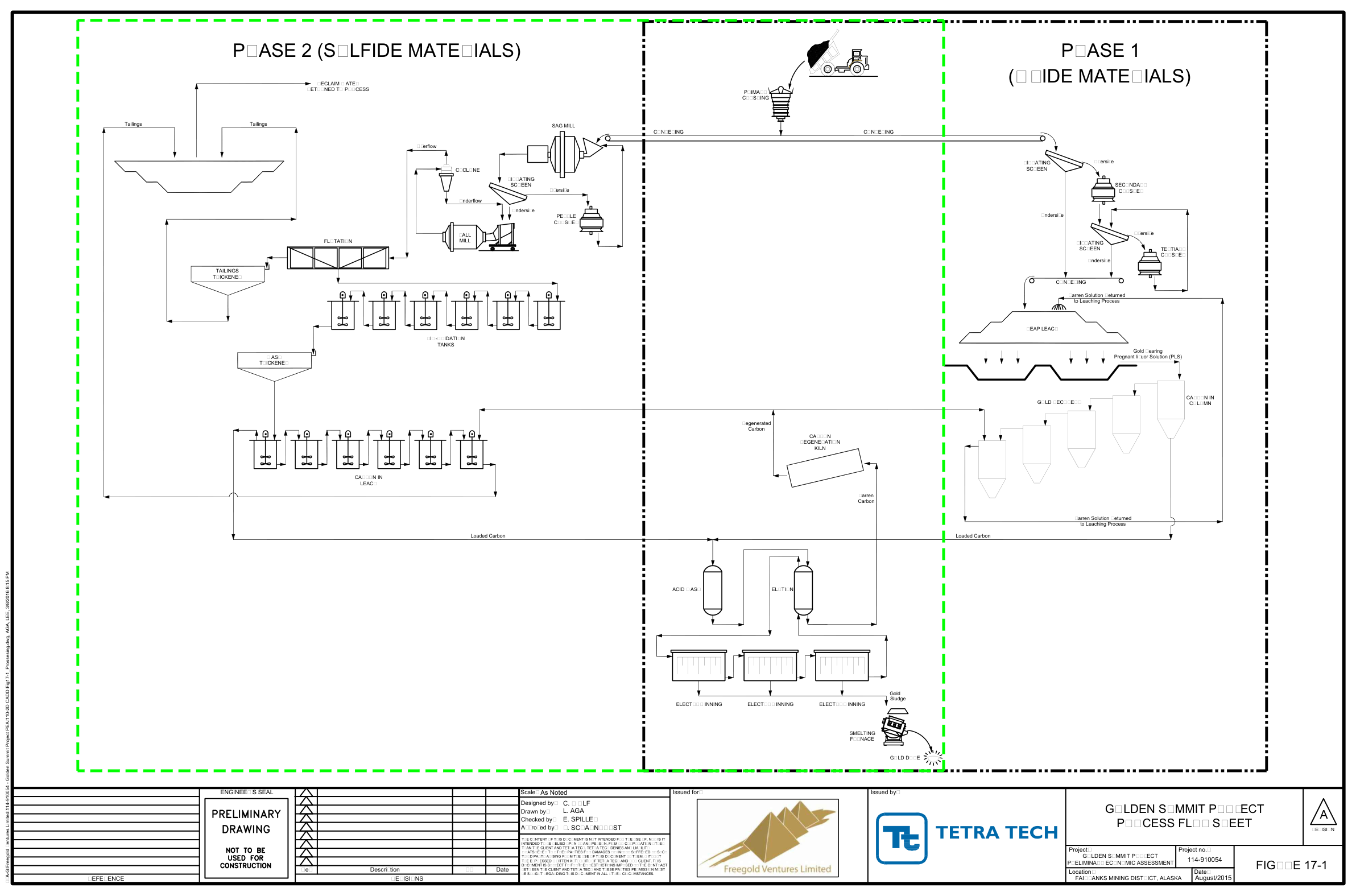
The 2016 preliminary economic assessment for Freegold's Golden Summit project near Fairbanks, Alaska, describes two 10,000 tpd gold streams: crushed oxide ore on a cyanide heap leach, and sulfide ore ground, floated, bio-oxidized and leached in carbon-in-leach tanks.
Golden Summit is a gold project in the Fairbanks Mining District of Alaska, in the Fairbanks North Star Borough. Freegold Ventures Limited retained Tetra Tech to prepare the NI 43-101 preliminary economic assessment (PEA), which was issued on March 10, 2016 with a report effective date of January 20, 2016. The PEA is an independent opinion of the technical aspects of the project and evaluates a two-phase, 24-year open pit mine producing two gold ore streams, each operating at 10,000 tonnes per day (tpd). Oxide material is processed by heap leach and sulfide material by bio-oxidation. The PEA gives an average annual gold output of 96 koz and a peak of 158 koz at a gold price of US$1,300/oz.
Critical Data
| Parameter | Value | Unit | Notes |
|---|---|---|---|
| Oxide heap leach rate | 10,000 | tpd | Phase 1 |
| Sulfide plant rate | 10,000 | tpd | Phase 2, from production year nine |
| Oxide gold recovery | 80 | % | Based on available test work |
| Sulfide gold recovery | 90 | % | Needs more test work to confirm |
| Heap feed size | Minus 1 | in | Nominal |
| Primary leach cycle | 90 | days | Seasonal leaching |
| Flotation feed grind | 100 to 200 | µm P80 | To be confirmed |
| SAG mill | 26 x 12 | ft | 4,500 hp |
| Ball mill | 16 x 28 | ft | 4,500 hp |
| Rougher flotation cells | 5 | Not applicable | 3,500 ft3 each |
| Bio-oxidation tanks | 6 | Not applicable | 35 ft x 35 ft |
| CIL tanks | 6 | Not applicable | 35 ft x 35 ft |
| Carbon columns | 5 | Not applicable | 16 ft diameter |
| Mine life | 24 | years | Two-phase open pit |
| Average annual gold production | 96 | koz | Peak 158 koz |
| Post-tax NPV5% | 188 | US$ million | At US$1,300/oz gold |
Overview
Recovery would use two processing operations. Phase 1 crushes run-of-mine oxide material and stacks it on a lined heap leach pad. Cyanide solution leaches the gold, which is adsorbed on carbon, eluted, electrowon and refined to doré. Phase 2, starting in production year nine, would crush and grind sulfide material, float the gold-bearing sulfides, oxidize the concentrate in bio-oxidation tanks and leach it in carbon-in-leach (CIL) tanks. Both phases share one elution circuit. Heap leaching of oxide material would continue through Phase 2 until the end of the mine life.
Key Process Stages
Sulfide processing trade-off
SGS metallurgical test work in 2014 showed that sulfide oxidation would likely be needed to reach acceptable gold recoveries. A trade-off study compared heap leaching of sulfide material, pressure oxidation (POX) of whole material followed by CIL, and POX of flotation concentrate followed by CIL. Whole material POX-CIL gave negative economics and was eliminated. Float-POX-CIL and sulfide heap leaching both gave positive results, but neither was judged economically preferred. Float-POX-CIL had a higher relative NPV but high capital cost and a longer payback, and sulfide heap leaching treated only a small part of the sulfide material because of low recoveries. Bio-oxidation was then adopted as an alternative. No bio-oxidation test work had been done on the deposit, so the PEA rests on the success of other oxidation methods and on benchmarking against operating bio-oxidation plants.
Oxide heap leach
A gyratory crusher at the mine feeds secondary and tertiary crushing to a nominal minus one-inch product. Conveyors place it on a lined 10,000 tpd heap leach pad. Barren solution with sodium cyanide is applied through buried drip irrigation lines, and pregnant solution flows by gravity to a pond and is pumped to carbon adsorption columns. New oxide material is added seasonally as the weather allows. In cold months, solution is recirculated within the pad but no fresh leaching occurs. Loaded carbon is acid washed, neutralized with caustic and stripped by the pressurized Zadra method. Stripped carbon is reactivated in a propane-fired rotary kiln, and the strip solution passes through electrowinning cells. The sludge is smelted into doré.
Sulfide grinding and flotation
Sulfide material uses the same primary crushing circuit and is stockpiled at the plant. A 26 ft by 12 ft SAG mill runs in closed circuit with a pebble crusher, and a 16 ft by 28 ft ball mill runs in closed circuit with five 26 inch hydrocyclones. Cyclone overflow goes to five rougher flotation cells of 3,500 ft3 each to recover gold-bearing sulfides. The flotation grind is assumed at 100 to 200 µm P80 for the study.
Bio-oxidation and CIL
Flotation concentrate is thickened and pumped to six agitated bio-oxidation tanks, 35 ft in diameter and 35 ft high. A wash thickener follows, and the oxidized residue goes to an acid neutralization circuit that raises the pH for cyanide leaching. Sodium cyanide is added and the slurry goes to six CIL tanks of the same size. CIL tailings are treated for cyanide detoxification and sent to a tailings storage facility. Loaded carbon goes to the shared elution circuit.
Additional Interesting Data and Summary
The PEA cites 2,358 koz of doré over the life of mine and a total cash cost of US$842/oz gold including royalties, refining and transport. The post-tax internal rate of return is 19.6%. The oxide recovery of 80% and sulfide recovery of 90% were used in all calculations, and the report states that further test work is needed to confirm the sulfide recovery.
Key Processes
- Gyratory, secondary and tertiary crushing to minus one inch
- Cyanide heap leaching with drip irrigation and carbon adsorption columns
- Zadra carbon stripping, electrowinning and doré smelting
- SAG and ball milling in closed circuit with cyclones
- Sulfide flotation
- Bio-oxidation of flotation concentrate
- Carbon-in-leach cyanidation with cyanide detoxification
Source: NI 43-101 Technical Report, Golden Summit Project, Preliminary Economic Assessment, March 10, 2016.
Project website: Golden Summit Project
