

This technical report details the proposed 0.9 Mt/a rotary kiln-electric furnace (RKEF) processing route for the Araguaia Nickel Project, based on pilot plant testwork and engineering design.
Report context
The technical report, dated based on the mining schedule developed in April 2017 with negligible difference to the Q3 2018 schedule, describes the proposed processing facilities for the Araguaia Nickel Project. The engineering design and estimates were developed by Ausenco Pty Ltd, including detailed engineering drawings, capital and operating cost estimates, and a project implementation plan. The process selection was confirmed by metallurgical testwork on Araguaia Nickel Project ore, including full bench scale testing and an integrated pilot plant campaign carried out during the first and second quarters of 2015.
Processing route
Process selection
Metallurgical testwork confirmed the suitability of the conventional RKEF process for treating the Araguaia Nickel Project ores to produce ferronickel (FeNi). The proposed process is a single line 0.9 Mt/a RKEF installation, producing approximately 15 kt/a nickel as FeNi.
Ore reception and preparation
Run-of-mine (ROM) ore will be stockpiled on reception pads for initial blending of different ore types to establish pre-determined metallurgical characteristics. Individual ROM piles will be sheeted to avoid excessive moisture buildup. The ROM shed will have capacity for approximately four days storage of wet ore. Material will be reclaimed by front-end loader for feeding onto a fixed grizzly positioned over an apron feeder, with the alternative of direct dumping from mine trucks.
The fixed grizzly is sized with a 500 mm x 500 mm gap. Undersize material passes to an apron feeder and is transferred by conveyor to a primary crusher (mineral sizer) with 200 mm gap. Crushed material proceeds to a secondary double mineral sizer with 50 mm gap. Combined dust from the dryer, rotary kiln, electric furnace and hygiene baghouses will be wetted to approximately 20% moisture in a pug mill and added to the ore at the primary crusher feed.
A covered homogenization shed will feature two piles, each with capacity of approximately four days of wet ore (36,000 wet tonnes each). One pile is created while the other feeds the plant. The fresh ore feed rate is 137.0 dry tonnes per hour (207.5 wet tonnes per hour) at 34% moisture.
Drying and tertiary crushing
Wet ore from homogenization piles will be conveyed to the rotary dryer feed hopper, fed by variable speed apron feeder. The dryer operates co-currently with combustion gases, burning pulverised coal with capability for fuel oil during start-up and as backup. The target moisture of dryer product is nominally 18%, with a range of 18% to 22%. The dryer has a nominal diameter of 4.4 m and length of 38.0 m, with 550 kW installed power, operating 7,446 hours per annum.
A 30 mm trommel at the dryer discharge sends oversize through a tertiary cone crusher (1,000 mm nominal mantle diameter, 150 kW), then joins trommel undersize dried ore for conveyance to the kiln feed bin or a covered dried ore stockpile building with capacity of approximately 10,000 wet tonnes.
Calcining
The rotary kiln operates counter-currently, with feed and reductant coal added at specified ratios. Carbon addition control is initially based on ore composition and reduction requirements, with fine adjustments from calcine assay. The kiln is constructed with three retention dams to maximise residence time, expected to be approximately three hours. The target calcine temperature at kiln discharge is typically 850°C to 900°C. For design purposes, a target of 875°C for kiln discharge calcine and 850°C for calcine feed to the furnace was adopted.
Heat is supplied by a pulverised coal burner at the calcine discharge end, operating under sub-stoichiometric conditions. The main burner represents 30% to 35% of overall fuel requirement. The balance of heat is supplied by reductant coal added through the feed and through coal scoops in the hot zone. Kiln dimensions are 5.5 m diameter and 120 m length, with 1,096 kW installed power. The kiln off-gas at approximately 300°C is treated in a dedicated electrostatic precipitator.
The observed dusting rate in pilot plant testing was approximately 0.5% of kiln feed; however, a design dust rate of 17.4% of kiln feed (dry basis, excluding coal) was adopted based on benchmarking other nickel laterite kiln operations. In pilot testing, the average calcine discharge temperature was 900°C to 925°C without sintering, and ring formation was not observed even up to approximately 1,050°C.
Smelting
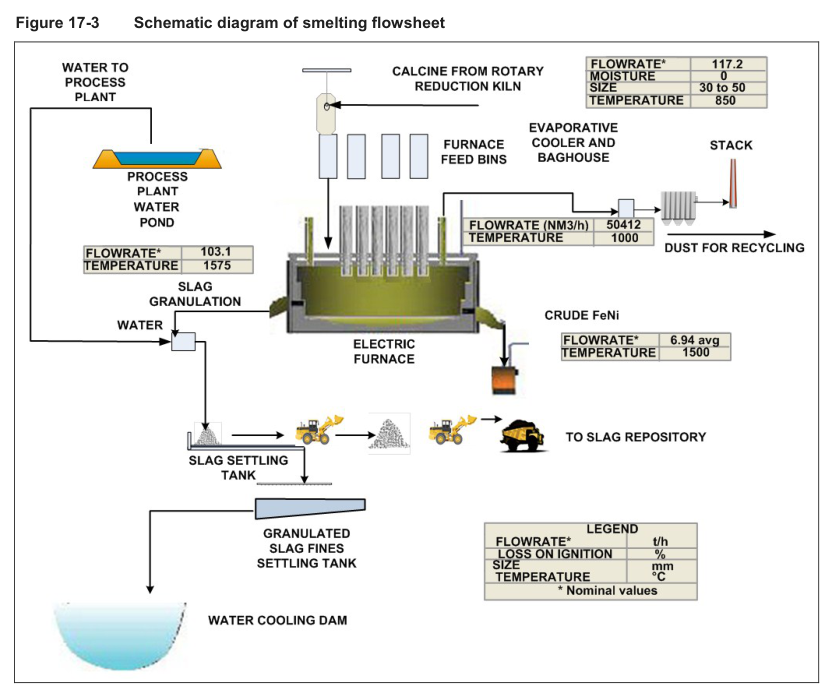
The electric furnace is rectangular with 32 m shell length and 9 m shell width, rated at approximately 57 MW. Six electrodes in line are powered by three single-phase transformers arranged in parallel. Specific power consumption is approximately 506 kWh per metric tonne of calcine, giving a required power rating of approximately 56.6 MW for smelting 117.1 tonnes per hour calcine. This calculation is based on slag tapping temperature of 1,575°C, metal tapping temperature of 1,500°C, freeboard temperature of 1,000°C, and heat loss of 6 MW.
The slag liquidus temperature is 1,380°C, corresponding to the process design criteria slag composition. Due to anticipated variability in ore feed within established limits, slag composition and properties will vary, and the process is designed to handle such variability. A SiO₂ to MgO ratio of 2.6 is expected in the slag phase.
The furnace cooling system uses three layers of copper plate block (horizontal block) in the slag layer fluctuation zone, with vertical blocks in the bath zone set between the furnace shell and refractory lining. Control of Al₂O₃ content below 7 wt% and SiO₂/MgO ratio below 2.6 by meeting specified blending composition criteria would largely mitigate potential excursions in furnace operating conditions.
Ferronickel refining
Crude FeNi tapped from the furnace at approximately 1,500°C in 50-tonne batches is transferred by ladle transfer car to the electric refining ladle furnace area. The two-stage refining process comprises oxidation and reduction. Oxygen blowing with slagging agent removes phosphorus, carbon and silicon. In the reduction process, reductant and slagging agent remove sulphur and oxygen.
The ladle furnace has 50-tonne capacity. Refining temperature is raised to approximately 1,630°C. Powder reagent consumption is 116 kg/t FeNi, with additional reagent at 20 kg/t FeNi. Aluminium grain consumption is 2.6 kg/t FeNi, calcium silicon grain consumption is 3 kg/t FeNi. Oxygen requirement is 15 Nm³/t FeNi and nitrogen requirement is 21 Nm³/t FeNi. The expected crude metal composition is 30% Ni with the balance iron plus minor elements; refined metal is also 30% Ni with reduced silicon (less than 0.04%), carbon (less than 0.04%), phosphorus (less than 0.03%) and sulphur (less than 0.04%).
Metal shotting and product conditioning
Hot refined FeNi at approximately 1,630°C is tapped from the ladle through a bottom pouring spout at controlled flow rate of 1 to 1.5 tonnes per minute into a rotating tundish above the shotting tank. Shotting time is 30 to 35 minutes. The dried material is screened into product sizes from 3 mm to 50 mm, with material outside this range (less than 2 mm or greater than 50 mm) normally recycled for re-melting. Product storage capacity is 3,000 tonnes in bulk configuration.
Auxiliary installations
Coal preparation covers unloading, transfer, stockpiling, crushing, screening, storage and milling. Total coal consumption is 154,157 dry tonnes per annum (184,619 wet tonnes per annum), comprising 40,811 dt/a fuel coal to the dryer burner, 53,776 dt/a fuel coal to the kiln burner, and 59,570 dt/a reductant coal. The stockpile provides seven days surge capacity (approximately 3,600 wet tonnes).
Dust is generated at the dryer, kiln, electric furnace and refinery, collected at dryer electrostatic precipitator, kiln electrostatic precipitator, furnace spray cooler and baghouse, refinery baghouse and hygiene baghouse. Dust typically contains relatively high nickel levels.
Heavy fuel oil will be used at the dryer and kiln for burner start-up and supplementary fuel. The pulverised coal to heavy fuel oil ratio at both units is set to 90:10. The heavy fuel oil storage tank has 500-tonne capacity. Diesel storage is 60 tonnes. LPG storage totals 20.4 tonnes in storage tanks.
The water system includes a water cooling dam, raw/fire water pond of 11,000 m³ capacity supplied from the cooling dam, fire water system, and slag granulation circuit. Slag granulation requires nominal 2,577 m³/h. Make-up water to the cooling circuit will be treated in a water softening and demineralisation plant, with softened water flow expected at approximately 40 m³/h.
Key reported parameters
| Parameter | Unit | Value | Basis |
|---|---|---|---|
| Plant throughput | Mt/a | 0.9 | Design (single line RKEF) |
| Nickel production | kt/a | 15 | Design (as FeNi) |
| Fresh ore feed rate | dt/h | 137.0 | Design – crushing circuit |
| Fresh ore moisture | % | 34.0 | Design |
| Dryer product moisture | % | 18 (range 18–22) | Design target |
| Dryer operation | h/a | 7,446 | Design |
| Kiln dimensions (diameter × length) | m | 5.5 × 120 | Design |
| Kiln installed power | kW | 1,096 | Design |
| Calcine discharge temperature | °C | 875 | Design target |
| Calcine temperature at furnace | °C | 800 | Design |
| Furnace shell length × width | m | 32 × 9 | Design |
| Furnace power rating (average/maximum) | MW | 56.6 / 68 | Design |
| Specific power consumption | kWh/t calcine | 506 | Design calculation |
| Metal tapping temperature | °C | 1,500 | Design |
| Slag skimming temperature | °C | 1,575–1,600 | Design |
| FeNi product grade | % Ni | 30 | Design / testwork and market demand |
| Nickel overall plant recovery | % | 92.8 | Project criteria |
| Crude metal temperature to refining | °C | 1,500 | Design |
| Refining temperature | °C | 1,630 | Design |
| Kiln residence time | h | ~3 | Expected |
| Kiln dust rate (design) | % of feed (dry basis) | 17.4 | Benchmarking basis |
| Kiln dust rate (pilot observed) | % of feed | ~0.5 | Pilot testwork |
| Calcine discharge temperature (pilot) | °C | 900–925 | Pilot testwork (no sintering) |
| Ring formation (pilot) | , | Not observed | Pilot testwork up to ~1,050°C |
| Metal production design rate | t/h | 7.6 | Design |
| Average slag production rate | t/h | 103.1 | Design |
| Coal consumption (total) | dt/a | 154,157 | Design |
| Base Case mass balance basis | , | Weighted average ROM from April 2017 mining schedule | Study basis |
Project website: https://horizonteminerals.com/uk/en/araguaia_project/
Technical qualifications
The report is based on metallurgical testwork including full bench scale testing and an integrated pilot plant campaign carried out during the first and second quarters of 2015 (discussed in Section 13 of the source report). The Base Case mass balance is based on the weighted average ROM ore composition from the mining schedule developed in April 2017; the difference between the April 2017 and Q3 2018 mining schedule is noted as negligible and covered by the process design criteria. The kiln design dust rate of 17.4% (dry basis, excluding coal) was adopted based on benchmarking other nickel laterite kiln operations and differs from the observed pilot plant dusting rate of approximately 0.5%. Furnace heat loss could increase by up to 3 MW if freeboard temperature exceeds 1,200°C and slag superheat exceeds 200°C for an extended period, which would decrease FeNi production. Slag composition and properties will vary due to anticipated ore feed variability within established limits, and the process is designed to handle such variability.
Source: Horizonte Minerals Plc , Araguaia Nickel Project Technical Report, relevant sections of Recovery Methods (Section 17).
