

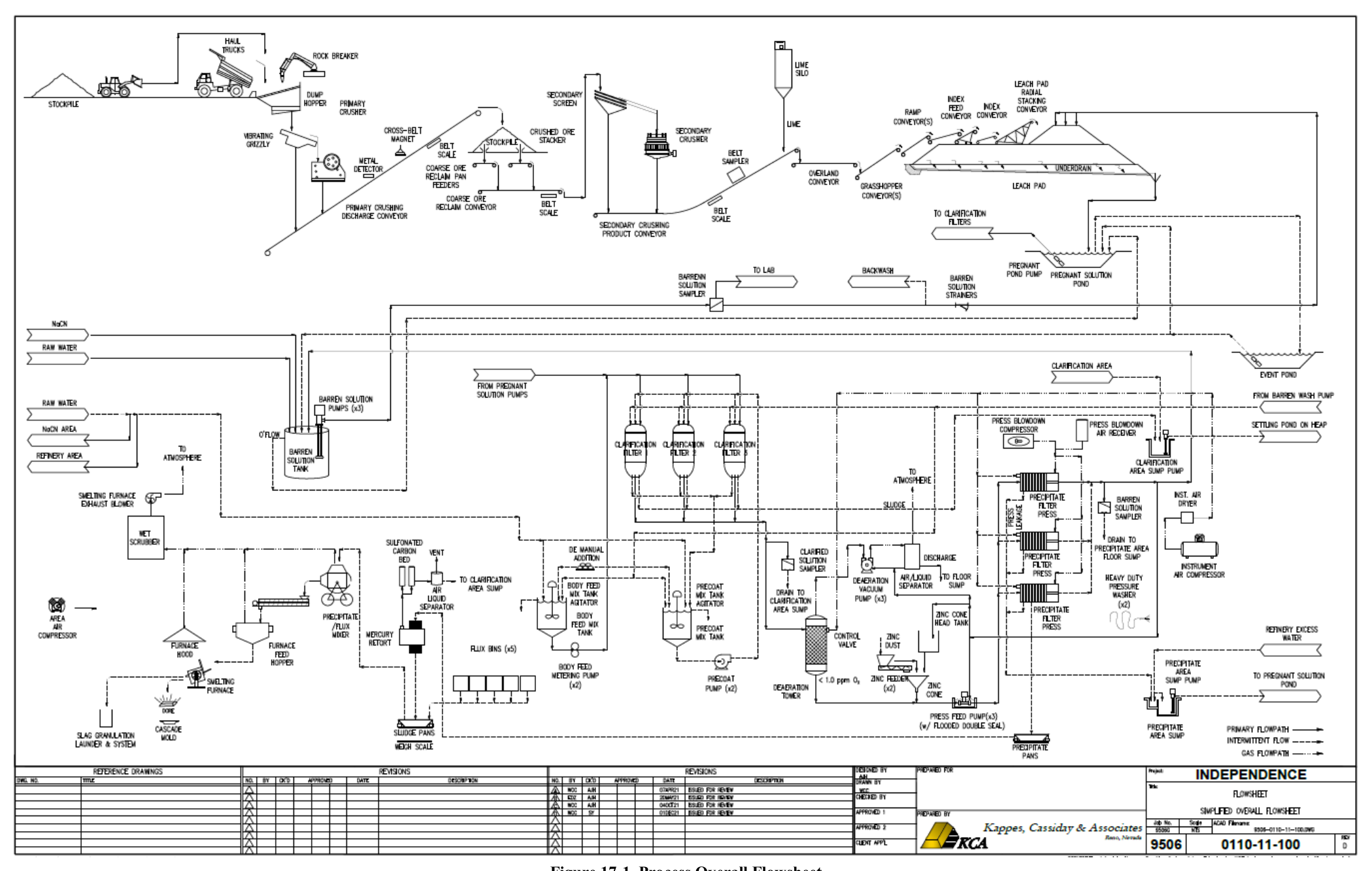
The January 2022 preliminary economic assessment for the Independence project in Lander County, Nevada describes two-stage crushing to 57 mm, 9 m lifts on a double-lined pad, and a Merrill-Crowe plant that makes doré.
The Independence Heap Leach Project is a gold and silver deposit in Lander County, Nevada, held by Golden Independence Mining Corp. The Preliminary Economic Assessment NI 43-101 Technical Report is dated January 24, 2022, with a mineral resource effective date of November 15, 2021. The overall process includes crushing, material stacking, heap leach, Merrill Crowe plant and refinery. The report recommends a crushing circuit at a nominal 9,000 t/d, equal to 3.29 Mt/y, which allows more than six years of mine life from a resource of around 20 Mt. Mill feed in each year is mostly oxide, with smaller amounts of transition and sulphide material. Gold recovery in the resource work is 79% for oxide, 60% for transition and 30% for sulphide material, and silver recovery is set at 30%.
Critical Data
| Parameter | Value | Unit | Notes |
|---|---|---|---|
| Crushing rate | 9,000 | t/d | 3.29 Mt/y |
| Primary crusher availability | 80 | % | About 470 t/h |
| Secondary crushing availability | 85 | % | About 440 t/h |
| Crushed product | 100% passing 57 | mm | P80 about 38 mm |
| Lift height | 9 | m | Maximum heap 81 m |
| Active lift bulk density | 1.66 | t/m3 | Not applicable |
| Leach cycle | 120 | days | Test work estimate |
| Irrigation rate | 10 | L/h/m2 | Drip emitters |
| Active leaching area | 72,030 | m2 | Not applicable |
| Barren solution flow | 720 | m3/h | 30 minute tank |
| Leach pad area | About 386,800 | m2 | 21.9 Mt capacity, two phases |
| Sodium cyanide use | 900 | t/y | About 30% liquid |
| Lime use | 6,700 | t/y | 2, 3 or 4 kg/t |
| Upset pond volume | 150,100 | m3 | Event plus pregnant pond |
Overview
Ore from the open pits is hauled in 90 t trucks to a two-stage open crushing circuit. Lime is dosed to the crushed product, and conveyors and mobile stackers build the heap in 9 m lifts. Dilute sodium cyanide solution is dripped on the heap for 120 days, and the pregnant solution drains by gravity to a pond and goes to a Merrill Crowe plant. Precipitate is dried, retorted, mixed with fluxes and smelted in an electric induction furnace to make doré.
Key Process Stages
Primary crushing
Trucks dump into a hopper that holds 200 t and is covered by a fixed grizzly with 500 mm by 500 mm openings, with a hydraulic rock breaker for oversize. An apron feeder moves ore to a vibrating grizzly with an 80 mm aperture, and oversize goes to a primary jaw crusher at an open side setting of about 100 mm. Jaw product and grizzly undersize join on one conveyor to a primary stockpile of 21,200 t, which is 51 m across and 19 m high and holds 48 hours of downstream crushing.
Secondary crushing and lime
Belt feeders reclaim ore to a secondary feed hopper and double deck screen, with top and bottom panels cut at 100 mm and 50 mm. Oversize goes to a cone crusher at a closed side setting of 33 mm. A tramp metal magnet and metal detector protect the crusher. Lime is added to the secondary product conveyor from a 100 t silo with a variable speed screw feeder at 2, 3 or 4 kg/t for oxide, transition or sulphide ore. All conveyors are interlocked so a trip stops everything upstream.
Stacking and the leach pad
Mobile grasshopper conveyors, an index feed conveyor, a horizontal index conveyor and a radial stacker build the heap in 9 m lifts to a maximum of 81 m. Old lifts are cross-ripped before new ore goes on top. The double-lined pad has a geosynthetic clay liner with hydraulic conductivity of 1×10⁻⁶ cm/s or less as the secondary system, and a 2.0 mm textured LLDPE primary liner with a leak detection system between them. Herringbone collection pipes sit under a 0.6 m overliner of crushed material screened to 100% passing 51 mm and no more than 10% passing 200 mesh. The pad is built in two phases.
Solution application
Barren solution of dilute sodium cyanide is pumped from the barren tank by vertical turbine pump and applied through drip emitters, which evaporate less than sprinklers and cut make-up water. Concentrated cyanide is metered in to hold target strength, and an antiscalant polymer is added continuously to reduce scaling in the irrigation system.
Ponds and water balance
The pregnant solution pond has an operating volume of about 44.8k m3 and settles solids before an internal divider berm. The event pond holds about 39.8k m3 and is sized for the 100-year, 24-hour storm of 63.2 mm plus a 48 hour pump outage drain down. Both use two 60-mil liners with leak detection. The arid site gives a net-negative water balance. Site water demand averages 521,300 m3 a year, of which heap make-up is 76%, road dust suppression 18% and the process plant 5%.
Merrill-Crowe plant
Pregnant solution is pumped at 712 m3/h through three clarification filters (two operating), a de-aeration tower that takes dissolved oxygen below 0.5 ppm, and three precipitate filter presses (two operating) with a diatomaceous earth precoat and zinc addition. An online dissolved oxygen meter checks the filter feed. Barren solution goes back to the barren tank, and filter cake is collected for smelting.
Additional Interesting Data and Summary
Estimated sodium cyanide consumption is 0.27, 0.405 and 0.255 kg/t for oxide, transition and sulphide material. Gold recovery on oxide material was not very sensitive to crush size in preliminary column tests, and test work showed variable gold and silver recovery between oxidation states. Antiscalant use is about 32 t a year, delivered in 1 m3 totes with two months of storage.
The pad as designed can hold 21.9 Mt, more than the roughly 20 Mt resource. Reagents are delivered in liquid form for cyanide, by 35 t bulk trucks for lime, and the plant utilization is assumed at 98% for solution handling and the Merrill-Crowe plant.
Key Processes
- Two-stage open circuit crushing to 100% passing 57 mm
- Lime addition on the crushed product conveyor
- Conveyor and radial stacker heap construction in 9 m lifts
- Single-stage cyanide heap leaching with drip emitters
- Merrill-Crowe precipitation with zinc
- Retorting and induction furnace smelting to doré
Source: Preliminary Economic Assessment NI 43-101 Technical Report on the Independence Heap Leach Project, Lander County, Nevada, USA, January 24, 2022.
