

Overview
Nestled in the mineral-rich Cariboo region of British Columbia, Canada, the Spanish Mountain Gold Project represents one of the most significant and advanced-stage gold development projects in North America. Operated by Spanish Mountain Gold Ltd. (TSX-V: SPA), this ambitious venture is poised to become a major producer, targeting an average annual output of over 200,000 ounces of gold over a projected 25-year mine life. Located approximately 70 kilometers northeast of the city of Williams Lake, the project leverages a substantial mineral resource base with a design head grade of 0.46 g/t gold and 0.65 g/t silver. The processing facility, as detailed in the recent NI 43-101 Technical Report and Preliminary Economic Assessment (PEA) dated July 2025, is engineered for a substantial throughput of 26,000 tonnes per day (t/d). This state-of-the-art mineral processing plant incorporates a sophisticated flowsheet designed to maximize recovery through a combination of gravity concentration, flotation, and leaching technologies. The project’s significance extends beyond its economic potential, embodying modern mining principles with a strong emphasis on dry stack tailings management, water recycling, and energy efficiency, setting a new benchmark for sustainable gold mining in Canada.
Key Process Stages
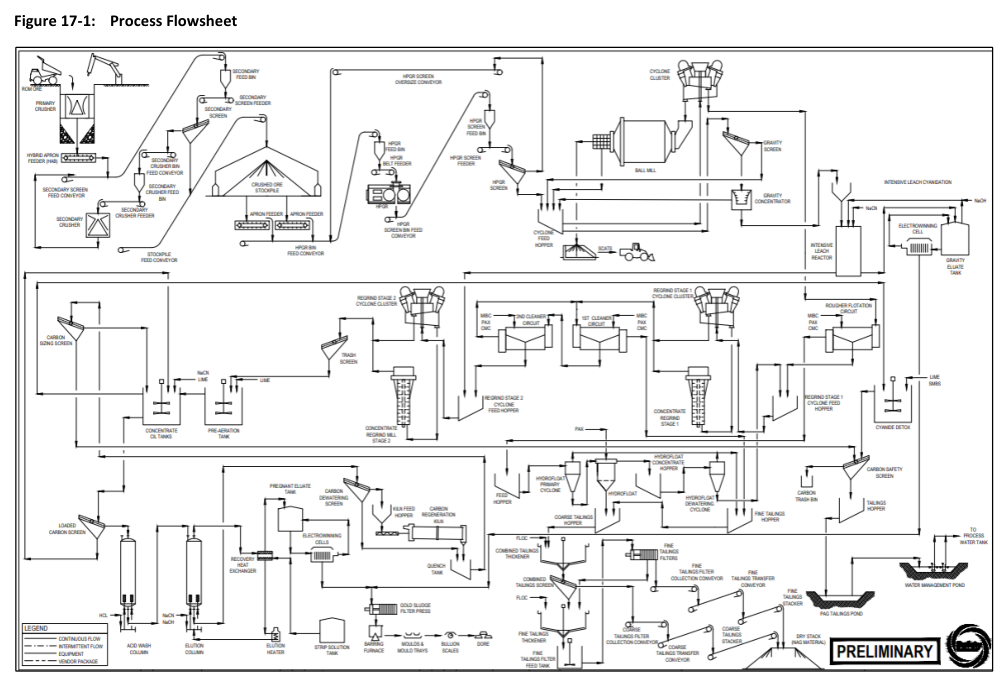
The Spanish Mountain Gold process plant employs a comprehensive and multi-stage circuit designed to efficiently liberate and recover fine gold from a low-grade sulfide ore. The circuit is a testament to modern metallurgical design, integrating conventional technologies with advanced unit operations to optimize recovery and minimize environmental impact.
- Stage 1: Two-Stage Crushing & HPGR Tertiary Grinding: Run-of-Mine (ROM) ore with a top size (F₈₀) of 127 mm is first reduced to a P₈₀ of 37 mm through primary and secondary crushing circuits. The crushed material is then further comminuted by a massive High-Pressure Grinding Roll (HPGR) unit (2.1m x 1.8m, 4100 kW power), which is highly energy-efficient. The HPGR operates with an 80% circulating load and produces a final ball mill feed product with a P₈₀ of just 4 mm.
- Stage 2: Ball Mill Grinding & Classification: The HPGR product is fed to a large ball mill (7.3m diameter x 10.4m effective grinding length, 10,400 kW) operating in closed circuit with a cyclone cluster. This stage grinds the material to a target P₈₀ of 350 µm at a high recirculating load of 350%. The cyclone overflow, at 35% solids, reports to flotation.
- Stage 3: Gravity Concentration & Intensive Leach (GIL): A portion of the cyclone feed is diverted to a gravity circuit featuring four concentrators. This circuit is designed to recover coarse, free gold early in the process, achieving a mass pull of 0.01%. The gravity concentrate is immediately fed to an Intensive Leach Reactor (ILR) for rapid cyanide dissolution, with the resulting pregnant solution sent directly to electrowinning for gold recovery, bypassing the main circuit and boosting overall efficiency.
- Stage 4: Rougher-Cleaner Flotation with Regrinding: The main stream undergoes bulk sulfide flotation using five rougher cells with reagents PAX (collector), CMC (depressant), and MIBC (frother), pulling 11% of the plant feed. The rougher concentrate is reground in two stages: first to a P₈₀ of 45 µm (13.1 kWh/t) and then, after two stages of cleaning, the final concentrate is reground to a ultra-fine P₈₀ of 20 µm (13.8 kWh/t) to liberate locked gold particles.
- Stage 5: Coarse Particle (HydroFloat) Flotation: In a key innovation, rougher flotation tailings are processed in a HydroFloat circuit to recover gold from coarser particles that conventional cells might miss. This step significantly reduces gold losses to tailings, with the HydroFloat tailings representing 44.7% of the plant feed.
- Stage 6: Concentrate Leaching & Carbon Adsorption (CIL): The finely ground flotation concentrate is leached in a six-tank Carbon-in-Leach (CIL) circuit with a total residence time of 24 hours. Sodium cyanide and oxygen are added to dissolve the gold, which is then adsorbed onto activated carbon within the same tanks.
- Stage 7: Carbon Elution, Electrowinning & Doré Production: Loaded carbon is acid-washed, stripped of gold in a pressurized elution column, and regenerated in a kiln for reuse. The gold-rich pregnant eluate is processed in an electrowinning cell to produce a sludge, which is then filtered, smelted with fluxes in a barring furnace, and poured into high-purity gold-silver doré bars.
- Stage 8: Tailings & Water Management: Tailings are meticulously managed. Flotation tailings are thickened and filtered for dry stacking. Leach residue undergoes cyanide destruction with SMBS before being sent to a separate, potentially acid-generating (PAG) tailings storage facility. Water from thickeners is extensively recycled back into the process, minimizing fresh water consumption.
Critical Data
The following table summarizes the key technical and operational parameters that define the scale and efficiency of the Spanish Mountain Gold processing circuit, as outlined in the NI 43-101 report.
| Parameter | Value | Unit | Notes |
|---|---|---|---|
| Design Throughput | 26,000 | tpd | Nominal daily processing rate |
| Mill Availability | 91 | % | Grinding & flotation section operational availability |
| Target Grind Size (P₈₀) | 350 | µm | Primary ball mill cyclone overflow size |
| Final Regrind Size (P₈₀) | 20 | µm | Flotation concentrate regrind for leaching |
| Bond Ball Work Index | 16.3 | kWh/t | Ore hardness measure |
| Installed Power (Process Plant) | 36.1 | MW | Total connected load for processing equipment |
| Leach Residence Time | 24 | hours | Total time in CIL circuit |
| Annual Water Consumption (Raw Makeup) | 1.5 | Mm³ | Estimated annual fresh water requirement |
| Annual Sodium Cyanide Consumption | 1,077 | t/a | Primary lixiviant for leaching circuits |
| Mine Life | 25 | Years | Based on current reserves and processing rate |
Additional Interesting Data and Summary
Beyond the impressive throughput and recovery metrics, the Spanish Mountain Gold Project is a case study in modern, responsible mineral processing. The circuit design incorporates several features aimed at reducing its environmental footprint. The use of an HPGR for tertiary crushing is a significant energy-saving choice, as HPGRs are known to be more efficient than traditional crushers and SAG mills for competent ores, directly reducing the project’s power consumption and greenhouse gas emissions. Furthermore, the commitment to filtered, dry stack tailings management is a paramount environmental achievement. This method drastically reduces the footprint of tailings storage, eliminates the need for a large impoundment dam and the associated perpetual water treatment, and greatly improves long-term geotechnical stability. The project plans to seginate tailings based on their geochemical properties, with non-potentially acid generating (non-PAG) material being dry-stacked and a smaller volume of PAG material stored sub-aqueously, demonstrating a sophisticated approach to environmental risk management.
Economically, the project is designed for longevity and efficiency. The 25-year mine life provides significant long-term benefits to the local economy and the region of British Columbia. The estimated annual reagent consumptions, such as 1,784 tonnes of PAX collector and 465 tonnes of MIBC frother, highlight the scale of the operation and its integration into global supply chains. The on-site generation of 93% purity oxygen via a Vacuum Swing Adsorption (VSA) plant is another optimization, ensuring a reliable and cost-effective supply of a critical reagent for the leaching process. The PEA outlines a robust project with compelling economics, positioning Spanish Mountain Gold Ltd. as a future mid-tier gold producer. The comprehensive flowsheet, with its sequential application of gravity, flotation, and leaching, is engineered to achieve maximum recovery from a complex ore body, ensuring that the project will be a technically and environmentally leader in the mining industry for decades to come.
Source: NI 43-101 Technical Report | Preliminary Economic Assessment | Project: Spanish Mountain Gold Project | Date: July 2025
