

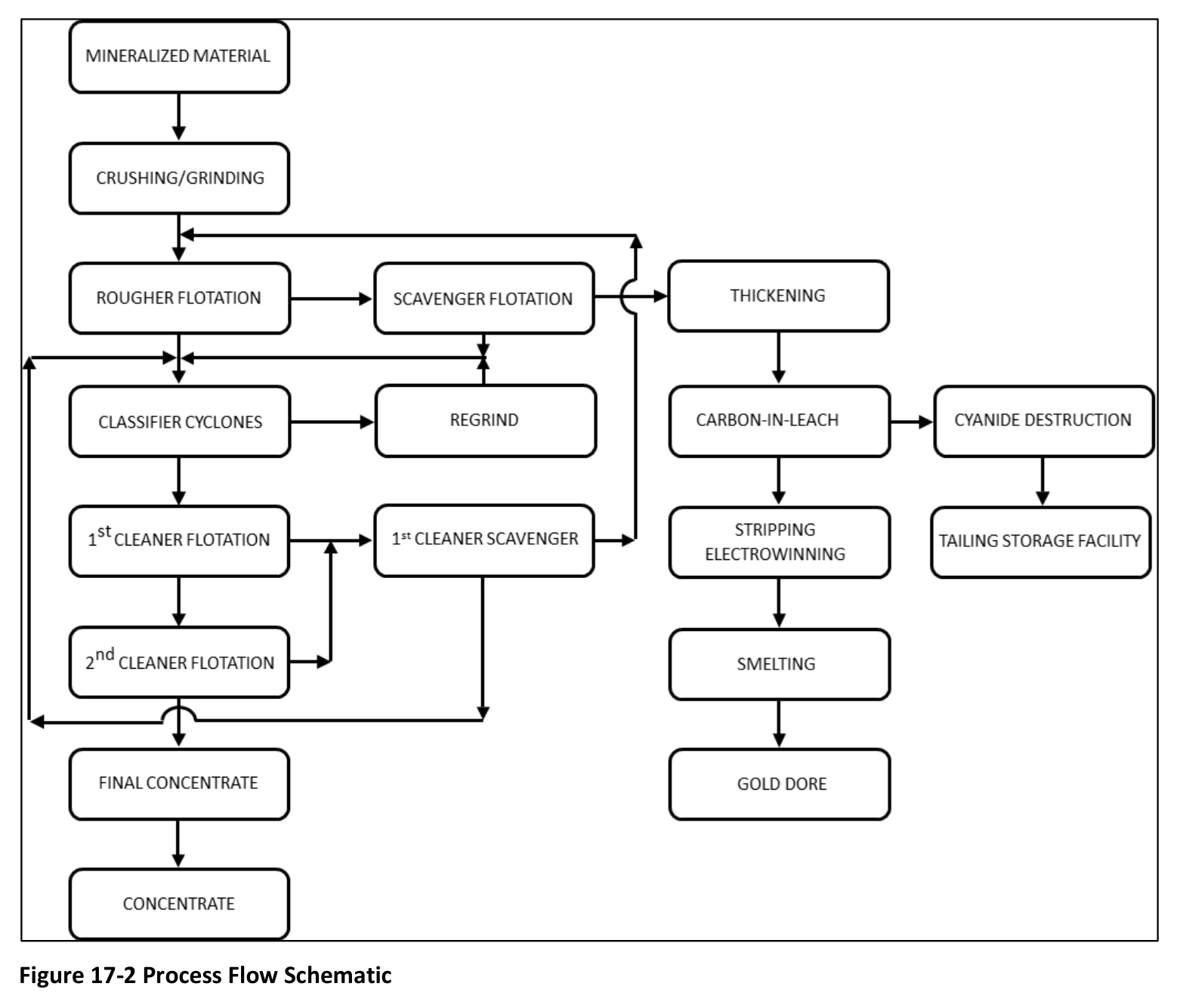
GoldMining Inc.'s La Mina project in Antioquia, Colombia would process ore through a conventional crushing, grinding, and flotation circuit, with cyanide leaching of flotation tailings to recover gold and silver.
The La Mina Gold-Copper Project is located in the Department of Antioquia in the Republic of Colombia, South America, approximately 51 km southwest of Medellín. GoldMining Inc. owns 100% of the project through its wholly owned subsidiary Bellhaven Copper & Gold Inc. The property consists of two concessions covering approximately 3,208 hectares. The project is a development-stage asset: GoldMining announced the updated Preliminary Economic Assessment on April 28, 2026, and filed the supporting technical report on June 8, 2026. The technical report has an effective date of April 22, 2026. The PEA contemplates a conventional open pit, truck and shovel operation feeding a 15,000 tpd processing plant that produces a copper concentrate and gold-silver doré. The mineral resource estimate includes Indicated resources of 33.8 million tonnes grading 0.73 g/t gold, 2.08 g/t silver, and 0.21% copper, plus Inferred resources of 56.2 million tonnes grading 0.58 g/t gold, 2.32 g/t silver, and 0.14% copper. No mineral reserves have been estimated. The report states the PEA is preliminary in nature, and there is no certainty that the reported results will be realized.
Critical Data
| Parameter | Value | Unit | Notes |
|---|---|---|---|
| Process plant throughput | 15,000 | tpd | Nominal rate |
| Projected mine life | 11.2 | years | 2026 PEA basis |
| Average gold recovery | 91 | % | 2026 PEA life-of-mine estimate |
| Average copper recovery | 80 | % | 2026 PEA life-of-mine estimate |
| Average silver recovery | 64 | % | 2026 PEA life-of-mine estimate |
| Circuit availability | 92 | % | Planned overall |
| Operating schedule | 24 | hours/day | Planned |
| Primary crusher product size | 38 | mm | Nominal, 80% passing |
| Grinding product size | 130 | µm | 80% passing |
| SAG mill | 9.8 dia. x 3.0 | m | 5.0 MW, open circuit |
| Ball mill | 5.8 dia. x 12.0 | m | 8.0 MW, closed circuit with hydrocyclones |
| Regrind ball mill | 4 dia. x 7.5 | m | 1,675 kW |
| Regrind product size | 30 | µm | Nominal |
| Cyclone overflow density | 35 | % solids by weight | Approximate |
| Rougher flotation cells | 8 x 120 | m³ | Bank configuration |
| Scavenger flotation cells | 8 x 120 | m³ | Bank configuration |
| First cleaner flotation cells | 2 x 30 | m³ | Bank configuration |
| Second cleaner flotation | 2 | columns | Operating in parallel |
| Cleaner scavenger flotation cells | 2 x 30 | m³ | Operating in series |
| Second cleaner concentrate grade | 23 | % Cu | Approximate |
| Second cleaner concentrate grade | 75.8 | g/t Au | Approximate |
| Second cleaner concentrate grade | 144.2 | g/t Ag | Approximate |
| Concentrate moisture | 8 | % by weight | Roughly, after filtration |
| Flotation feed mass to rougher concentrate | 8–12 | % | Approximate, dry weight basis |
| Pre-aeration tanks | 2 x 19 dia. x 19 high | m | Agitated, operating in series |
| Pre-aeration residence time | 12 | hours | Roughly |
| CIL tanks | 8 x 19 dia. x 19 high | m | Agitated, operating in series |
| CIL residence time | 48 | hours | In the range of |
| Activated carbon concentration | 35 | g/L solution | Coconut shell carbon |
| Cyanide detoxification tanks | 2 x 19 dia. x 19 high | m | Agitated, operating in parallel |
| Cyanide detox retention time | 12 | hours | Approximately |
| Process department manpower | 128 | employees | Planned |
| Tailings storage facility | Lined | Not applicable | Detoxified tailing slurry |
Project status and study basis
La Mina is not an operating mine. GoldMining’s April 2026 PEA evaluates a proposed open-pit operation processing 15,000 tpd over a projected 11.2-year mine life. The study estimates average metallurgical recoveries of 91% for gold, 80% for copper, and 64% for silver. These are PEA projections, not demonstrated plant performance. The study includes Inferred Mineral Resources and does not declare Mineral Reserves, so its production and economic outcomes remain preliminary.
Overview
The La Mina processing plant is designed around a conventional crushing and grinding circuit followed by copper flotation. Gold and silver are recovered as by-products in the copper concentrate, and additional gold is recovered from flotation tailings through cyanide leaching in a carbon in leach circuit. The flowsheet then includes cyanide detoxification before tailings are sent to a lined storage facility.
Mineralized material from the La Cantera, La Garrucha, and Middle Zone open pits will be processed at 15,000 tonnes per day. The plant is planned to operate 24 hours per day with overall circuit availability of 92%. The process department is expected to have 128 employees.
The processing route begins with primary crushing and coarse stockpiling, moves through a SAG mill and ball mill grinding circuit, then flotation with a regrind stage and two cleaning stages. Final flotation tailing reports to pre-aeration tanks and then to a CIL circuit. Pregnant carbon is stripped and reactivated, and the gold and silver are recovered by electrowinning and refined into doré bars. CIL tailings go through cyanide detoxification before being deposited in the tailings storage facility.
Key Process Stages
Crushing begins with haul trucks from the open pits depositing run of mine material into a gyratory crusher feed hopper. Gyratory crusher product is conveyed to a cone crusher for secondary size reduction. The crushed rock is reduced to a nominal 38 mm 80% passing size and discharged onto a crushed material stockpile.
The grinding circuit receives crushed material from the stockpile at a controlled feed rate. A 9.8 m diameter by 3 m long 5.0 MW SAG mill operates in open circuit. SAG mill product discharges to a vibrating screen, with oversize conveyed to one of two pebble crushers operating in parallel. Pebble crusher product returns to the SAG mill. Screen undersize material reports to the cyclone feed pump sump, where dilution water is added. Slurry is pumped to a cyclone cluster. Cyclone underflow flows by gravity to the ball mill feed chute. The ball mill, measuring 5.8 m diameter by 12.0 m long with 8.0 MW power, operates in closed circuit with the hydrocyclones. Ball mill product discharges to the cyclone feed pump sump and along with SAG mill discharge is pumped to the cyclone cluster. Cyclone overflow slurry at approximately 35% solids by weight flows by gravity to the first rougher flotation conditioning tank. Lime is added as required to the cyclone feed pump sump to adjust slurry pH for flotation. Grinding media additions are based on power factor set points, which are periodically adjusted to compensate for liner wear.
Flotation begins with cyclone overflow reporting to the first of two conditioning tanks operating in series. Collector and frother are added, and the conditioned slurry is pumped to a bank of eight 120 m³ rougher flotation cells. Frother and collector may also be added to individual cells as necessary. Electric blowers supply flotation air. Rougher tailings report to the first of two scavenger conditioning tanks, also in series, where more collector and frother are added. The conditioned slurry is pumped to a bank of eight 120 m³ scavenger flotation cells. Rougher concentrate, approximately 8% to 12% of the flotation feed dry weight, combines with scavenger concentrate and is pumped to a cyclone cluster. Cyclone overflow reports to the first cleaner conditioning tank, while underflow goes to a 4 m diameter by 7.5 m long 1,675 kW regrind ball mill that grinds to a nominal 30 µm to further liberate valuable minerals. Scavenger tailing slurry goes to a final flotation tailing thickener.
The cleaner circuit uses a single conditioning tank with collector and frother additions. Lime is introduced to achieve a pH of 11.0, which depresses pyrite. Conditioned slurry feeds a bank of two 30 m³ first cleaner flotation cells. First cleaner concentrate feeds a second cleaner stage of two flotation columns operating in parallel. Second cleaner concentrate, at approximately 23% copper, 75.8 g/t gold, and 144.2 g/t silver, is pumped to the concentrate dewatering thickener. First and second cleaner tailing products go to cleaner scavenger flotation consisting of two 30 m³ cells in series. Cleaner scavenger concentrate is pumped to the regrind mill cyclone cluster, while tailing product goes to the first rougher conditioning tank.
Copper concentrate dewatering begins with thickening. Thickener overflow reports to a process makeup water tank. Underflow is pumped to a pressure filter feed holding tank, then to one of two pressure filters operating in parallel. Concentrate is dewatered to roughly 8% moisture by weight and deposited in a concentrate storage area, where it is loaded into trucks for shipment to a third-party smelter. Filtrate is pumped to the process makeup water tank.
Pre-aeration and cyanide leach treat the scavenger flotation tailings. Scavenger tailing is pumped to a high-rate thickener, with overflow going to the process makeup water tank. Underflow slurry at approximately 45% to 48% solids by weight reports to the first of two 19 m diameter by 19 m high agitated pre-aeration tanks operating in series. Compressed air oxidizes sulfide minerals, reducing sodium cyanide consumption and gold dissolution time. Total pre-aeration residence time is roughly twelve hours. The pre-aerated slurry is pumped to a train of eight 19 m diameter by 19 m high agitated CIL tanks operating in series. Each tank contains activated coconut shell carbon at a concentration of 35 grams per liter of solution. Activated carbon is pumped upstream counter-current to the leach slurry flow. Sodium cyanide and milk of lime are added to the CIL tanks to maintain optimum cyanide concentration and pH. Compressed air addition provides oxygen levels for the gold dissolution reaction. Dissolved gold and silver adsorb onto the activated carbon surfaces. CIL residence time is in the 48 hour range.
Carbon stripping and reactivation begins with loaded carbon pumped from the first CIL tank to one of two acid wash tanks operating in parallel, where scale is removed from carbon surfaces. Carbon is then transferred to one of two strip vessels operating in parallel. Caustic solution is added to increase pH to alkaline levels. Pressurized hot alkaline solution circulates through the strip vessels and electrowinning cells, where gold and silver in solution plate onto steel wool cathodes. Stripped carbon is thermally reactivated in a rotary kiln, then passed over a vibratory screen to remove fine particles. Reactivated and screened carbon is transferred to the last tank of the CIL train.
Refining starts with electrowinning cell sludge manually washed from the loaded steel wool cathodes. The sludge is dried, then melted in a single sludge melt furnace. The molten gold and silver-bearing product is poured into doré bar molds. Doré bars are sent to a third-party refinery for final purification.
Tailing treatment begins with CIL tailing slurry pumped to the first of two 19 m diameter by 19 m high agitated cyanide detoxification tanks operating in parallel. Residual cyanide levels are reduced to acceptable limits. Detox retention time is approximately twelve hours. Detoxified tailing slurry is sent to the lined tailings storage facility.
Additional Interesting Data and Summary
The process plant relies on a range of reagents including flotation collector, frother, milk-of-lime, flocculant, anti-scalant, sodium cyanide, and cyanide detox reagent. Process service systems include fresh water supply, process water made up largely of recycled water from the TSF and from in-plant processes, potable water, fire suppression water, flotation plant blowers, pre-aeration/CIL/cyanide detoxification reaction compressors, and services and instrument air compressors.
The flowsheet uses a SAG mill with pebble crushing in open circuit, followed by a ball mill in closed circuit with hydrocyclones. Flotation includes rougher, scavenger, regrind, and two cleaning stages with columns, plus a cleaner scavenger stage. The CIL circuit follows flotation tailings thickening and pre-aeration. Carbon is stripped, reactivated, and returned to the circuit. Electrowinning and furnace refining produce doré bars. Tailings are detoxified before deposition in a lined facility.
The processing design is described at a PEA level, and the report recommends further work including locked-cycle flotation and variability testing, along with expanded metallurgical test work. The report also notes that the mineral resource estimate used for the PEA includes Inferred Mineral Resources, which are considered too speculative geologically to have economic considerations applied that would enable categorization as Mineral Reserves.
Study history
- 2016 resource report: Bellhaven Copper & Gold documented the La Cantera and Middle Zone resource models and recommended further work, including evaluation of La Garrucha.
- 2021 technical report: GoldMining updated the resource review and identified sufficient information to advance a PEA.
- 2023 PEA: the project basis advanced to a 15,000 tpd open-pit and flotation-plus-leach concept incorporating La Cantera, Middle Zone, and La Garrucha.
- 2026 updated PEA: GoldMining retained the 15,000 tpd flowsheet, updated the resource and economic assumptions, and reported 91% gold, 80% copper, and 64% silver recovery over a projected 11.2-year mine life.
Technical report library and primary sources
- GoldMining: La Mina project and current resource statement
- April 28, 2026 updated PEA announcement (EDGAR)
- June 8, 2026 technical-report filing announcement (EDGAR)
- July 24, 2023 updated PEA announcement
Key Processes
- Gyratory crushing followed by cone crushing to 38 mm 80% passing
- SAG mill in open circuit with pebble crushers, then ball mill in closed circuit with hydrocyclones
- Copper flotation with rougher, scavenger, regrind, first cleaner, second cleaner columns, and cleaner scavenger stages
- Concentrate thickening and pressure filtration to 8% moisture for smelter shipment
- Pre-aeration of flotation tailings for twelve hours to oxidize sulfides
- Cyanide leaching in eight CIL tanks with 48-hour residence time using coconut shell carbon
- Carbon stripping with hot alkaline solution, electrowinning onto steel wool cathodes, and thermal reactivation
- Sludge melting and doré bar production for third-party refining
- Cyanide detoxification in agitated tanks with twelve-hour retention before tailings deposition
- Reagent systems for flotation collector, frother, milk-of-lime, flocculant, anti-scalant, sodium cyanide, and cyanide detox reagent
Source: Technical Report and Preliminary Economic Assessment for the La Mina Gold-Copper Mineral Deposit, Antioquia, Republic of Colombia, April 22, 2026. Project website: La Mina
Technical report and processing history
The following archived source profiles have been consolidated here to preserve the project’s processing history and study context.
La Mina Project — 2023 Technical Report
La Mina Project — 2023 Technical Report
| Company | GoldMining Inc. |
| Date | 2023-07-24 |
| Commodities | Copper, Gold, Silver |
| Throughput | 15,000 tpd |
| Status | Development |
Executive Summary
This NI 43-101 Technical Report outlines the Preliminary Economic Assessment (PEA) for the La Mina Project, operated by GoldMining Inc. The project involves the mining and milling of mineralization from the La Cantera, Middle Zone, and La Garrucha zones. The proposed operation is an open-pit mine with a conventional concentrator designed to process 15,000 tonnes per day (tpd) of ore. The primary objective is to produce a copper concentrate with gold and silver as by-products.
The processing plant design includes crushing and grinding to liberate minerals, followed by froth flotation to recover copper-bearing minerals and gold into a high-grade concentrate. The flotation tailings will undergo cyanide leaching and gold adsorption/desorption using Carbon-in-Leach (CIL) technology to extract residual gold. The gold is then electrowon into sludge and smelted into doré. The plant is planned to operate 24 hours per day with a circuit availability of 92%.
The conceptual design is based on preliminary metallurgical test work and general industry experience. No preliminary equipment sizing, except for grinding mills, has been undertaken. The project is currently in the development stage, with future metallurgical design expected to investigate potential improvements such as direct flotation reactors in the cleaner circuit.
Website: https://www.goldmining.com/projects/colombia/la-mina-project/
Report Date: 2023-07-24
Region:
Project Status: Development
Commodity: Copper, Gold, Silver
Throughput: 15,000 tpd
Mine Life:
Mine Type:
Ore type:
La Mina Project — 2022 Technical Report
La Mina Project — 2022 Technical Report
| Company | GoldMining Inc. |
| Date | 2022-12-20 |
| Status | PEA |
Executive Summary
The Pre-Feasibility Study (PEA) for the La Mina Project outlines a conventional concentrator processing plant designed to handle mineralization from the La Cantera and Middle Zone open pits. The proposed facility operates at a nominal throughput of 10,000 tonnes per day with an overall circuit availability of 92%. The process flow includes crushing, grinding, froth flotation, and concentrate dewatering to produce a copper concentrate with gold as a by-product.
The metallurgical design is based on preliminary test work and industry experience, as detailed equipment sizing beyond grinding mills has not yet been finalized. The plant schedule involves 24-hour operation for 350 days per year. Reagents such as PAX, frother, and lime are utilized to facilitate mineral separation and tailings settling.
Key Commodities
Copper, Gold
Processing Overview
Website: https://www.goldmining.com/projects/colombia/la-mina-project/
Report Date: 2022-12-20
Region:
Project Status: PEA
Commodity:
Throughput:
Mine Life:
Mine Type:
Ore type:
La Mina Project — 2021 Technical Report
La Mina Project — 2021 Technical Report
| Company | GoldMining Inc. |
| Date | 2021-07-06 |
| Region | Antioquia, Colombia |
| Commodities | Gold, Copper |
| Status | Exploration |
Executive Summary
This NI 43-101 Technical Report covers the La Mina Project in Antioquia, Colombia, prepared for GoldMining Inc. with an effective date of July 6, 2021. The report focuses on the La Cantera and Middle Zone Deposits, reviewing exploration data and geological models to confirm resource reliability.
The authors conclude that the geology of the deposits is well understood and represented in the models. Mineral resources are pit constrained, and the grade estimates can be relied upon. The technical work conforms to CIM Definition Standards, and sufficient information exists to complete a Preliminary Economic Assessment (PEA).
Recommendations include preparing a PEA, evaluating exploration opportunities to expand the La Cantera and Middle Zone resources, and conducting infill drilling to upgrade resources to Measured and Indicated categories. The author notes no risks or uncertainties impacting the project’s viability.
Website: https://www.goldmining.com/projects/colombia/la-mina-project/
Report Date: 2021-07-06
Region: Antioquia, Colombia
Project Status: Exploration
Commodity: Gold, Copper
Throughput:
Mine Life:
Mine Type:
Ore type:
La Mina Project — 2016 Technical Report
La Mina Project — 2016 Technical Report
| Company | Bellhaven Copper & Gold Inc. |
| Date | 2016 |
| Region | Antioquia, Colombia |
| Commodities | Copper, Gold |
| Status | Exploration |
Executive Summary
This NI 43-101 Technical Report, prepared by Metal Mining Consultants Inc. for Bellhaven Copper & Gold Inc., validates the mineral resource statement for the La Mina Project located in Antioquia, Colombia. The report covers the La Cantera and Middle Zone Deposits, confirming that the geology is well understood and represented in the models. MMC concluded that grade estimates can be relied upon and that metallurgical studies were sufficient to convert Inferred Resources to Indicated Resources. The mineral resources have been pit-constrained, providing a basis for a Preliminary Economic Assessment (PEA).
The report identifies that the mineral deposit remains open at depth, with additional drilling having closed off some mineralization near the surface. MMC recommends several resource development plans, including updating the economic analysis and evaluating exploration opportunities to expand the La Cantera and Middle Zone deposits. Specific recommendations include drilling tests for the La Garrucha target and infill drilling to upgrade resources to Measured and Indicated categories. The author concludes there are no known or foreseeable impacts or risks to the project’s continued viability.
Website: https://www.goldmining.com/projects/colombia/la-mina-project/
Report Date: 2016
Region: Antioquia, Colombia
Project Status: Exploration
Commodity: Copper, Gold
Throughput:
Mine Life:
Mine Type:
Ore type:
La Mina Project: Gold-Copper Flotation and CIL Recovery
La Mina Project: Gold-Copper Flotation and CIL Recovery
Source: GoldMining Inc (2026)
Website: https://www.goldmining.com/projects/colombia/la-mina-project/
Critical Data
| Parameter | Value | Unit | Notes |
|---|---|---|---|
| Throughput | 15,000 | tpd | Nominal design rate |
| Mill Power | 14.675 | MW | Combined SAG (5.0 MW) and ball mill (8.0 MW) plus regrind mill (1.675 MW) |
| Target Grind Size | 130 | μm (P80) | Primary grinding circuit; flotation regrind to 30 μm |
| Head Grade | Not specified | Not provided in Section 17; concentrate grades: 23% Cu, 75.8 g/t Au, 144.2 g/t Ag | |
| Recovery % | Not stated | % | Not provided in Section 17 |
| Processing Capacity | 15,000 | tpd | Same as throughput; 92% availability |
| Energy Consumption | Not provided | kWh/t | Not specified in Section 17 |
| Water Consumption | Not provided | m³/t | Process water largely recycled from TSF and in-plant processes |
| Operating Hours | 24 | hours/day | Continuous operation with 92% circuit availability |
Overview
GoldMining Inc., through its Preliminary Economic Assessment (PEA) effective April 22, 2026, outlines a robust gold-copper recovery process for the La Mina Gold-Copper Mineral Deposit located in the Department of Antioquia, Republic of Colombia. The proposed processing facility is designed to handle 15,000 tonnes per day (tpd) of mineralized material sourced from the La Cantera, Middle Zone, and La Garrucha open pits. This conventional yet advanced flowsheet integrates primary crushing, grinding, and copper flotation to produce a high-grade copper concentrate containing gold and silver as valuable by-products. The flotation tailings then undergo cyanide carbon-in-leach (CIL) treatment to recover additional gold and silver, which are refined into doré bars on-site. The process is supported by a dedicated team of 128 process department employees and achieves a nominal circuit availability of 92%. The PEA demonstrates the economic viability of the La Mina Project, though it remains preliminary in nature. The recovery methods are designed for maximum efficiency, with careful attention to environmental stewardship through cyanide detoxification and a lined tailings storage facility. This integrated approach ensures that the La Mina Project can deliver a premium copper concentrate to third-party smelters while maximizing precious metal recovery, positioning GoldMining Inc. as a promising player in the Colombian mining sector.
Key Process Stages
- Stage 1: Primary Crushing and Coarse Stockpile – ROM material from open pits is fed into a gyratory crusher, followed by a cone crusher for secondary reduction to a nominal 38 mm 80% passing size. Crushed material is conveyed to a stockpile for downstream grinding.
- Stage 2: Grinding Circuit – The grinding circuit consists of a 9.8 m diameter x 3 m long 5.0 MW SAG mill in open circuit, followed by a 5.8 m diameter x 12.0 m long 8.0 MW ball mill in closed circuit with hydrocyclones. The target grind size is 80% passing 130 µm. Pebble crushers handle SAG mill screen oversize, and lime is added for pH control.
- Stage 3: Flotation Circuit – Cyclone overflow at ~35% solids enters two conditioning tanks for collector and frother addition. Rougher flotation uses eight 120 m³ cells, followed by scavenger flotation with eight 120 m³ cells. Rougher and scavenger concentrates are reground in a 1,675 kW regrind ball mill to 30 µm. Cleaner stages, including two flotation columns, produce a final concentrate grading approximately 23% Cu, 75.8 g/t Au, and 144.2 g/t Ag at pH 11.0 to depress pyrite.
- Stage 4: Copper Concentrate Thickening and Filtration – Second cleaner concentrate is thickened in a high-rate thickener, with overflow recycled as process water. Underflow is dewatered using pressure filters to approximately 8% moisture. Filter cake is stored for truck shipment to a third-party smelter; filtrate returns to the process water tank.
- Stage 5: Preaeration, CIL Leach, Gold Adsorption, and Refining – Scavenger tailing thickener underflow (45–48% solids) feeds two 19 m x 19 m pre-aeration tanks with compressed air for sulfide oxidation (12-hour residence). Slurry then enters eight 19 m x 19 m CIL tanks in series with activated carbon (35 g/L). Gold and silver are adsorbed over 48-hour residence. Loaded carbon is acid washed, stripped using hot alkaline solution in electrowinning cells, and reactivated in a rotary kiln. Electrowinning sludge is dried and melted in a furnace to produce doré bars for off-site refining.
Additional Interesting Data and Summary
The La Mina Project’s recovery methods are underpinned by a comprehensive process plant infrastructure designed for operational efficiency and environmental responsibility. The plant will employ 128 personnel across management, assay, metallurgy, maintenance, and operations, reflecting a strong commitment to skilled labor and quality control. Key reagents include flotation collector, frother, milk-of-lime, flocculant, anti-scalant, sodium cyanide, and cyanide detox reagent, all stored and handled according to industry best practices. Process water is primarily recycled from the tailings storage facility (TSF) and internal circuits, minimizing freshwater demand. The TSF is lined to prevent groundwater contamination, and cyanide detoxification tanks (two 19 m x 19 m agitated vessels with ~12-hour retention) ensure residual cyanide levels meet acceptable limits before tailings deposition. The process plant’s service systems include fresh water, potable water, fire suppression, flotation blowers, pre-aeration and CIL compressors, and instrument air. Economically, the production of a high-grade copper concentrate (23% Cu) with significant gold and silver credits enhances project revenue, while doré bars offer additional precious metal value. The PEA is a preliminary assessment; Inferred Mineral Resources are considered too speculative to convert to reserves, and there is no certainty the projected economic performance will be realized. However, the robust process design—from gyratory crushing to final doré refining—demonstrates GoldMining Inc.’s technical capability. Future development will likely focus on optimizing reagent consumption, improving recovery rates, and advancing environmental monitoring. Overall, the La Mina Project presents a well-integrated gold-copper recovery scheme that balances metallurgical performance with sustainable practices, positioning it as a significant potential contributor to Colombia’s mining sector.
Key Processes: Flotation, CIP/CIL, Cyanidation, Gravity Separation, SAG Mill, Ball Mill, Crushing
Target Commodities: Gold, Silver, Copper
