

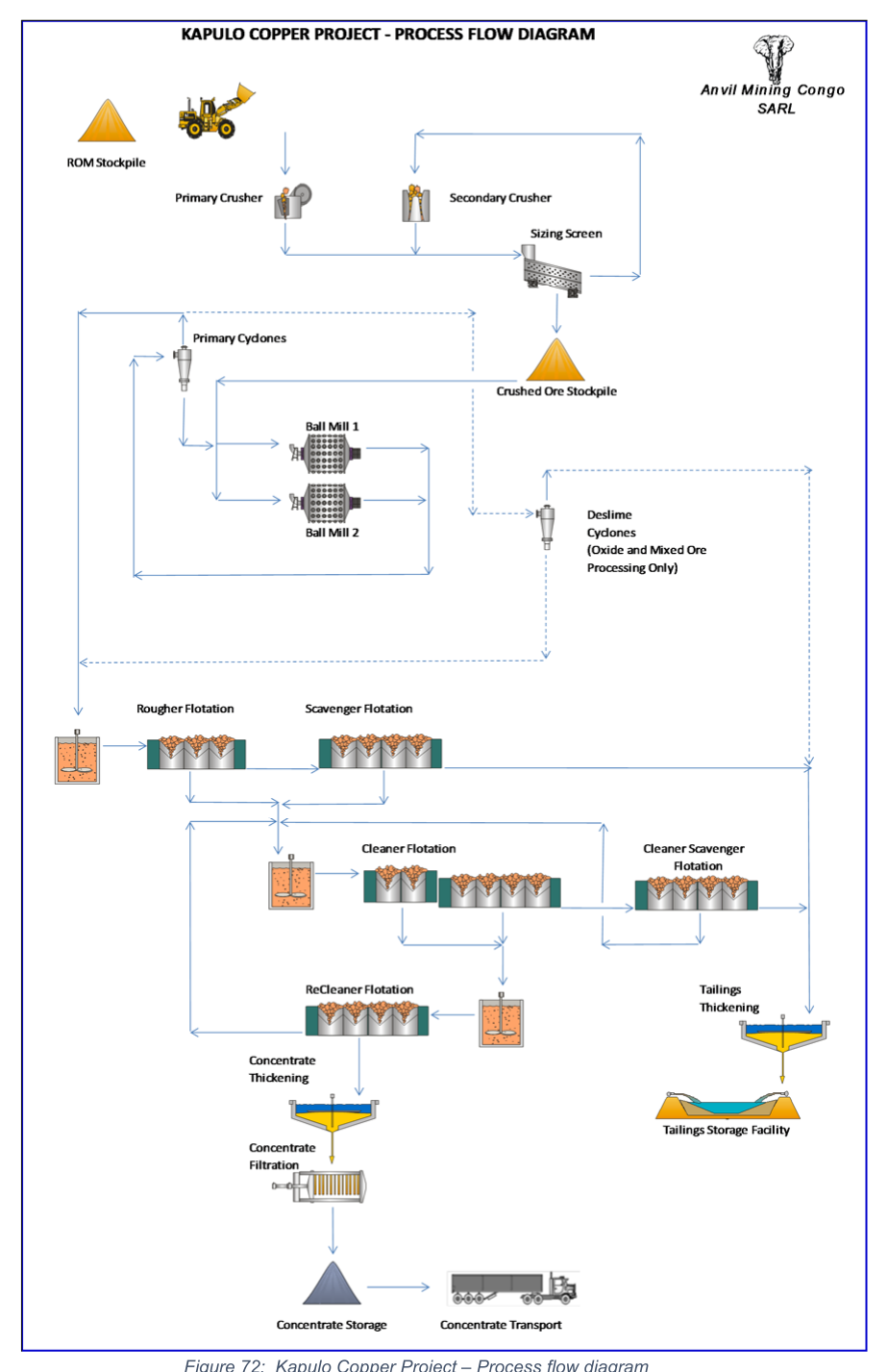
The November 2014 feasibility study update for Mawson West's Kapulo project describes a two-stage crushing and ball mill plant for 0.5 Mtpa of oxide or 0.6 Mtpa of sulphide ore, with sulphidisation flotation for oxides and bulka-bag concentrate.
Kapulo is a copper project in the Democratic Republic of the Congo. Mawson West Limited, through Anvil Mining Congo SA (AMC), is developing the project to make saleable copper concentrates, and prepared the National Instrument 43-101 Technical Report, a Feasibility Study Update, with an effective date of 30 November 2014. An extensive metallurgical test work program defined the ore processing flowsheet. AMC also owns and operates the Dikulushi mine, about 150 km south of Kapulo, and experience processing similar ores at similar rates there shaped the main unit processes chosen for Kapulo, especially the crushing, grinding and concentrate dewatering configurations, which are very similar at the two projects. The unit processes are conventional and used extensively in copper concentrate facilities worldwide.
Critical Data
| Parameter | Value | Unit | Notes |
|---|---|---|---|
| Annual throughput | 500,000 / 600,000 | t/a | Oxide / sulphide, campaign basis |
| Ore grade | 5.5 / 4.4 | % Cu | Oxide / sulphide |
| Main copper mineral | Malachite / chalcopyrite | Not applicable | Oxide / sulphide |
| Crushing rate | 117 / 152 | t/h | 75% utilisation |
| Crusher product P80 | 14 / 12 | mm | Two-stage crushing |
| Grinding throughput | 62.5 / 75 | dry t/h | 91.3% to 93.1% availability |
| Grind size | 110 / 75 | µm P80 | Oxide / sulphide |
| Bond ball mill work index | 16.9 / 17.4 | kWh/t | Oxide / sulphide |
| Copper concentrate grade | 44 / 32 | % w/w | Oxide / sulphide |
| Copper recovery | 75 / 88 | % | Design |
| Concentrate mass recovery | 10 / 12 | % w/w | Design |
| Flotation method | Sulphidisation / conventional | Not applicable | Oxide / sulphide |
| Desliming cut | 5 to 10 | µm | Oxide: 11% mass and 15% Cu to slimes |
| Filter cake moisture | 17 / 9 | % w/w | Oxide / sulphide |
| Transport package | 1.8 | t wet | Bulka-bag |
Overview
The Kapulo flowsheet consists of crushing and screening, an open crushed ore stockpile to disconnect the crushing circuit from downstream processing, ball milling in closed circuit with hydrocyclones, desliming, mineral flotation, concentrate dewatering, tailings dewatering and reagent preparation. Desliming of the ball mill product has been shown by test work to improve flotation performance for oxide and predominantly oxidised transitional ore types. The process plant is designed for campaign processing of either 0.5 Mtpa of oxide ore or initially 0.6 Mtpa of sulphide ore, with design grades taken from the ore tested.
Key Process Stages
Crushing
A 90 t live ROM bin with a 1.2 m apron feeder feeds a vibrating grizzly that removes fines ahead of a Metso C125 jaw crusher with manual open side setting adjustment and tramp release. An inclined double deck screen has 40 mm and 22 mm decks, and a crusher feed bin and vibrating pan feeder supply a Metso HP300 cone crusher as the second stage. The circuit runs 16 hours a day on oxide and 14 hours a day on sulphide ore, with a 75% utilisation, and produces a top size of 25 mm. Dust extraction is included.
Milling and desliming
Three vibrating pan feeders reclaim crushed ore from the stockpile, and a trouser-leg chute splits feed to two parallel 1,000 kW overflow ball mills of 3.4 m diameter and 5.5 m equivalent grinding length, rubber lined, with a single cluster of five Krebs gMAX 200 mm hydrocyclones. A 1.2 m by 2.4 m vibrating trash screen with 2 mm urethane panels removes plastic, detonator cord and wood fibres supplied with the ore. For oxide ore, small-diameter hydrocyclones cut the mill product at 5 to 10 µm, sending 11% of mass and 15% of the copper to slimes.
Flotation
Oxide ore is floated by sulphidisation and sulphide ore by conventional flotation, both at 33.5% solids with a scale-up factor of 2 and a design gas hold-up of 15%. Rougher and scavenger flotation time averages 36 minutes for oxide and 28 for sulphide ore. Cleaner 1 is 18 and 16 minutes, the cleaner scavenger 18 and 8 minutes, and the recleaner 14 and 16 minutes. The equipment is seven 20 m3 Metso tank cells, three roughers and four scavengers, six 5 m3 cleaner cells and four 5 m3 cleaner scavenger cells, and four 3 m3 recleaner cells, with an Amdel MSA 4 stream analyser measuring copper, iron and slurry density.
Dewatering, tailings and reagents
Concentrate goes to a 10 m ROYMEC high-rate thickener and a TH Minerals hydraulic filter press with 20 recessed plates and 115 m2 of filtration area, using feed pumping pressure and air blowing, since membrane squeezing was not found effective in testing. Concentrate is thickened at 0.15 m2 per t/h for oxide and 0.25 for sulphide, to 50% solids, then filtered at a cake flux of 100 kg per m2 per hour for oxide and 300 for sulphide, giving 17% and 9% moisture. It is packed in 1.8 t bulka-bags. Tailings go to a second 10 m ROYMEC high-rate thickener, designed at 1.0 m2 per t/h to 45% solids for oxide and 50% for sulphide before pumping to the tailings storage facility (TSF). Reagents are stored, mixed and distributed throughout the plant. Services include raw water from the Lwau River weir, process water, tailings return water and fire and potable water, plus high pressure and low pressure air.
Additional Interesting Data and Summary
The processing facility design is based on new equipment and includes a power station, office block, laboratory, workshops, change room and control rooms. The design philosophy is a cost effective, reliable and maintainable processing solution with a moderate level of instrumentation and automation.
The design Bond crusher work index is 15 kWh/t for both ore types, the Bond abrasion index is 0.3 g for oxide and 0.5 g for sulphide, and the dry solids density is 2.7 and 2.8 t/m3.
Key Processes
- Jaw and cone crushing with grizzly and sizing screens
- Parallel ball milling with hydrocyclones and trash screening
- Cyclone desliming of oxide ore
- Sulphidisation flotation of oxide copper and conventional flotation of sulphide copper
- Concentrate thickening, filtration and bulka-bag packing
- Tailings thickening and pumping to a TSF
Source: National Instrument 43-101 Technical Report, Kapulo Copper Project, DRC, Feasibility Study Update, November 30, 2014.
