

—
Standfirst
The Kay Mine Project in Arizona proposes a process plant treating 0.7 Mtpy of volcanogenic massive sulphide material through flotation and an Albion Process circuit to produce copper-lead concentrate, zinc concentrate, and gold Doré.
—
Article Body
The Kay Mine Project is a preliminary economic assessment-stage project located in Arizona, USA, being advanced by Arizona Metals Corp. The operation would treat copper-zinc-lead volcanogenic massive sulphide material to produce copper-lead concentrate, zinc concentrate, and gold recovered from pyrite concentrate. The proposed process plant has a nominal throughput of 0.7 Mtpy of fresh rock. The technical report, effective April 30, 2026, does not state an expected construction timeline.
Critical Data
| Parameter | Value | Unit | Notes |
|---|---|---|---|
| Nominal annual throughput | 700,000 | t/y | Process design criterion |
| Nominal daily throughput | 1,920 | t/d | Process design criterion |
| Crusher plant availability | 70 | % | Design value |
| Process plant availability | 91 | % | Design value |
| Design copper head grade | 2.05 | % | Design value |
| Design zinc head grade | 5.25 | % | Design value |
| Design lead grade | 0.48 | % | Design value |
| Design gold grade | 2.51 | g/t | Design value |
| Design silver grade | 52.92 | g/t | Design value |
| Copper recovery | 88.30 | % | Design value |
| Design Cu concentrate grade | 32.52 | % | Design value |
| Zinc recovery | 75.90 | % | Design value |
| Design zinc grade | 64.57 | % | Design value |
| Pyrite concentrate gold recovery | 62.00 | % | Design value |
| Pyrite concentrate silver recovery | 20.30 | % | Design value |
| Gold overall recovery, including Albion | 80.0 | % | Design value |
| Primary grind size, P80 | 60 | µm | Design value |
| Primary ball mill dimensions | Ø 3.9 x 5.2 | m | Effective grinding length |
| Primary ball mill motor | 1,350 | kW | Fixed speed motor |
| Hydrocyclone circulating load | 350 | % | Design value |
| CIL residence time | 48 | h | Design value |
| Cyanide detoxification retention time | 2 | h | Design value |
| Cyanide detoxification pH | 8.5 | pH | Lime slurry addition maintains pH |
| WAD cyanide in solution after detoxification | 10.5 | mg/L | Process target |
| Crushed rock stockpile live capacity | 1,050 | t | Equivalent to 12 h of mill feed |
| Albion regrind product size, P80 | 10 to 12 | µm | Design value |
| Albion regrind mill installed power | 1,719 | kW | IsaMill M7500 |
| Albion concentrate storage tank | 799 | m³ | Agitator with 64 kW motor |
| Albion leach reactors | 9 | unit | OxiLeach OLR1700, 316 kW each |
| Oxygen plant capacity | 329 | t/d | Design value |
| CIL thickener diameter | 22 | m | Underflow at 45% solids |
| CIL tanks | 6 | unit | 870 m³ each |
| ADR plant capacity | 2 | t | Two-tonne ADR plant |
| Strip columns | 2 | unit | 10 t carbon capacity each |
| Carbon regeneration kiln | 10 | t/d | 100% carbon regeneration |
| Cyanide detox tank | 135 | m³ | Mechanically agitated |
| Tailings thickener diameter | 22 | m | Conventional |
| Tailings filter press dimensions | 3,050 x 2,640 | mm | 81 plates, GHT2500F18 |
| Process plant personnel | 72 | personnel | Annual requirement |
| Crusher work index | 10.7 | kWh/t | Design value |
| Bond ball mill work index, 85th percentile | 12.2 | kWh/t | Design value |
| ROM maximum size | 500 | mm | Design value |
| Crusher circuit product size, P80 | 10.7 | mm | Design value |
| SMC A x b | 53.3 | Not applicable | Test result |
| Copper-lead rougher flotation | 5 x OK16 | unit | 16 m³ cells |
| Copper-lead regrind mill | HIG 500 | unit | Not applicable |
| Copper regrind circuit product size, P80 | 15 | µm | Design value |
| Copper 1st cleaner flotation | 5 x OK3 | unit | 3 m³ cells |
| Copper 2nd cleaner flotation | 2 x OK3 | unit | 3 m³ cells |
| Zinc rougher flotation | 8 x OK3 | unit | 3 m³ cells |
| Zinc regrind mill | HIG 500 | unit | Not applicable |
| Zinc regrind circuit product size, P80 | 15 | µm | Design value |
| Zinc 1st cleaner flotation | 3 x OK3 | unit | 3 m³ cells |
| Zinc 2nd cleaner flotation | 3 x OK3 | unit | 3 m³ cells |
| Zinc 3rd cleaner flotation | 2 x OK3 | unit | 3 m³ cells |
| Pyrite rougher flotation | 4 x OK16 | unit | 16 m³ cells |
| Cu-Pb concentrate thickener | 9.7 m dia. | m | Conventional thickener |
| Cu-Pb filter feed tank holding capacity | 1 | h | Design value |
| Cu-Pb concentrate filter press | PF 16/19 M12 1 45 | unit | 6 t/h |
| Zn concentrate thickener | 9.7 m dia. | m | Conventional thickener |
| Zn filter feed tank holding capacity | 1 | h | Design value |
| Zn concentrate filter press | PF 16/19 M12 1 45 | unit | 6 t/h |
| Gland seal water particulate filter | 25 | micron | Feed to gland water tank |
Overview
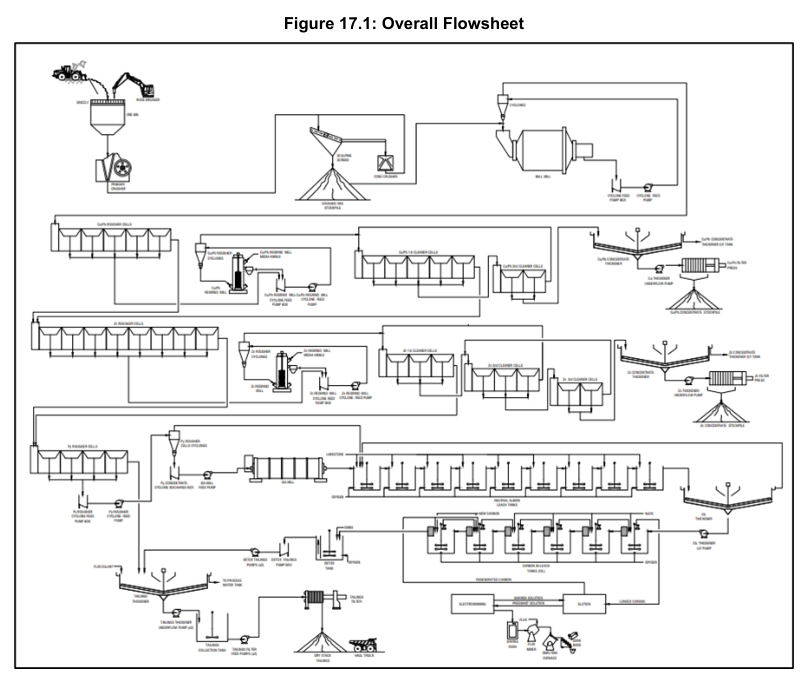
The proposed process plant for the Kay Mine Project follows a conventional metallurgical flowsheet for volcanogenic massive sulphide material. Run of mine ore from the open pit will be delivered by rear dump trucks to a primary crusher dump pocket. Two-stage crushing will reduce material before it enters a coarse material stockpile. From the stockpile, ore is reclaimed and ground in a ball mill with hydrocyclones to a P80 of 60 µm. The ground product flows by gravity to a copper-lead flotation circuit, with the copper-lead rougher and 1st cleaner tailings feeding a zinc flotation circuit. A pyrite flotation circuit recovers pyrite concentrate from the zinc tailings.
The pyrite concentrate containing refractory gold will be treated in an Albion Process plant. This involves regrinding in an IsaMill to a P80 of 10 to 12 µm, followed by oxidative leaching in OxiLeach reactors. The leached slurry is thickened and fed to a carbon-in-leach circuit where gold is leached with sodium cyanide and adsorbed onto activated carbon. Loaded carbon is processed through an ADR circuit for elution and electrowinning, producing gold Doré bars. CIL tailings pass through cyanide destruction before filtration. Pyrite flotation tailings also report to the tailings thickener and filter press, with dry stack tailings trucked to a dedicated Tailings Storage Facility.
The flowsheet is based on metallurgical test work, industry standards, and conventional unit operations. The processing facility will employ a moderate level of automation with remote-control functions to allow critical process operations with minimal operator intervention.
Key Process Stages
The crushing circuit consists of a jaw crusher, double deck inclined scalping screen operating in closed circuit with a cone crusher, and a single dust collection system with a baghouse. A rock breaker assists in breaking oversize material retained on a stationary grizzly. A belt magnet on the sacrificial conveyor recovers trash metal before crushed material moves to the primary ball mill feed conveyor, which is fitted with a weightometer.
The crushed rock stockpile has a live capacity of approximately 1,050 tonnes, equivalent to 12 hours of mill feed. Two reclaim apron feeders with variable speed drives control the reclaim rate feeding the grinding circuit. A water spray system at the chute and an integrated dust collection system mitigate airborne particulate matter during material handling.
Grinding is performed in a 3.9 m diameter by 5.2 m effective grinding length ball mill with a 1,350 kW fixed speed motor. Process water maintains a 75% slurry discharge density. A trommel removes grinding media scats and pebbles. A cyclone cluster of nine 250 mm hydrocyclones, with seven operating and two standby, classifies the slurry at a 350% circulating load.
The copper-lead flotation circuit uses five 16 m³ Metso OK16 or similar cells for rougher flotation, a HIG 500 regrind mill, then five 3 m³ Metso OK3 or similar cells for 1st cleaner flotation and two 3 m³ Metso OK3 or similar cells for 2nd cleaner flotation. The 2nd cleaner tailings are pumped back to the 1st cleaner flotation. Final copper-lead concentrate reports to a 9.7 m diameter conventional thickener followed by pressure filtration, then to a concentrate stockpile.
The zinc flotation circuit has eight 3 m³ Metso OK3 or similar cells for rougher flotation, a HIG 500 regrind mill, then three 3 m³ Metso OK3 or similar cells for 1st cleaner flotation, three for 2nd cleaner flotation, and two for 3rd cleaner flotation. Tailings from the 3rd and 2nd cleaners are pumped countercurrently to the 2nd and 1st cleaners. Final zinc concentrate is thickened in a 9.7 m diameter thickener, pressure filtered, and discharged to a zinc concentrate stockpile.
Pyrite rougher flotation consists of four 16 m³ Metso OK16 or similar mechanical cells producing a pyrite concentrate. Rougher tailings are pumped to the tailings thickener before filtration.
The Albion Process plant contains an IsaMill M7500 with 1,719 kW installed power producing a ground product with a P80 of 10 to 12 µm. The ground concentrate is stored in a 799 m³ tank with a 64 kW agitator, then leached in nine OxiLeach OLR1700 reactors, each with a 316 kW motor. Leached slurry is pumped to a cyclone cluster, with underflow stored in a slurry cooling tower to reduce temperature.
Cyanidation of the Albion product begins with a 22 m diameter CIL thickener that increases slurry density. Flocculant promotes settling of solids. Thickener underflow at 45% solids feeds six 870 m³ OxiLeach tanks providing 48 hours total residence time. Sodium cyanide and activated carbon are added for leaching and adsorption, with oxygen sparging. CIL tailings pass through a carbon safety screen to capture residual carbon particles.
Cyanide detoxification uses a 135 m³ mechanically agitated tank with 2 hours retention. The conventional SO₂/O₂ air process is employed. Lime slurry maintains pH at 8.5, and copper sulphate acts as a catalyst. Sodium metabisulphite provides the SO₂ source. The process reduces WAD cyanide in solution to 10.5 mg/L. The circuit treats CIL tailings, process spills, cold cyanide barren solution effluent, acid wash effluent, and area sump pump discharge.
Loaded carbon from the CIL circuit is pumped to a two-tonne ADR circuit and screened to the acid wash column. Hydrochloric acid removes inorganic foulants such as calcium, magnesium, sodium salts, and silica. The strip circuit has two columns that can hold 10 t of carbon each, allowing more than one strip per day. The strip solution contains approximately 2.0% hydroxide and 0.2% sodium cyanide at 150°C and 500 kPa. A heat recovery heat exchanger cools the solution exiting the elution vessel. The elution column can also operate as a cold strip circuit to remove copper from carbon.
Carbon regeneration uses a diesel fired kiln treating 10 t of carbon per day, equivalent to 100% regeneration. Screen undersize carbon fines drain to a carbon fines tank. Fresh carbon is added to the carbon pre-attrition tank to compensate for attrition losses.
Electrowinning cells operate on a single-pass basis producing a gold sludge. Cathodes are manually transferred to a cathode washing tank where a high-pressure washer dislodges the sludge. A filter press filters the sludge, the filter cake is dried in a drying oven, and the dried cake is manually transferred to an electric smelting furnace with flux materials for batch smelting into gold Doré bars, stored in a secure vault.
Tailings from the cyanide destruction circuit and pyrite rougher flotation feed a 22 m diameter tailings thickener. Underflow feeds a tailings collection tank, then a 3,050 x 2,640 mm, 81 plates filter press producing dry stack tailings. Filtered tailings are trucked to the dedicated Tailings Storage Facility.
Additional Interesting Data and Summary
Reagents are prepared on site and distributed through various handling and makeup systems. Reagent preparation and storage facilities are located within containment areas designed to accommodate more than the content of the largest tank. Storage tanks have level indicators, instrumentation, and alarms. Sumps and sump pumps are provided for spillage control.
Sodium cyanide serves as a zinc depressant in the grinding mill and as a gold lixiviant in the cyanidation circuit. It ships in briquette form by road in 18-t ISO containers and is stored in a separate mixing facility. Quicklime is used as a pH modifier in flotation and the CIL circuit. Zinc sulphate acts as a zinc depressant in the grinding circuit and as a catalyst for cyanide destruction. Copper sulphate activates the zinc flotation circuit and supports cyanide destruction. Sodium humate is used for arsenic depression in the zinc regrind circuit. Aero 5100 dithiophosphate serves as a sulphide collector, and methyl isobutyl carbinol as a frother. Sodium hydroxide is used in the Albion oxidative leach process, elution, and cyanide mixing. Hydrochloric acid removes carbonates in the acid wash process. Activated carbon is delivered in bulk bags and added to the carbon attrition tank as make-up. Sodium metabisulphite provides SO₂ for cyanide destruction. Flocculant settles solids in the thickeners.
Plant services include three air compressors providing plant and instrument air. An oxygen generation plant with pressure swing adsorption produces industrial grade oxygen for the Albion, CIL, and cyanide destruction circuits. Treated water from a catchment pond supplies dust suppression, reagent preparation, gland seal water, cooling water systems, and make-up for the process water system. Raw water buffer tank feeds the truck shop, fuel bay, sewage treatment plant, fire water tank, and emergency domestic water tank. Process water comprises thickener overflows and filtrate from concentrate and tailings filtration. Potable water is produced in a vendor-supplied plant for safety showers and washrooms. Gland seal water passes through 25-micron particulate filters.
Metallurgical samplers generate shift composite samples from the secondary grind cyclone overflow, final copper-lead concentrate, final zinc concentrate, rougher pyrite concentrate, rougher pyrite tailings, and cyanidation tailings. Process control samplers monitor fifteen additional streams including rougher concentrates and tailings, regrind cyclone overflows, cleaner tailings, leach feed and tailings, final tailings, and pregnant and barren solutions. Weightometers measure crushed material and mill feed tonnage. A manual belt cut sampling point allows collection of a mill feed head grade sample. Regular surveys of gold and silver in circuit allow reconciliation of precious metals.
Reagent consumption values are presented for flotation reagents, Albion Process reagents, and leaching, acid wash, and elution reagents. Consumables consumption covers crusher jaws, mill liners, grinding media, and screen panels. The process plant will employ 72 personnel across management, technical support, laboratory, process operations, and maintenance departments. Operating staff will work 8-hour shifts on a rotation cycle. The power demand for the process plant will be discussed in Section 18.6 of the technical report.
Key Processes
- Two-stage crushing with jaw crusher, cone crusher, and scalping screen
- Coarse ore stockpiling and reclaim
- Ball mill grinding with hydrocyclones to P80 60 µm
- Copper-lead rougher, regrind, and cleaner flotation
- Zinc rougher, regrind, and cleaner flotation
- Pyrite rougher flotation
- Albion Process oxidative leaching
- Carbon-in-leach cyanidation
- Cyanide detoxification with SO₂/O₂ process
- Acid wash and elution
- Carbon regeneration
- Electrowinning and smelting to Doré
- Concentrate thickening and pressure filtration
- Tailings thickening and filtration for dry stack tailings
Source: Preliminary Economic Assessment NI 43-101 Technical Report – Kay Mine Project, Arizona, USA, April 30, 2026. Project website: Kay Mine Project
