

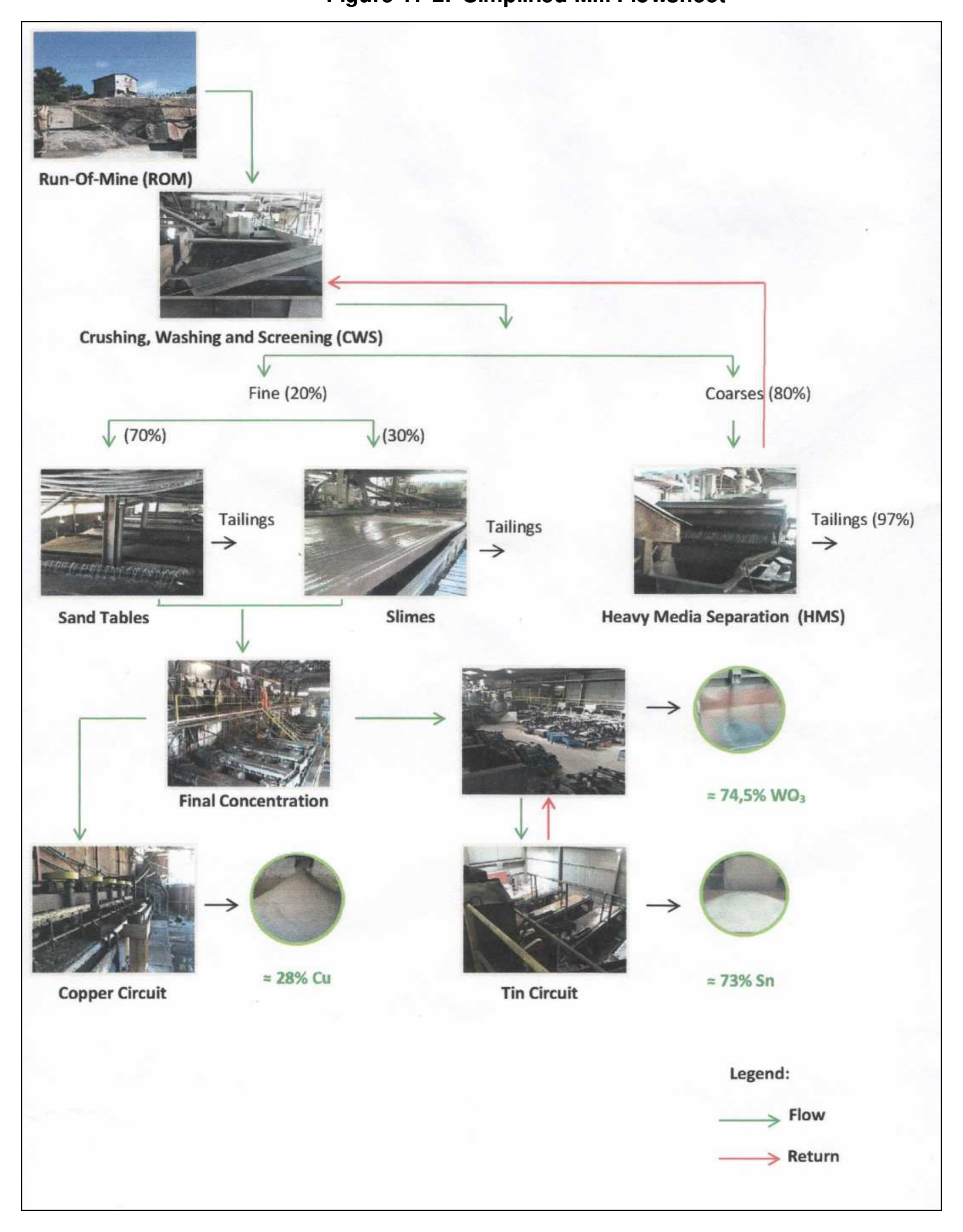
Almonty's December 2016 technical report on the Panasqueira tungsten mine in Portugal describes a plant that makes concentrates averaging over 75% WO3 at 80.3% recovery, with a copper circuit and a tin circuit using the sulphides and cassiterite separated along the way.
The Panasqueira Mine lies in central Portugal, in the Distrito de Castelo Branco, on the southern edge of the Serra da Estrela, in the Covilhã area. Almonty Industries owns 100% of Beralt Ventures Inc., which holds the mine through Beralt Tin & Wolfram (Portugal) S.A. The NI 43-101 Technical Report on the Mineral Resources and Reserves of the Panasqueira Mine, Portugal, was written by Adam Wheeler and is dated 31st December 2016. Panasqueira produces very high grade concentrates, which are almost pure wolframite, helped by the coarse crystalline character of the ore. Wolframite, cassiterite and chalcopyrite are the economic minerals to be recovered as concentrates. Pyrite, arsenopyrite and siderite are the heavy minerals removed from concentrates.
Critical Data
| Parameter | Value | Unit | Notes |
|---|---|---|---|
| Crushing plant feed | About 160 | t/h | ROM below 100 mm |
| Vein material in ROM | About 11 | % | Remainder is waste rock |
| Underground conveyor | 1,203 | m | Santa Barbara belt to four bins |
| Heavy media density | 2.7 | SG | Ferrosilicon medium |
| HMS rejection | About 80 | % of feed | Holds about 10% of WO3 |
| Plant recovery, 2016 | 80.3 | % | Bulk of losses in coarse tails |
| High grade concentrate | Over 75 | % WO3 | Over 89% of recovered mtus |
| Fine concentrate | Above 74 | % WO3 | Not applicable |
| Copper circuit feed | About 5,000 | t/y | Small ball mill, 7 flotation cells |
| Copper concentrate, 2016 | About 380 | t | About 27% Cu, 77% recovery |
| Tin concentrate | About 70 | t/y | About 74% Sn |
| Copper circuit grind | 60% minus 200 | mesh | Lime to pH 11.5 |
Overview
Wolframite breaks easily and goes preferentially into the fines, so only two stages of crushing are needed to liberate it. The plant crushes ore, rejects most of the barren rock in a heavy media separation (HMS) circuit, concentrates the remainder on shaking tables, and removes sulphides on James tables. Sulphide table tailings feed a copper circuit. Table concentrate is dried, sized and split with dry high-intensity magnetic separators into wolframite, cassiterite and siderite.
Key Process Stages
Crushing and screening
An underground jaw crusher delivers ROM ore below 100 mm to four storage bins along the 1,203 m Santa Barbara conveyor belt. Vibrating feeders feed the crushing plant at about 160 t/h. Primary screens send plus 25 mm material to one of two short head cone crushers in closed circuit. All screening uses copious spray water, and secondary screens remove minus 0.8 mm material from the minus 25 mm HMS feed. Because wolframite is brittle and goes into the fines, the report stresses cleaning the stoped area of all possible fines after mining.
Heavy media separation
The HMS process uses a hydrocyclone with a dense slurry medium kept at an SG of 2.7 using very fine magnetic ferrosilicon. It removes about 80% of the ore, which holds no tungsten. The plus 0.5 minus 25 mm HMS tailings are washed and screened from the cyclone overflow by sieve bends and shaking screens, and they represent about 80% of feed by weight but only about 10% of the WO3. One roll crusher is dedicated to plus 3 minus 5 mm HMS concentrate, which recirculates to HMS.
Gravity tables and sulphide removal
Minus 3 mm material is treated in a hydraulic classifier before gravity shaking tables. The tables eliminate quartz and silicates and leave a pre-concentrate of wolframite, sulphides, cassiterite and siderite. In the slimes section, tables recover the finest particles, since almost all wolframite in the slimes tailings is finer than 150 µm. The pre-concentrate is conditioned with sulphuric acid, Nafta and Gasoil before passing over James tables, where sulphides float to the tailings, even 2 mm grains.
Copper circuit
Sulphide table tailings are ground in a ball mill to 60% minus 200 mesh, with lime to raise pH to 11.5, and the copper is recovered by differential flotation in Denver type cells. Concentrates above 28% Cu are possible while holding arsenic below 2%. Arsenopyrite goes to the tailings, which carry up to 30% arsenic. The circuit runs only when there is enough material to feed it for a long period, and it usually starts late at night when lower power rates make ball mill start-up more efficient. The report suggests that segregating the arsenopyrite tailings could cut arsenic discharge to the larger tailings pond.
Magnetic separation and tin
Sulphide-free table concentrates are dried and screened into plus 20, minus 20 plus 60 and minus 60 mesh lots. Each size is treated separately by dry high-intensity cross-belt magnetic separators to produce high grade wolframite concentrate, non-magnetic cassiterite and magnetic siderite with a little ferrosilicon. In the tin circuit, siderite is discarded, and cassiterite goes to tables to remove finer gangue and to a mechanical flotation cell to remove remaining fine sulphides.
Additional Interesting Data and Summary
Wolframite concentrates are packed in one tonne bags and trucked in containers to the port at Lisbon for shipment. Thickener overflow water is retreated in the mill, and a water treatment unit sits downhill at Salgueira. The report describes how ore characteristics suit HMS well: coarse crystals, macroscopic sulphides inside quartz gangue, quartz in vugs and muscovite halos about 2 cm above and below the veins.
The copper circuit produced about 380 t of concentrate in the year to December 2016 at roughly 27% copper, with average arsenic grade around 20% in its tailings. The tin circuit makes about 70 t of concentrate a year at around 74% tin.
Key Processes
- Underground jaw crushing and conveyor transport
- Cone crushing in closed circuit with screens
- Ferrosilicon heavy media separation
- Gravity shaking tables and James tables
- Differential sulphide flotation for copper
- Dry high-intensity magnetic separation
- Tin recovery by tabling and flotation
Source: Technical Report on the Mineral Resources and Reserves of the Panasqueira Mine, Portugal, December 31, 2016.
