

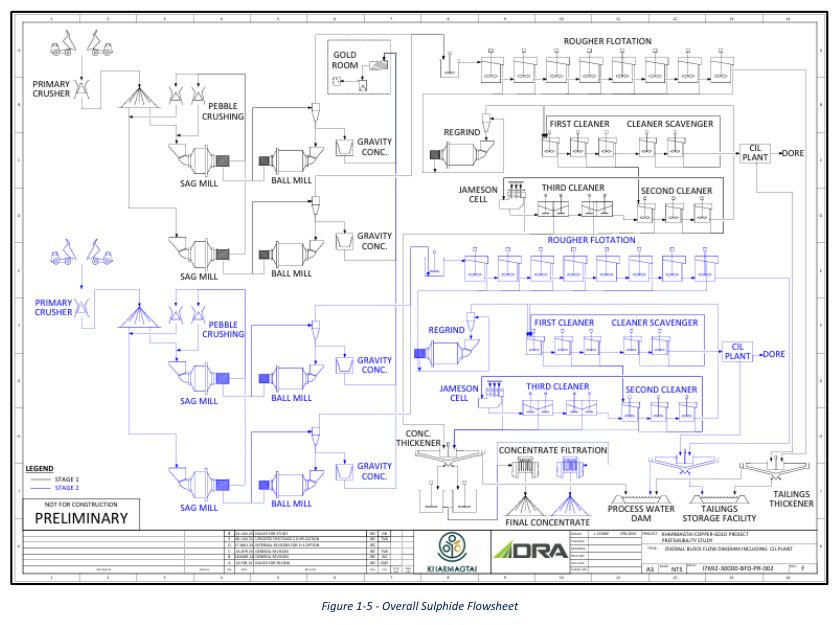
The Kharmagtai Project scoping study assessed a conventional SABC comminution circuit with gravity gold recovery and flotation to produce doré and a copper-gold concentrate.
Report context
The Kharmagtai Project Scoping Study, dated 6 April 2022, reported on ore processing options for the Kharmagtai Project located in Omnogovi Province, Mongolia. The study evaluated processing of sulphide mineralisation based on metallurgical testwork undertaken between 2008 and 2019, reviewed by Tilyard Mining Services in 2019 and East Riding Mining Services in 2022. Two plant throughput options were assessed: a single line 15 Mtpa plant and a dual line 30 Mtpa plant. The oxide mineralisation was treated as waste.
Processing route
Design philosophy
The ore processing option comprised a conventional SABC mill comminution circuit followed by gravity gold recovery and flotation to produce doré and a copper-gold concentrate. The design was based on a standard copper/gold porphyry flowsheet using industry standard, well-proven technology.
Throughput rates
The Kharmagtai primary ore was described as hard, with Bond Work Indices as high as 26 kWh/t. Limited comminution data suggested an average of around 18 kWh/t. The Cadia Hill mine in central west NSW, Australia, was considered a reasonable reference case. Cadia Hill ore had a Bond Work Index of 17 kWh/t and achieved 17 Mtpa at 180 µm through a single-train SABC circuit with a 20 MW, 40' SAG mill. Because limited data suggested Kharmagtai primary ore is harder than Cadia Hill ore, Xanadu set the maximum throughput rate through a single train SABC circuit at 15 Mtpa.
Comminution circuit
Primary crushing would use a 60 x 110 gyratory crusher with a 750 kW motor capable of receiving direct tipped feed, discharging onto a crushed ore stockpile with 20 hours live capacity. Both the primary crusher and stockpile would be covered for weather protection.
The grinding circuit would comprise a 40' x 20' SAG mill with a 20 MW motor, two MP1000 recycle crushers, and one 27' x 46' 20 MW ball mill operating in closed circuit. The design note stated that Ausenco specified two ball mills, which the study replaced with a single larger ball mill to simplify design. The grinding circuit would be housed in an insulated, heated shed.
Flotation circuit
The flotation circuit would contain two stages of flash flotation. Coarse gold would be recovered from the flash flotation concentrate and smelted to produce gold doré. The remainder of the flash float concentrate would report to the final concentrate. The circuit would consist of roughers and rougher scavengers, regrind mills, cleaners and cleaner scavengers. The flotation circuit would be housed in an insulated, heated shed.
Recovery assumptions
In 2019 CSA nominated an ore processing plant comprising generic crushing, SABC comminution, rougher flotation, cleaner flotation with final thickening and filtration circuits to produce a copper-gold concentrate. Copper and gold recoveries and concentrate grades from 2008 testwork are shown in the table below.
Xanadu undertook additional metallurgical testwork in 2019 on nine variability composites selected based on alteration type (potassic, sericite, albite-chlorite and tourmaline breccia) from individual deposits and two master composites from three deposits (Stockwork Hill, White Hill and Copper Hill). Tilyard (2019) recommended recoveries by alteration type based on a 25% Cu concentrate.
The latest geological interpretation cast doubt on the validity of the representivity and classification of the 2019 metallurgical samples, so varying recoveries by lithology with the current data set was not considered valid. Without a clear relationship between grade and recovery or a valid lithology/recovery relationship, all results were given equal weighting and average recoveries were used.
The locked cycle testwork was considered the most reliable predictor of performance as these tests used optimum flotation conditions and recycled some cleaner product streams. Based on testwork and the 2019 CSA process, recoveries of 89.5% Cu and 70% Au at a 25% copper concentrate were considered reasonable for the scoping study.
Additional testwork demonstrated that a portion of the gold at Kharmagtai is gravity recoverable. A rule-of-thumb estimate from Australian porphyry operations indicated a gravity circuit can add 5% to gold recovery. Testwork that extended rougher flotation time by 30% gave an additional 2.5% gold recovery. The addition of a scavenging circuit after the roughers should achieve this additional recovery as well as a slight improvement in copper recovery of 0.5%.
The copper and gold recoveries used for this study were 90% for Cu and 77.5% for Au.
Concentrate handling and tailings
Flotation concentrate would be thickened, filtered and placed into containers, then trucked to a nearby rail-siding and transported to smelters by rail.
CSA 2019 designed a tailings storage facility (TSF) 4.6 km southwest of the plant site. The unlined TSF design comprised a series of saddle dams between hills constructed in two lifts with a capacity of 190 Mm³, sufficient for approximately 305 Mt of tailings or about 10 years of proposed operation. This study accounted for additional tailings storage with a pro rata tonnage cost and added a $25 M allowance to the TSF initial capital cost for a redesigned lined TSF if required. The final tailing storage solution for life of mine would be addressed in the PFS.
Key reported parameters
| Parameter | Value | Basis |
|---|---|---|
| Plant throughput (single line) | 15 Mtpa | Proposed design by Xanadu |
| Plant throughput (dual line) | 30 Mtpa | Proposed design |
| SAG mill | 40' x 20', 20 MW | Proposed design |
| Ball mill | 27' x 46', 20 MW | Proposed design (single mill replacing two specified by Ausenco) |
| Primary crusher | 60 x 110 gyratory, 750 kW | Proposed design |
| Bond Work Index (maximum) | 26 kWh/t | Testwork |
| Bond Work Index (average) | ~18 kWh/t | Limited testwork data |
| Copper recovery (study used) | 90% | Derived from testwork averages and adjustments |
| Gold recovery (study used) | 77.5% | Derived from testwork averages, gravity circuit addition, and extended flotation time |
| Copper recovery (locked cycle tests average) | 89.5% | Testwork (3 samples) |
| Gold recovery (locked cycle tests average) | 69.75% | Testwork (3 samples) |
| Copper recovery (arithmetical average all tests) | 84.6% | Testwork (21 samples) |
| Gold recovery (arithmetical average all tests) | 65.4% | Testwork (21 samples) |
| Concentrate grade | 20-25% Cu | Design target from testwork |
| TSF capacity (initial) | 190 Mm³ / ~305 Mt | CSA 2019 design |
| TSF life (initial) | ~10 years | Estimated |
Technical qualifications
The report noted that comminution data was limited. The latest geological interpretation cast doubt on the validity of the representivity and classification of the 2019 metallurgical samples tested. Without a clear relationship between grade and recovery or a valid lithology/recovery relationship, all results were given equal weighting and average recoveries were used. The flowsheet used in the testwork mirrors the Oyu Tolgoi flowsheet. The study treated the oxide mineralisation as waste.
Source: Xanadu Mines Limited, Kharmagtai Project Scoping Study, 6 April 2022. Section 17 Recovery methods.
