

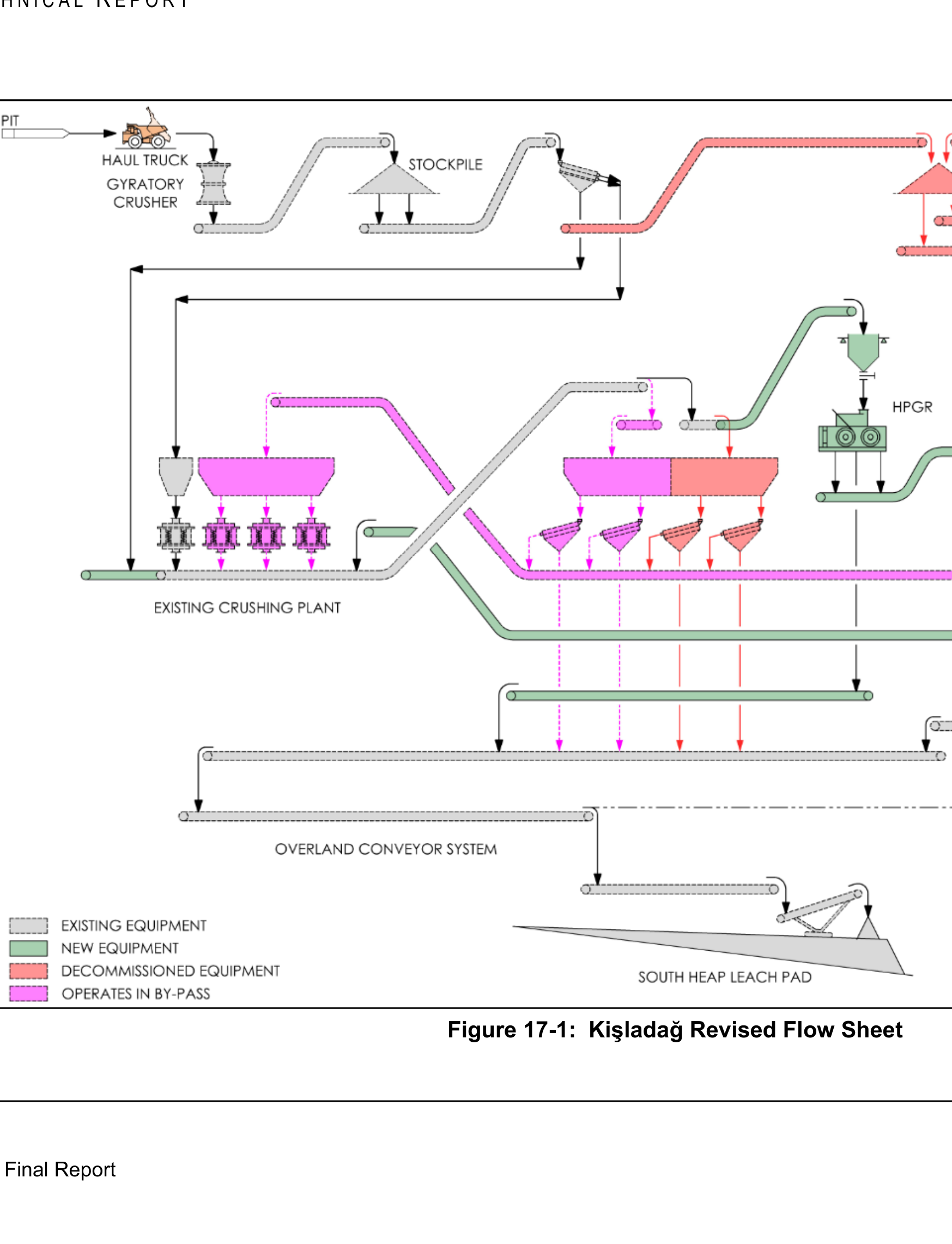
Eldorado Gold's 2020 technical report on Kışladağ near Uşak replaces the tertiary crushers with a high pressure grinding roll circuit and adds concentrated cyanide to the ore before stacking, aiming at better recovery from deeper sulphide ore.
Kışladağ is an operating open pit gold mine and heap leach in west-central Türkiye, 35 km southwest of Uşak near the village of Gümüşkol, at about 1,000 m on the western edge of the Anatolian Plateau. Eldorado Gold Corporation owns and runs it through its wholly owned subsidiary Tüprag. Commercial production began in 2006. The technical report, effective January 17, 2020, supports a material change in processing. After test work on extended leaching, the mine had returned to heap leaching in place of a milling project studied in 2018. The plan installs a high pressure grinding roll (HPGR) circuit in place of tertiary crushing and adds a cyanide cure step, keeping throughput at 12.6 Mt a year and producing about 160,000 oz of gold a year.
Critical Data
| Parameter | Value | Unit | Notes |
|---|---|---|---|
| Commercial production | 2006 | Not applicable | Open pit and heap leach |
| Annual ore throughput | 12.6 | Mtpa | Modified plant |
| Gold production | About 160,000 | oz/a | Design, as doré |
| Plant operating time | 80 | % | 7,008 hours per year |
| Average head grade | 0.72 | g/t Au | Design basis |
| Life of mine gold recovery | 56 | % | Design basis |
| Crushed product size | 6.5 | mm P80 | Current three-stage circuit, minimum |
| Primary gyratory crusher | 1,270 mm x 1,651 mm | Not applicable | Up to 2,000 t/h |
| Coarse ore stockpile | 20,000 | t | Surge ahead of secondary |
| HPGR recirculating load | Up to 100 | % | Edge product returned |
| Lift height | 10 | m | 80 m sweep per cell |
| Irrigation rate | 5.0 to 6.5 | L/h/m2 | Drip emitters |
| South pad capacity | 234 | Mt | In service until about 2029 |
| North pad capacity | 90 | Mt | Planned |
| ADR carbon columns | 5 trains of 5 | Not applicable | Zadra stripping |
Overview
Kışladağ started at 5 Mtpa, mostly on oxide ore, then expanded to 10 Mtpa and later 12.5 Mtpa. As the pit deepened, sulphide ore became dominant, and oxide feed has been negligible since 2016. The deeper sulphide ore leached less well, so Eldorado ran test work in 2018 and 2019 on alternative crushing and on cyanide curing. Leach tests on HPGR-crushed ore showed a modest gain in gold recovery. An internal scoping study from November 2019 then assessed adding an HPGR to the crushing circuit.
In the revised flowsheet, a gyratory crusher and an open circuit secondary cone crusher feed the HPGR. The HPGR centre-cut product goes by overland conveyor to the pad, and the edge product returns for a second pass. Concentrated cyanide solution is added to the crushed ore before stacking. Agglomeration remains under study to improve percolation. The ore is stacked in 10 m lifts and irrigated with dilute cyanide, and gold is recovered from the pregnant solution in carbon columns, Zadra stripping, electrowinning and smelting.
Key Process Stages
Primary crushing
Haul trucks tip run-of-mine ore straight into a 1,270 mm by 1,651 mm gyratory crusher rated at up to 2,000 t/h. The dump pocket holds 300 t, sized for Caterpillar 136 t trucks after the mine moved to owner operation in 2008. A conveyor carries the product to a 20,000 t coarse ore stockpile, which provides surge capacity for the secondary circuit.
Secondary screening and crushing
Two apron feeders reclaim the stockpile onto a conveyor feeding a 2.4 m by 6.4 m double deck screen. Undersize below 65 mm goes to the HPGR. Oversize goes to a 200 t bin, and an apron feeder takes it to an MP1000 cone crusher in open circuit. The bottom deck aperture will be set so that the secondary product suits the HPGR's maximum feed size.
HPGR
Screen undersize and secondary crusher product feed the HPGR on an existing conveyor. The centre-cut product goes to the overland conveyor, and new conveyors return the edge product for another pass, with up to 100% recirculating load. The HPGR fits inside the existing crushing area and reuses most of the conveyors. The report says it greatly simplifies materials handling compared with the tertiary crushing and screening plant it replaces.
Stacking
Overland conveyors carry the ore to the pad, with a bypass to a 20,000 t stockpile during conveyor maintenance. A mobile tripper on the last overland conveyor feeds portable ramp conveyors up the pad slope. On top, grasshoppers, a feed conveyor and a horizontal conveyor feed a radial stacker that places 10 m lifts across an 80 m wide cell. Concentrated cyanide solution goes onto the ore before stacking. Since 2018 the operation has laid HDPE interlift liners, which shorten the solution flow path, reduce dilution of pregnant solution and cut the inventory of dissolved gold in the heap.
Leaching and water management
Pumps and drip emitters apply dilute cyanide from the barren pond at 5.0 to 6.5 L/h/m2. The pregnant, barren and intermediate ponds hold 8,600 m3, 17,400 m3 and 7,200 m3, with a spare 8,600 m3 pond. All have double HDPE liners with leak detection and floating plastic balls to cut evaporation and keep wildlife off the water. Storm ponds of 116,000 m3 and 98,000 m3 handle a 100-year 24-hour storm and beyond. An emergency hydrogen peroxide circuit can detoxify any solution that has to be released.
Gold recovery
The ADR plant has five trains of five carbon columns. Loaded carbon is pressure stripped by the Zadra method, followed by electrowinning and smelting. The doré is refined to 99.999% purity at a domestic refinery.
Additional Interesting Data and Summary
The south heap leach pad is made up of 30 cells, each 80 m wide and 800 to 1,000 m long, covering about 1.0 km by 2.4 km. It can hold 234 Mt and should reach capacity around 2029, when a new 90 Mt north pad directly north of it takes over.
The plant design targets about 160,000 oz a year. The ADR plant has produced more than 300,000 oz in some years.
The final crushed size will depend on how much HPGR crushing is used. The current three-stage circuit produces 80% passing 6.5 mm, which the report treats as the minimum. Power comes from the Uşak industrial zone on 154 kV and 34.5 kV lines.
Key Processes
- Gyratory primary crushing to a 20,000 t stockpile
- Double deck screening and open circuit secondary cone crushing
- HPGR tertiary crushing with edge recycle
- Concentrated cyanide addition before stacking
- Overland conveying and radial stacking in 10 m lifts with interlift liners
- Drip irrigation with dilute cyanide
- Carbon column adsorption, Zadra stripping and electrowinning
- Smelting to doré
Source: Technical Report, Kişladağ Gold Mine, Turkey, January 17, 2020.
Project website: Kışladağ Gold Mine
