

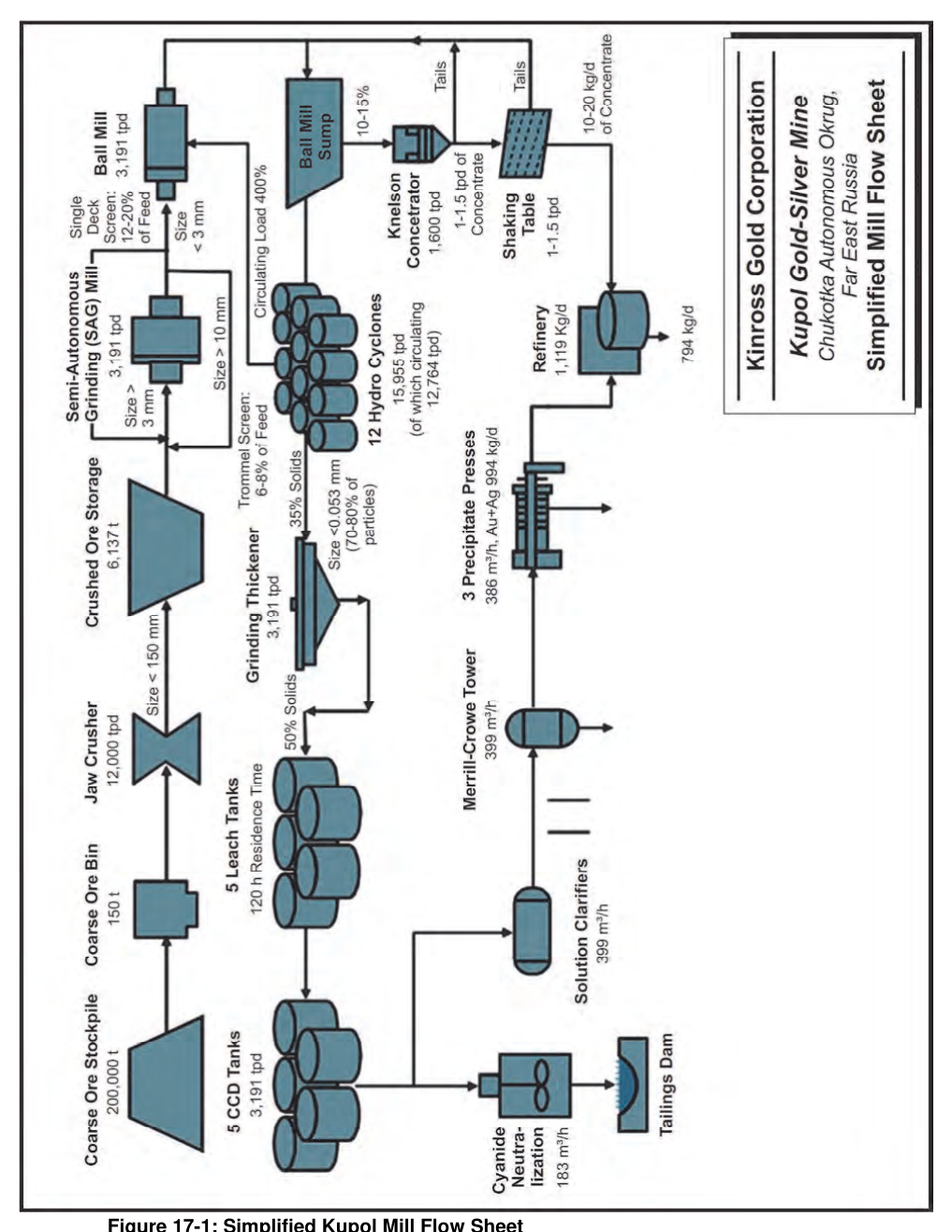
Kinross's March 2015 technical report on the Kupol and Dvoinoye mines describes a 4,500 t/d mill in Chukotka, Russia with SAG and ball milling, Knelson gravity concentrators, six leach tanks, CCD thickeners, zinc precipitation and a hypochlorite cyanide destruction step.
The Kupol mill in the Russian Federation processes ore from two gold-silver mines, Kupol and Dvoinoye, owned by Kinross Gold Corporation at the time of the report. The NI 43-101 technical report has an effective date of March 31, 2015. The two ores are processed in batches, with Dvoinoye ore typically processed at the start of each month. The milling process consists of primary crushing and a semi-autogenous grinding (SAG) mill and ball mill circuit, with conventional gravity technology followed by whole ore leaching. Merrill-Crowe precipitation produces gold and silver doré bars, and doré is shipped to the non-ferrous metals plant in Krasnoyarsk. Average mill recovery, based on both Kupol and Dvoinoye ore, is 95% for gold and 85% for silver, and mill availability is 94%.
Critical Data
| Parameter | Value | Unit | Notes |
|---|---|---|---|
| Mill rate | About 4,500 | t/d | 1,642,500 t/y, two shifts, 365 days |
| Average recovery | 95 / 85 | % Au / % Ag | Kupol and Dvoinoye ore |
| Mill availability | 94 | % | Reported |
| Coarse ore bin | 150 | t | Grizzly bars spaced 700 mm |
| Jaw crusher discharge | 150 | mm | Birdsboro-Buchanan |
| Crushed ore bin | 3,500 | m3 | Fed by two apron feeders |
| SAG mill | 7.0 x 3.0 | m diameter x EGL | Closed with a 2 mm screen |
| Ball mill | 5.0 x 9.2 | m diameter x EGL | Nine Krebs cyclones |
| Cyclone overflow | 80 | % minus 0.075 mm | 15% solids |
| Gravity concentrators | 2 | Knelson KC-XD30 | Gravity table follows |
| Thickener underflow | 50 | % solids | To pre-aeration |
| Leach tanks | 6 | Not applicable | Sixth added in 2013 |
| CCD stages | 5 | Not applicable | EIMCO deep-cone thickeners |
| 2014 Kupol gold grade | 8.16 to 10.95 | g/t | Monthly range |
| 2014 Kupol gold recovery | 92.25 to 94.66 | % | Monthly range |
Overview
The mill is designed for two shifts a day, 365 days a year, at approximately 4,500 t/d. That capacity was reached through modifications in 2013 that provided capacity for Dvoinoye ore as well as Kupol ore. Ore is crushed, ground in two stages, partly passed through gravity concentration and then leached with cyanide in covered tanks. Soluble gold and silver are recovered in a CCD circuit and precipitated with zinc dust. A cyanide destruction system reduces cyanide to an acceptable level, and tailings flow by gravity through a pipeline to a conventional tailings impoundment.
Key Process Stages
2013 modifications
New equipment included a booster station with new pumps supplying reclaim water to the mill, two motor control centres, a grinding water tank and pumps, a sixth leach tank and a fourth clarifier for pregnant solution. Replacements included Krebs gMax-20 cyclones in place of gMax-10, a 12 ft by 24 ft SAG mill discharge screen in place of a 6 ft by 16 ft one, 20 pumps and 22 larger motors.
Crushing and grinding
Trucks deliver ore to a stockpile, and a front-end loader transfers it through grizzly screens into a 150 t coarse ore bin. A jaw crusher with a 150 mm discharge opening feeds a 3,500 m3 crushed ore bin, and two apron feeders supply the SAG mill feed conveyor. A wet 7.0 m by 3.0 m Koppers (Metso) SAG mill runs in closed circuit with a vibrating screen for a 2 mm primary grind. Undersize goes to nine Krebs hydrocyclones, and underflow goes to a 5.0 m by 9.2 m Koppers (Metso) ball mill. Hydrocyclone overflow is at 80% minus 0.075 mm.
Gravity recovery
Slurry from the cyclone feed sump goes to two Knelson KC-XD30 centrifugal concentrators with a control unit that varies the operating mode and flush cycle. Concentrate is processed further on a gravity table, and as concentrate builds up it is refined to concentrate bars.
Thickening and leaching
Hydrocyclone overflow at 15% solids flows by gravity to a surge tank and an EIMCO deep-cone thickener with flocculant. The underflow at 50% solids goes to a covered, ventilated pre-aeration tank and flows by gravity into six covered leach tanks with agitators. Cyanide is added to the first three tanks, lime milk to the pre-aeration tank and the first and third tanks to adjust pH, and lead nitrate to the pre-aeration tank and the first two tanks. Cyanide is dosed based on silver and gold content.
CCD and Merrill-Crowe
The last leach tank overflows to a five-stage CCD circuit of EIMCO deep-cone thickeners, with barren solution from the Merrill-Crowe circuit as wash. The first thickener overflow, the pregnant solution, goes to pressure leaf clarifiers and then a de-aeration tower, where zinc dust precipitates gold and silver. A filter press collects the precipitate, which is dried, fluxed and melted in an induction furnace to make doré bars. Barren solution is returned for washing.
Cyanide destruction
CCD thickener 5 underflow goes to a hypochlorite cyanide destruction tank, from which slurry flows by gravity to the tailings impoundment.
Additional Interesting Data and Summary
Monthly 2014 data for Kupol show ore milled from 99,002 to 119,796 tonnes, silver recovery from 82.20% to 88.28%, and gold and silver grades of 8.16 to 10.95 g/t and 84.84 to 131.96 g/t. The report gives separate 2014 mill performance tables for Dvoinoye.
Production histories for the two mines are in the report's earlier sections, and the report presents a simplified flow sheet of the Kupol mill.
Key Processes
- Grizzly screening and jaw crushing
- SAG and ball milling with cyclone classification
- Knelson gravity concentration with table cleaning
- Pre-aeration and six-tank whole-ore cyanide leach
- Five-stage counter-current decantation
- Merrill-Crowe zinc precipitation and induction smelting
- Hypochlorite cyanide destruction
Source: Kupol Mine and Dvoinoye Mine, Russian Federation, National Instrument 43-101 Technical Report, March 31, 2015.
