

Processing and Recovery Methods
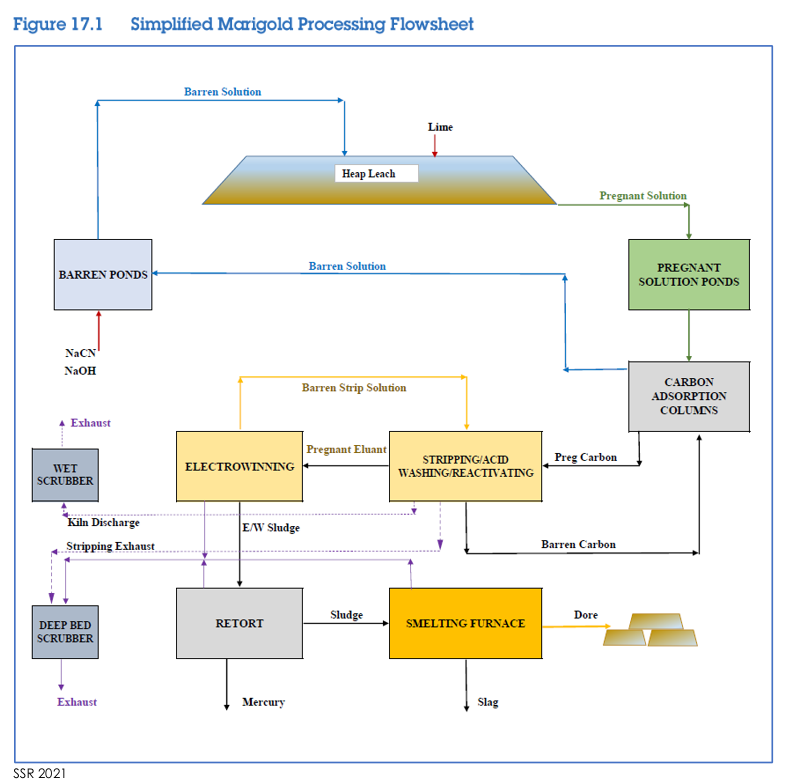
The Marigold Mine employs a Run-of-Mine (ROM) heap leaching process combined with Carbon Adsorption/Desorption/Recovery (ADR) and electrowinning to produce a final doré product. The oxide ore is processed entirely via heap leaching, a cost-effective method for gold recovery.
1. Ore Stacking on Leach Pad
– Ore Handling: ROM ore is hauled by trucks and stacked in 6.1 m to 12.2 m lifts on the leach pad.
– pH Control: Pebble lime is added to haulage trucks from a silo to maintain optimal pH before dumping.
– Leach Pad Preparation: Fresh and spent ore are ripped and cross-ripped to enhance permeability.
– Solution Application:
– Drip tubing and impact sprinklers distribute barren solution at 0.122 to 0.143 L/min/m².
– Header and sub-header lines ensure uniform solution distribution.
2. Leaching Solution Distribution
– Pond System:
– Two barren ponds, four pregnant ponds, and one stormwater/overflow pond.
– Ancillary Systems: Sodium cyanide (NaCN) addition (two locations), sodium hydroxide (NaOH) for pH adjustment, and antiscalant injection.
– Leach Pad Expansion:
– Originally constructed in 1990, expanded to 20 cells (with permitting for an additional cell).
– Active Leaching Area: ~0.5 million m² at any given time.
– Solution Pumping:
– Two barren solution distribution systems (total capacity: 43.5 m³/min).
– One lean solution system (max flow: 5.7 m³/min), recycled from low-grade pregnant solution.
– Total flow to pad: 49.2 m³/min.
3. Pregnant Solution Processing
– Carbon Adsorption:
– Pregnant solution is pumped to five parallel carbon column trains (each with five columns).
– Total flow rate: 37.9 m³/min (handled by six vertical turbine pumps).
– Gold Recovery Efficiency (2017): 95.4% from carbon columns.
– Solution Recycling:
– Discharge solution reports to barren ponds for reconditioning (NaCN/NaOH addition) before recirculation.
4. Carbon Processing (Strip Circuit)
– Carbon Elution:
– Loaded carbon is stripped in two vessels (2-ton and 3-ton capacity).
– Stripping Conditions:
– pH 13 (adjusted with NaOH).
– Temperature 141°C (heated via boiler and heat exchangers).
– Solution flow rate: 114–151 L/min.
– Gold Recovery Efficiency (2017): 95.6% from strip circuit.
– Electrowinning:
– Pregnant eluant passes through two parallel 2.1 m³ electrowinning cells.
– A third cell is used for cathode replating.
– Barren solution is recycled until stripping is complete (target: <17.1 g/t gold).
5. Refining
– Retorting & Smelting:
– Electrowinning sludge is retorted (mercury removal) and smelted in a propane-fired furnace.
– Flux is added to produce final doré bars.
– Carbon Reactivation:
– Stripped carbon is screened, acid-washed, and thermally reactivated before reuse.
6. Ventilation & Emissions Control
– Mercury Scrubbing:
– Exhaust gases from stripping, electrowinning, retort, and smelting pass through:
– Deep bed scrubber (sulfur-impregnated carbon) for mercury capture.
– Wet scrubber (water mist) for additional mercury condensation.
Key Equipment & Capacities
– Carbon Columns:
– Existing (2017): 20 columns (five trains).
– Post-2018 Expansion: 30 columns (additional two trains).
– Pumping Systems:
– Barren solution pumps upgraded to 597 kW motors (increasing flow from 43.5 to 53.0 m³/min).
– Pregnant solution pumps expanded to match flow rates.
– Pond Volumes:
– Pregnant ponds: 137,059 m³ (post-expansion).
– Barren ponds: 40,648 m³.
Recovery Rates & Performance
– Heap Leach Recovery (1990–2017): 70.3% (90–120-day leach cycles).
– Carbon Column Recovery (2017): 95.4%.
– Strip Circuit Recovery (2017): 95.6%.
Innovations & Challenges
– 2018 Expansion Projects:
– Upgraded pumping capacity to 53.0 m³/min (eliminating lean solution system).
– Added two carbon column trains to increase throughput.
– Challenges:
– Managing gold-in-solution inventory in the pad.
– Optimizing reagent consumption (NaCN: 0.17 kg/t ore; lime: 0.68 kg/t ore).
Throughput & Capacity
– Solution Flow Rates:
– Pre-2018: 37.9 m³/min (pregnant), 49.2 m³/min (total to pad).
– Post-2018: 53.0 m³/min (matched pregnant/barren flows).
– Power Consumption: 2.3 million kWh/month (2017 average).
Reagent Consumption (2017 Averages)
| Reagent | Consumption (kg/t ore) |
|——————|———————–|
| Sodium Cyanide | 0.17 |
| Lime | 0.68 |
| Caustic Soda | 0.01 |
| Activated Carbon | 0.01 |
—
This summary provides a comprehensive technical breakdown of the Marigold Mine’s processing circuit, emphasizing operational parameters, recovery efficiencies, and planned optimizations. Let me know if you need further details on any section.
Technical report and processing history
The following archived source profiles have been consolidated here to preserve the project’s processing history and study context.
Marigold Mine — 2017 Technical Report
Marigold Mine — 2017 Technical Report
| Company | SSR Mining |
| Date | 2017 |
| Region | Nevada, USA |
| Commodities | Gold |
| Mine Type | Open Pit |
| Status | Operating |
Executive Summary
The Marigold Mine is a long-standing oxide gold operation utilizing a ROM heap leaching process combined with a Carbon Adsorption/Desorption/Recovery (ADR) circuit. The facility has been in operation for approximately 28 years, with gold recovery from the heap leach pad historically averaging 70.3%. The process involves stacking oxide ore on a leach pad with lime addition for pH control, followed by solution application and collection into pregnant and barren ponds.
The ADR circuit recovers gold from the pregnant solution using carbon columns, followed by elution and electro-winning to produce a doré product. The text details specific equipment upgrades planned for 2018, including increased pumping capacity and additional carbon column trains to match barren solution flow rates. Reagent consumption for sodium cyanide and lime remains within industry norms, with power supplied from the local grid.
Operational data indicates a consolidated gold recovery of 95.4% from carbon columns and 95.6% from the strip circuit in 2017. The mine does not utilize a crushing circuit, relying instead on the ROM heap leach method which is deemed cost-effective for the current ore types. Ventilation systems are in place to manage mercury vapors from the refining and stripping processes.
Processing Profile
- Leaching: ROM Heap Leach
- Recovery: Carbon Adsorption/Desorption/Recovery (ADR)
- Refining: Electro-winning and Smelting
Reports
Website: https://www.ssrmining.com/operations/production/marigold/
Report Date: 2017
Region: Nevada, USA
Project Status: Operating
Commodity: Gold
Throughput:
Mine Life:
Mine Type: Open Pit
Ore type:
Marigold Mine — 2014 Technical Report
Marigold Mine — 2014 Technical Report
| Company | Silver Standard |
| Date | 2014 |
| Region | Nevada, USA |
| Commodities | Gold |
| Mine Type | Heap Leach |
| Status | Operating |
Executive Summary
The Marigold processing plant utilizes industry-standard ROM heap leaching combined with carbon adsorption, desorption, and electro-winning circuits to produce a final precious metal doré product. Ore is delivered by haulage truck and stacked on leach pads with pH control via pebble lime. Solution application is managed through header lines and drip tubing, with a total solution flow rate to the leach pad of 13,500 gpm.
Gold recovery is achieved through pregnant solution collection and pumping to five parallel carbon column trains. Loaded carbon is transported to the process facility for elution in strip vessels, followed by electro-winning cells where metals are plated out. The stripped carbon is reactivated and returned to service, while the plated material is retorted and smelted for final recovery.
Historical gold recovery from the heap leach pad from 1990 to 2014 was 71.6%, with current strip circuit and carbon column recovery rates exceeding 96%. The process relies on sodium cyanide and lime reagents, with power supplied from the local grid and propane used for refining and heating.
Processing Profile
Website: https://ir.ssrmining.com/investors/news/press-release-details/2014/Silver-Standard-to-Purchase-Marigold-Mine/default.aspx
Report Date: 2014
Region: Nevada, USA
Project Status: Operating
Commodity: Gold
Throughput:
Mine Life:
Mine Type: Heap Leach
Ore type:
