

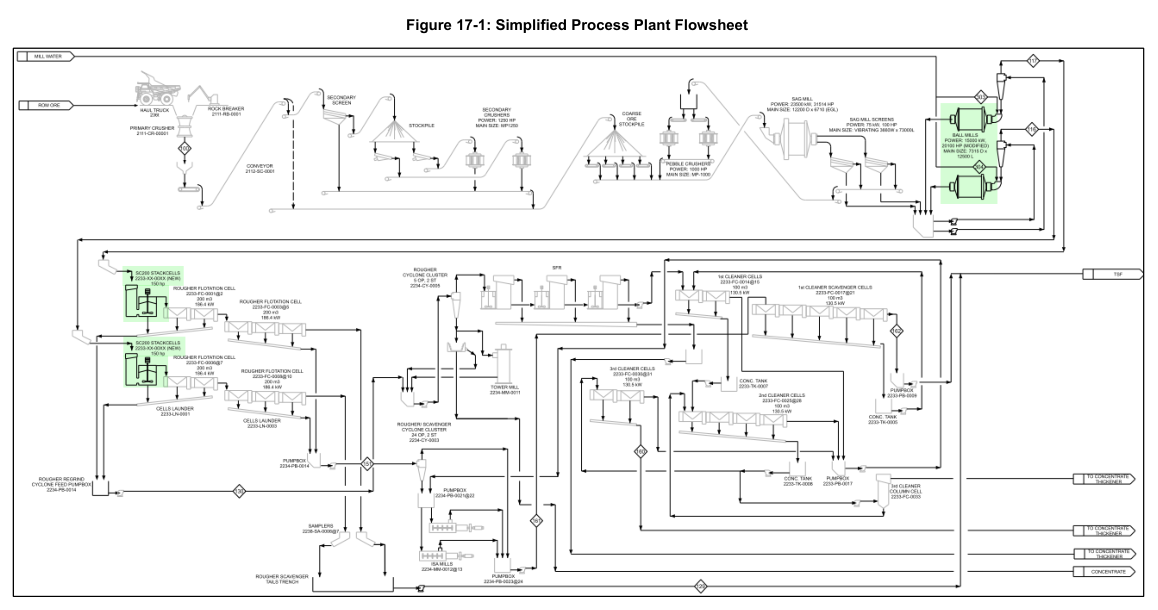
The Mount Milligan Mine employs a comprehensive mineral processing circuit designed to recover copper, gold, and silver from run-of-mine (ROM) ore. The plant was originally designed for a nominal throughput of 60,000 t/d, later increased to 62,500 t/d following the installation of a secondary crushing circuit in 2016 and process optimizations.
Processing and Recovery Methods
1. Crushing Circuit
– Primary Crushing:
– Equipment: 1.525 m x 2.794 m (60″ x 110″) gyratory crusher
– Output: 150 mm top size
– Capacity: 3,500–4,000 t/h
– Secondary Crushing (added in 2016):
– Two 1,000 kW cone crushers
– Target product size: 60 mm or finer
– Live ore stockpile capacity: 60,000 t
2. Grinding Circuit (SABC Configuration)
– SAG Mill:
– Dimensions: 12.20 m (40’) diameter x 6.71 m (22’) EGL
– Drive: 23.5 MW gearless motor
– Discharge screen oversize recycled to pebble crushers (target: 12 mm product)
– Ball Mills (2 units):
– Dimensions: 7.32 m (24’) diameter x 12.50 m (41’) EGL
– Power: 26 MW total (two 6.5 MW motors per mill)
– Operated in closed circuit with twenty 840 mm (33”) cyclones
– Pebble Crushers (2 units):
– Each powered by 750 kW motors
– Final Grind Size:
– Design: 80% passing 212 µm
– 2019 average: 175 µm
3. Flotation Circuit
– Rougher/Scavenger Flotation:
– Two parallel trains of five 200 m³ tank cells (two rougher, three scavenger)
– Natural pH, 35–40% solids slurry density
– Reagents: PAX (potassium amyl xanthate), A3409 (gold collector), Polyfroth H28C (frother)
– Mass pull target: 12%
– Regrinding:
– Rougher concentrate: Reground to 80% passing 40–50 µm in a 1,125 kW tower mill (six 500 mm + two 375 mm cyclones).
– Rougher-scavenger concentrate + cleaner tails: Reground to 80% passing 18–25 µm in two 3,000 kW IsaMills™ (twenty-six 250 mm cyclones).
– Gravity Gold Recovery:
– Centrifugal concentrator recovers coarse gold from 20% of rougher concentrate regrind cyclone underflow.
– Gold concentrate is blended into final flotation concentrate.
– Cleaner Flotation (3 stages):
– First cleaner: Two 100 m³ tank cells
– Second cleaner: Four 30 m³ tank cells
– Third cleaner: Two 30 m³ tank cells + one 4 m x 12 m flotation column
– Final concentrate grade: ~21.5% Cu, 30–40 gpt Au
– pH control: ~11.3 for pyrite rejection
4. Tailings Management
– Rougher-scavenger tailings: Non-sulphide gangue, stored in TSF.
– Cleaner-scavenger tailings: Sulphide gangue, stored underwater in a lined pond to prevent acid generation.
5. Concentrate Handling & Dewatering
– Thickening: 12 m diameter high-rate thickener (60–65% solids).
– Filtration: 96 m² pressure filter (target 8.5% moisture).
– Transport: Trucked to Mackenzie rail loadout, then shipped from North Vancouver.
6. Power Consumption (2019 Data)
– Total: 535,708 MWh (32.76 kWh/t ore)
– Major consumers:
– SAG mill: 33.4%
– Ball mills: 29.1%
– Regrinding: 7.3%
7. Innovations & Challenges
– Secondary crushing circuit (2016) increased throughput by 4.2%.
– IsaMills™ for ultrafine regrinding improve liberation.
– Gravity gold recovery enhances overall gold recovery.
– Tailings segregation mitigates environmental risks (acid drainage prevention).
Conclusion
The Mount Milligan processing circuit integrates crushing, SABC grinding, flotation, regrinding, and gravity concentration to produce a high-grade copper-gold concentrate. Operational optimizations, including secondary crushing and advanced regrinding, have enhanced efficiency, with a nominal throughput of 62,500 t/d and a final concentrate grade of ~21.5% Cu and 30–40 gpt Au. Power-intensive grinding dominates energy use, while tailings management ensures environmental compliance.
Technical report and processing history
The following archived source profiles have been consolidated here to preserve the project’s processing history and study context.
Technical Report on the Mount Milligan Mine — Recovery Methods
Technical Report on the Mount Milligan Mine — Recovery Methods
| Company | N/A |
| Date | 2025-06-30 |
| Region | British Columbia, Canada |
| Commodities | Copper, Gold, Silver |
| Throughput | 62,500 tpd (Current), 66,300 tpd (Planned 2029) |
| Status | Operating |
Executive Summary
This section of the Technical Report details the recovery methods employed at the Mount Milligan Mine. The process plant was originally designed for 60,000 tpd, increased to 62,500 tpd in 2016, with plans to reach 66,300 tpd by 2029. The plant processes sulphide ore to produce a marketable concentrate containing copper, gold, and silver.
The processing circuit includes primary gyratory crushing, secondary cone crushing, and an SAG/ball mill/pebble crusher grinding circuit. Flotation circuits consist of rougher-scavenger trains and a three-stage cleaner circuit, including column cells. Gravity concentration is used for coarse gold recovery. Final concentrate is thickened and pressure-filtered before transport to rail loadout.
Processing Profile
- Crushing: Gyratory, Cone, Pebble Crusher
- Milling: SAG, Ball Mill
- Flotation: Rougher-Scavenger, Cleaner, Column
- Gravity: Centrifugal
- Dewatering: Thickener, Pressure Filter
Website: https://www.genomebc.ca/blog/soothsaying-with-soil-genomics-and-innovative-land-reclamation-research-at-the-mount-milligan-mine/
Report Date: 2025-06-30
Region: British Columbia, Canada
Project Status: Operating
Commodity: Copper, Gold, Silver
Throughput: 62,500 tpd (Current), 66,300 tpd (Planned 2029)
Mine Life:
Mine Type:
Ore type:
Mount Milligan Mine — 2021 Technical Report (Recovery Methods)
Mount Milligan Mine — 2021 Technical Report (Recovery Methods)
| Company | Teck Resources |
| Mine | Mount Milligan Mine |
| Date | 2021 |
| Region | Mackenzie, BC, Canada |
| Commodities | Copper, Gold, Silver |
Executive Summary
The Mount Milligan process plant is designed to process ore at a nominal rate of 62,500 tpd, producing a marketable concentrate containing copper, gold, and silver. The facility utilizes a comprehensive comminution circuit involving primary gyratory crushing, secondary cone crushing, and a SAG/ball mill/pebble crusher grinding circuit. The ore is crushed to a top size of 150 mm, with secondary crushing targeting a P80 of 60 mm before grinding.
Flotation is the primary recovery method, utilizing rougher-scavenger circuits followed by three stages of cleaner flotation and a flotation column. Gravity concentration is employed to recover coarse metallic gold particles from the rougher concentrate stream. The final concentrate is thickened and pressure-filtered to a moisture content of 8.5% before being transported to rail loadout for shipment to Pacific Rim purchasers.
Tailings management involves storing rougher-scavenger tailings and cleaner scavenger tailings in separate areas within the Tailings Storage Facility (TSF). Sulphide tailings are kept underwater to prevent acid generation. The plant is supported by dedicated reagent preparation, assay, and metallurgical laboratories, with power consumption heavily weighted towards comminution circuits.
Processing Overview
Website: https://vancouversun.com/news/local-news/bc-slashes-timeframe-to-issue-mount-milligan-mine-permit
Report Date: 2021
Region: Mackenzie, BC, Canada
Project Status:
Commodity: Copper, Gold, Silver
Throughput:
Mine Life:
Mine Type:
Ore type:
Mount Milligan Mine — 2019 Technical Report
Mount Milligan Mine — 2019 Technical Report
| Company | Centerra |
| Date | 2019 |
| Region | British Columbia, Canada |
| Commodities | Copper, Gold, Silver |
| Mine Type | Open Pit |
| Throughput | 62,500 t/d |
| Status | Operating |
Executive Summary
The Mount Milligan process plant is designed to process ore at a nominal rate of 62,500 t/d, producing a marketable concentrate containing copper, gold, and silver. The facility utilizes a conventional gyratory crusher for primary crushing, followed by a secondary crushing circuit with cone crushers. The grinding circuit consists of a SAG mill, ball mills, and pebble crushers, targeting a final feed size to flotation of 80% passing 212 µm.
The recovery process involves rougher and scavenger flotation circuits, followed by three stages of cleaner flotation to produce a final concentrate targeting approximately 21.5% Cu and 30-40 gpt Au. A gravity circuit is employed to scalp coarse gold from the rougher concentrate using a centrifugal concentrator. Tailings are managed in a TSF with separate storage for sulphide and non-sulphide streams to prevent acid generation.
Processing Profile
Reports
Website: https://www.centerragold.com/operations/mount-milligan/default.aspx
Report Date: 2019
Region: British Columbia, Canada
Project Status: Operating
Commodity: Copper, Gold, Silver
Throughput: 62,500 t/d
Mine Life:
Mine Type: Open Pit
Ore type:
Mount Milligan Mine — 2015 Technical Report
Mount Milligan Mine — 2015 Technical Report
| Company | Thompson Creek Metals Company Inc. |
| Date | 2015-01-21 |
| Region | British Columbia, Canada |
| Commodities | Copper, Gold, Silver |
| Mine Type | Open Pit |
| Throughput | 60,000 t/d (nominal), 62,500 t/d (updated) |
| Status | Operating |
Executive Summary
The Mount Milligan concentrator is designed to process ore at a nominal rate of 60,000 t/d, producing a marketable concentrate of copper, gold, and silver. The facility utilizes a Semi-Autogenous/Ball Mill/Pebble Crushing (SABC) grinding circuit followed by rougher/scavenger and cleaner flotation stages. A gravity concentration circuit is integrated to recover coarse metallic gold from the rougher concentrate regrind circuit.
Operational updates indicate that the constructed milling facility is unlikely to achieve the designed 60,000 t/d average throughput consistently without modification. A secondary crushing circuit was planned to reduce the SAG feed size, targeting an estimated throughput of 62,500 t/d. The final flotation concentrate is thickened and pressure-filtered to approximately 8% moisture before shipment to overseas smelters.
Tailings are managed in a Tailings Storage Facility (TSF) with separate storage areas for rougher/scavenger tailing and cleaner/scavenger tailing to prevent acid generation from sulphide mineral oxidation. The plant employs a Distributed Control System (DCS) for process control and instrumentation, with remote monitoring capabilities via CCTV.
Processing Profile
Website: https://www.centerragold.com/operations/mount-milligan/default.aspx
Report Date: 2015-01-21
Region: British Columbia, Canada
Project Status: Operating
Commodity: Copper, Gold, Silver
Throughput: 60,000 t/d (nominal), 62,500 t/d (updated)
Mine Life:
Mine Type: Open Pit
Ore type: Sulphide (Porphyry)
Mount Milligan Mine — 2025 Technical Report
Mount Milligan Mine — 2025 Technical Report
Company: Not Specified
Date: 2025
Executive Summary
The Mount Milligan process plant, designed for a nominal rate of 60,000 tpd, has seen its capacity increase to 62,500 tpd through secondary crushing circuit upgrades and process optimizations. Further enhancements to the grinding and flotation circuits are planned for 2029 to achieve a processing capacity of 66,300 tpd. The plant currently processes ore to produce a marketable concentrate containing copper, gold, and silver.
Key operational aspects include a multi-stage crushing circuit, a SAG/ball mill/pebble crusher grinding circuit, and a comprehensive flotation system comprising rougher-scavenger, cleaner, and column cells. Gravity concentration is employed to recover coarse gold particles. The process also includes thickening and dewatering of the final concentrate before it is transported for sale. Tailings are managed in separate storage areas to prevent acid generation from sulphide minerals.
The report details planned upgrades for 2029, focusing on increasing ball mill motor capacity and adding rougher-scalper flotation cells to support the higher throughput. These modifications are not expected to negatively impact the cleaner circuit performance or overall concentrate production values. The existing reagent systems, assay laboratory, water supply, and air service systems are deemed sufficient for the planned increase in production.
Website: https://www.centerragold.com/operations/mount-milligan/default.aspx
Report Date:
Region:
Project Status:
Commodity:
Throughput:
Mine Life:
Mine Type:
Ore type:
