

The technical report provides limited information on the recovery methods at the New Afton Mine, with the “Recovery Methods” section (Section 17) appearing incomplete or truncated in the provided content. Below is a detailed breakdown of the available information and its implications:
1. Processing Plant Operational Timeline
– The report states the process plant has been operational since “mid [year not specified].” This suggests the plant has a history of continuous operation, but the exact commissioning date or operational duration is not provided.
2. Key Observations from Incomplete Data
– The section lacks specific details on:
– Processing/Recovery Methods: No mention of crushing, grinding, flotation, leaching, or other metallurgical techniques.
– Equipment Specifications: Absence of data on mills, classifiers, thickeners, filters, or other unit processes.
– Process Flow: No description of circuit configuration (e.g., open/closed grinding, reagent schemes).
– Recovery Rates/Efficiencies: No quantitative metrics for metal recovery (e.g., Au, Cu, Ag).
– Throughput/Capacity: Plant tonnage or design capacity not stated.
3. Notable Gaps and Challenges
– The report’s extraction date (2025-03-09) suggests future retrieval, but the original document (dated February 2020) may have been partially shared or redacted.
– Critical technical challenges, innovations, or solutions are omitted due to the truncated content.
4. Recommendations for Further Review
– A full review of the source document (New_Afton_Mine.pdf) is required to extract comprehensive details on:
– Ore characteristics and head grades.
– Specific recovery circuits (e.g., gravity separation, flotation tailings treatment).
– Operational parameters (e.g., grind size, residence times, reagent dosages).
—
Note: The summary is constrained by the incomplete source material. Additional technical specifics would require access to the full report.
Technical report and processing history
The following archived source profiles have been consolidated here to preserve the project’s processing history and study context.
New Afton Mine — 2020 Technical Report
New Afton Mine — 2020 Technical Report
| Company | New Gold Inc. |
| Date | 2020-02-28 |
| Region | British Columbia, Canada |
| Commodities | Gold, Copper |
| Mine Type | Underground |
| Throughput | 15,300 tpd (2019 avg) |
| Status | Operating |
Executive Summary
The New Afton Mine process plant has been in operation since mid-2012, with throughput averaging above the nameplate of 11,000 tpd since early 2013. A mill expansion completed in 2015 added tertiary grinding and flotation cleaning capacity, allowing throughput to peak at 16,420 tpd in 2017. In 2019, average throughput was 15,300 tpd, with annual gold production reaching 68,786 oz and copper production at 79,439,000 lb.
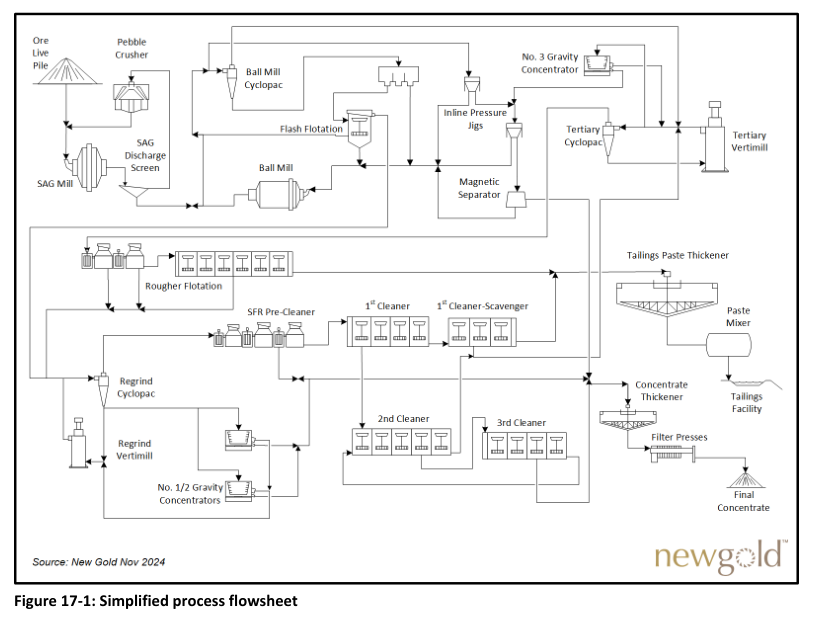
The processing circuit utilizes a combination of crushing, grinding, flotation, and gravity concentration. Ore is crushed via a gyratory crusher and ground using SAG and ball mills in closed circuit with hydrocyclones. Tertiary grinding is achieved using a Vertimill. Flotation circuits include rougher and cleaner stages using SFR and tank cells, supplemented by flash flotation and inline pressure jigs for native copper and gold recovery.
Tailings management involves the New Afton Tailings Storage Facility (NATSF), Pothook TSF, and the historical HATSF. The facility is transitioning to thickened tailings deposition starting in 2021 to improve stability and water recovery. The mine operates as an underground block caving operation producing sulphide ore containing gold and copper.
Website: https://newafton.newgold.com/
Report Date: 2020-02-28
Region: British Columbia, Canada
Project Status: Operating
Commodity: Gold, Copper
Throughput: 15,300 tpd (2019 avg)
Mine Life:
Mine Type: Underground
Ore type:
New Afton Mine: High-Capacity Copper-Gold Processing Circuit
Overview
The New Afton Mine process plant has been operational since 2012, consistently exceeding its nameplate capacity of 11,000 tonnes per day (tpd). A 2015 expansion added tertiary grinding and additional flotation capacity, enabling peak throughput of 16,420 tpd in 2017. The 2019 average throughput was 15,300 tpd, processing copper-gold ore through an advanced circuit featuring multiple recovery methods.
Key Process Stages
- Primary Crushing: FLSmidth 1,100 mm x 1,800 mm gyratory crusher reduces ROM ore to -150 mm
- SAG Milling: 8.5m x 4m Farnell-Thompson mill (5,220 kW) with double-deck screening (2.4m x 6.1m Deister screen)
- Ball Milling: 5.5m x 9.8m Farnell-Thompson ball mill (5,220 kW) with Krebs GMax-26 hydrocyclones
- Tertiary Grinding: Metso Vertimill 3000 (added in 2015) with Krebs hydrocyclones
- Flotation: Two-stage SFR cells + six 100m³ tank cells for rougher flotation, followed by regrind and cleaner circuits
- Gravity Recovery: Gekko inline pressure jig, Knelson concentrators for native copper/gold recovery
- Dewatering: Concentrate thickened to 55% solids, filtered to <9% moisture using two filter presses
Critical Data
| Parameter | Value |
|---|---|
| Design Throughput | 11,000 tpd |
| Peak Throughput (2017) | 16,420 tpd |
| 2019 Average Throughput | 15,300 tpd |
| SAG Mill Power | 5,220 kW (variable speed) |
| Ball Mill Power | 5,220 kW (fixed speed) |
| 2019 Gold Recovery | 79.43% |
| 2019 Copper Recovery | 83.47% |
| Processing Cost (2019) | $7.90 USD/t |
Tailings Management
The New Afton Tailings Storage Facility (NATSF) features five centerline raised dams with LLDPE geomembrane lining. Current capacity utilizes cyclone sand deposition, transitioning to thickened tailings in 2021. The facility includes extensive instrumentation with 69 vibrating wire piezometers and automated monitoring systems.
