

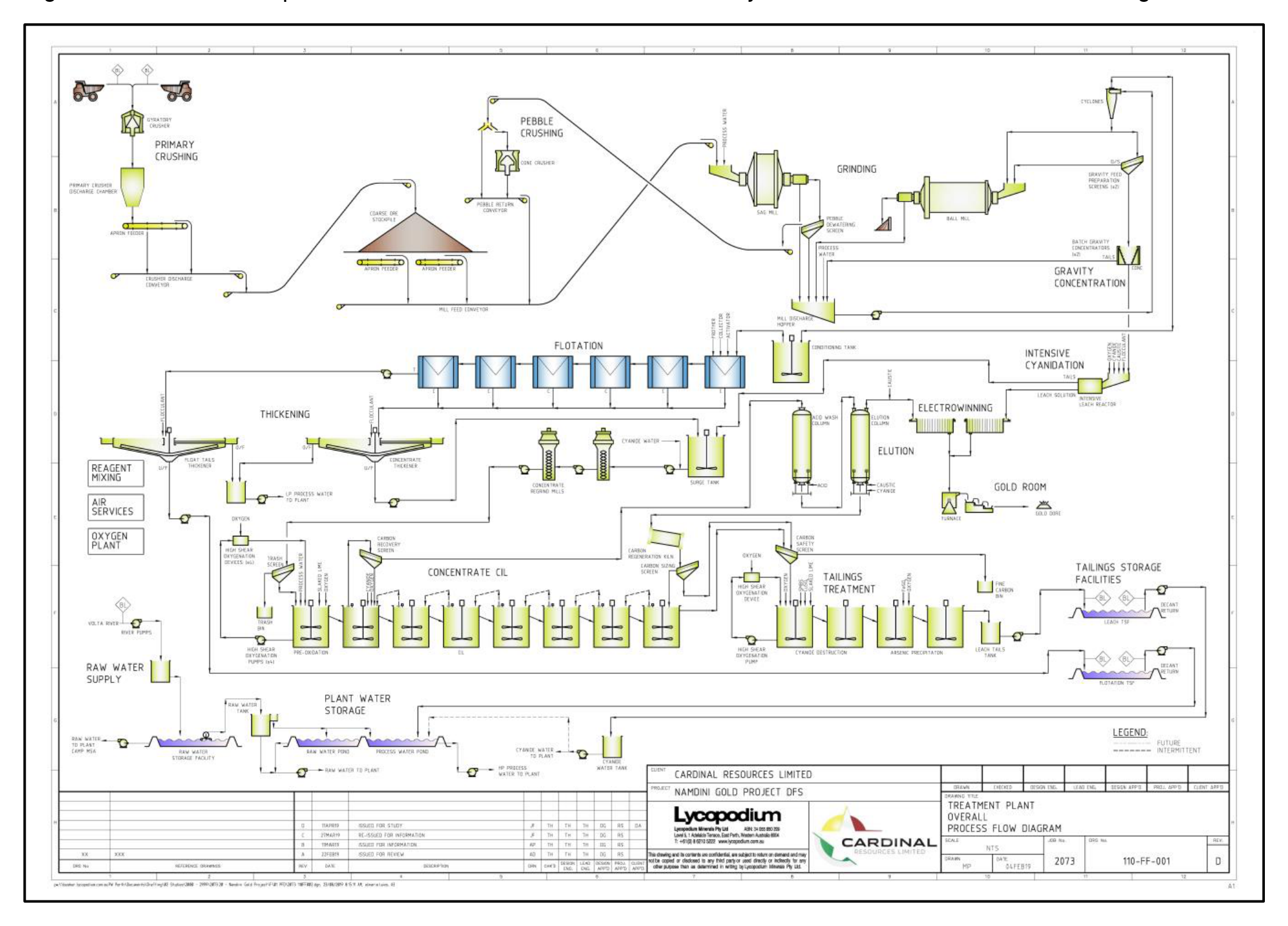
The October 2019 feasibility study for Cardinal Resources' Namdini gold project in Ghana describes a gyratory crusher, a 11.6 m SAG mill with pebble crushing, gravity recovery, flotation of pyritic gold concentrate and a concentrate CIL circuit with cyanide destruction and arsenic precipitation.
Namdini is a gold project in Ghana, West Africa. The Namdini Gold Project Feasibility Study NI 43-101 technical report has an effective date of 28 October 2019 and was authored by Lycopodium Minerals and Independent Metallurgical Operations for Cardinal Resources Limited. The process plant is based on a robust metallurgical flowsheet with well-proven unit operations, designed for optimum recovery at minimum operating cost. The main ore lithologies are Metavolcanics (MVO), Granite (GRA) and Diorite (DIO), with MVO and GRA making up most of the plant feed and a smaller amount of DIO coming later from the life-of-mine pit. The predominant association of gold with pyrite allows conventional flotation, so the design adds a rougher flotation stage followed by regrind of the concentrate to liberate fine gold locked in pyritic ore. The plant is designed for an initial throughput of 9.5 Mtpa.
Critical Data
| Parameter | Value | Unit | Notes |
|---|---|---|---|
| Initial throughput | 9.5 | Mtpa | Largest rate with dual pinion drives |
| Mill feed rate | 1,188 | tph | Design |
| Crushing availability | 75 | % | Mechanical |
| Plant availability | 91.3 | % | Remainder of the plant |
| Feed blend | 56 / 29 / 15 | % MVO / GRA / DIO | Average |
| Primary crusher product | 150 | mm P80 | Gyratory with fixed rock breaker |
| Coarse ore stockpile | 12 | hours live | Two apron feeders |
| SAG mill | 11.6 x 5.7 | m diameter x EGL | 2 x 9,000 kW, grate discharge |
| Ball mill | 8.2 x 12.7 | m diameter x EGL | Variable speed |
| Grind size | 106 | µm P80 | SABC circuit |
| Competence A*b | 28.8 to 31.3 | Not applicable | Hard ore category |
| Bond ball mill work index | 17.3 to 18.9 | kWh/t | Start-up and LOM |
| Total specific energy | 23.7 to 24.7 | kWh/t | At P80 106 µm |
| Concentrate regrind | 9 | µm P90 | High intensity |
| CIL tanks | 7 | Not applicable | Plus one pre-aeration tank |
| Elution | 4.5 | t split AARL | Electrowinning and smelting |
Overview
The process plant has single-stage primary crushing, a coarse ore stockpile, two-stage SAG and ball milling in closed circuit with cyclones, with pebble recycle crushing (SABC), gravity recovery with scalping screens, centrifugal concentrators, an intensive leach reactor and a dedicated electrowinning cell, rougher flotation to make a gold-rich sulphide concentrate, and thickening of flotation tails for water recovery before disposal in a separate non-cyanide tailings storage facility. The flotation concentrate is thickened and reground to a P90 of 9 µm, treated by Maelgwyn's Aachen high shear oxidation process and leached in a concentrate carbon-in-leach (CIL) circuit.
Key Process Stages
Comminution selection
The feed is hard. SMC drop weight A*b values vary from 29.9 to 40, and the SAG mill power efficiency is low at 1.36, though partial crushing could improve it. Orway Mineral Consultants found that 9.5 Mtpa is the largest throughput achievable with dual pinion mill drives, and pebble crushing manages the build-up of critical size material. Abrasion is relatively low, from 0.090 for metavolcanics to 0.290 for granite at the 85th percentile design level, which means favourable wear liner and steel media consumption. The circuit selected was primary gyratory crushing followed by two-stage SAG and ball milling with recycle crushing, since it can accommodate competent ore feed and minimizes operating cost while still producing the relatively fine product required. A future upgrade from a primary crush only circuit to a secondary crush fed circuit is possible.
Crushing, grinding and gravity recovery
A fixed hydraulic rock breaker clears oversize at the ROM pad, which also allows some blending. The single-stage gyratory crusher feeds a coarse ore stockpile with 12 hours of live capacity, reclaimed by two apron feeders. The SAG mill is 11.6 m in diameter with 5.7 m EGL and two 9,000 kW drives, with 125 mm grinding media. The ball mill is 8.2 m by 12.7 m. Gravity recovery uses scalping screens, centrifugal concentrators and an intensive leach reactor with a dedicated electrowinning cell.
Flotation and regrind
Rougher flotation makes a gold-rich sulphide concentrate. Flotation tails are thickened for water recovery and sent to a separate non-cyanide tailings storage facility. The concentrate is thickened and reground to P90 9 µm in a high intensity regrind mill, and Maelgwyn's Aachen high shear oxidation process is applied to the regrind product before CIL.
CIL and elution
The concentrate CIL circuit has one pre-aeration tank and seven CIL tanks for gold and silver adsorption. A 4.5 tonne split AARL elution circuit, electrowinning and smelting produce doré. CIL tailings go through cyanide destruction using sulphur dioxide and oxygen and arsenic precipitation, and are disposed of in a lined tailings storage facility.
Additional Interesting Data and Summary
Comminution test work began in 2016 and covered SPI and Bond ball mill work index data. Two further campaigns in early and late 2017 and a further campaign in June 2018 followed, and the report notes that the early 2017 test material came from near the contact zone and is expected to feed the plant only late in the schedule. The November 2017 and 2018 tests better represent the start-up blend in years 1 to 5.
The mill sizing criteria differ between the start-up period and the life of mine, with Bond crusher work index of 19.8 and 19.0 kWh/t, milling feed F80 of 137 and 112 mm, and SAG mill specific energy of 12.0 and 11.7 kWh/t.
Key Processes
- Gyratory crushing with a fixed rock breaker
- SAG and ball milling with pebble crushing in closed circuit with cyclones
- Gravity concentration with intensive leach and electrowinning
- Rougher flotation of pyritic gold concentrate
- High intensity regrind to 9 µm and Aachen high shear oxidation
- Pre-aeration and seven-tank carbon in leach
- Split AARL elution, electrowinning and smelting
- Cyanide destruction and arsenic precipitation of CIL tailings
Source: Namdini Gold Project Feasibility Study NI 43-101 Technical Report, Ghana, West Africa, October 28, 2019.
