

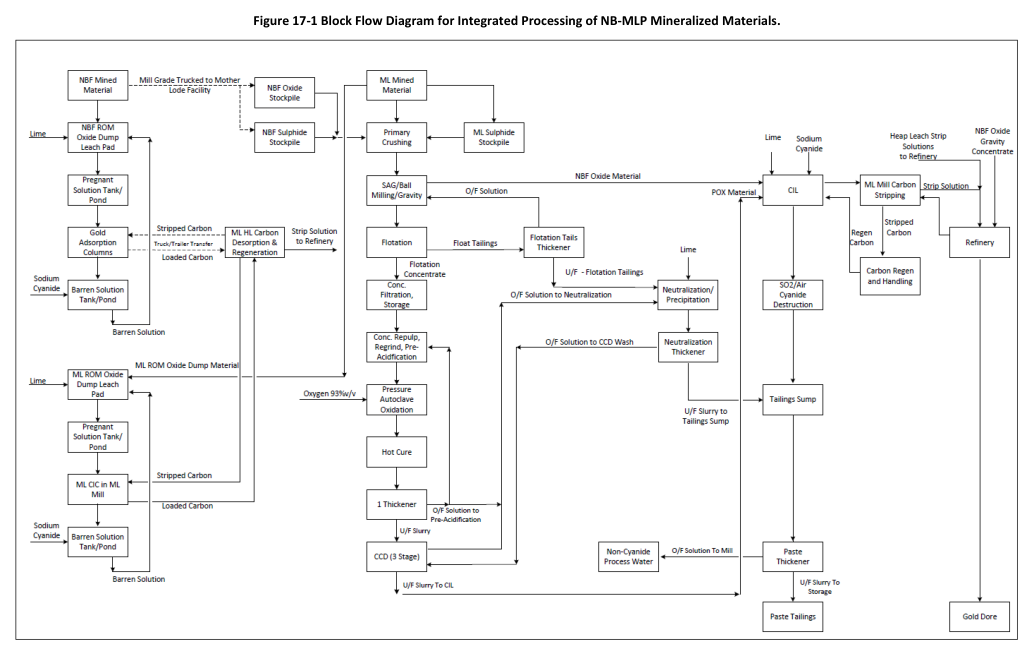
This report presents the proposed processing routes and metallurgical assumptions for the integrated North Bullfrog and Mother Lode Project as of the 2018 Preliminary Economic Assessment.
Report context
The 2018 Preliminary Economic Assessment for the North Bullfrog and Mother Lode Project describes proposed processing facilities for oxide and sulphide mineralized materials from both properties. The integrated Project includes heap leaching for oxide materials and a mill processing facility for both oxide and sulphide materials. The sulphide mill material and energy balance were modeled with the METSIM™ process simulator.
Processing route
Oxide heap leaching
Oxide materials from both Mother Lode and North Bullfrog properties would be processed in a standard heap leach recovery circuit. Mother Lode heap leach materials would be trucked to the pad at a nominal rate of 13,600 tonnes per day. North Bullfrog heap leach materials would be trucked to the pad at a nominal rate of 61,000 tonnes per day. Mineralized material would be stacked in 9.1 m lifts. Lime would be added to individual truck loads. Leaching would use buried emitters with a weak cyanide solution. Solution application rates would range from 12 l/hr-m² to 6.0 l/hr-m². Pregnant solution from the heap would be collected in a pond and pumped to a Carbon-in-Columns plant.
The Mother Lode CIC plant would treat 680 m³/hr and consist of a single train of five cascading carbon columns. The NBP CIC plant would consist of two parallel trains processing approximately 1,818 m³/hr. Carbon would advance on a weekly basis countercurrent to solution flow. Loaded carbon would be acid washed, stripped, and regenerated. Strip solution would be sent to electrolytic cells for gold recovery in a precipitate sludge, followed by retorting for mercury removal and melting into doré bars.
Mill processing
The MLP mill would process NBP oxide, NBP sulphide, and MLP sulphide materials separately from stockpiles at a rate of 8,200 tpd. The study assumed the mill would process oxide material 50% of the time and sulphide material 50% of the time. The flotation plant would remain idle while oxide material is processed. The pressure oxidation plant would be fed from the flotation plant or stockpiled flotation concentrate and would run continuously.
YellowJacket oxide milling
YellowJacket oxide material would be processed using a mill/gravity/cyanide leach circuit. Material would be primary crushed at 8,200 tpd, followed by primary SAG milling with pebble crushing and secondary ball milling, with gravity separation of cyclone underflow. Gravity tails at a P80-size of 74 µm would be leached in a CIL circuit for 24 hours. CIL tails slurry would be treated in a cyanide detoxification process using Inco/SO₂ air process methods, followed by pumping to a paste tailings thickener. Slurry would be pumped from thickener underflow as a paste into a storage facility. Loaded carbon from the CIL circuit would be acid washed, stripped, and regenerated.
Sulphide milling
Mother Lode and NBP sulphide materials would be delivered from the mines via truck and stockpiled or directly dumped into the primary crusher feed bin. Reclaimed materials would be blended to control sulphide content in feed to the flotation/POX plant. Milling would be performed using a primary SAG mill with recycle pebble cone crushing and a secondary ball mill in closed circuit with cyclones. Cyclone overflow at a P80 of 74 µm would exit the grinding circuit to the flotation circuit.
Sulphide flotation and concentrate handling
Gold and sulphide minerals predominately in pyrite would be concentrated by bulk sulphide flotation in rougher and scavenger flotation cells. Flotation concentrate would be thickened and either pumped to the regrinding mill or filtered and stored in covered storage buildings. Reclaimed concentrate would be ground to P80 10-15 µm at a rate of 410-1066 tpd and stored in agitated tanks for feed to the POX circuit.
Pressure oxidation
Concentrate slurry would be pumped to a pre-acidification tank and combined with acidic overflow solution from the pressure leach autoclave discharge. Pre-acidified slurry would be pumped into the pressure leach autoclave by high pressure piston positive displacement pumps. Sulphide minerals would be oxidized by oxygen at a temperature of 225°C and 3,600 kPa. Oxygen partial pressure would be maintained at 690 kPa. Oxygen at 93% v/v would be supplied from a vacuum swing adsorption oxygen plant. POX slurry would be let-down to atmospheric pressure through flash vessels and retained in brick-lined agitated Hot Cure tanks. Slurry from Hot Cure tanks would flow to a thickener, then through a two-stage CCD wash circuit.
Cyanide leaching and carbon absorption
Oxide mill material and POX neutralized slurry would be pumped to the CIL circuit providing approximately 24 hours of leach time. Activated carbon would be added to CIL tanks, each containing seven tonnes of carbon. Loaded carbon from the first CIL tank would be taken in seven-ton batches for processing in the carbon handling circuit. Slurry exiting the last CIL tank would be screened and flow to the cyanide detoxification circuit.
Tailings detoxification and storage
Material exiting the CIL circuit would be detoxified with an Inco/SO₂ air process and pumped to a paste tailings thickener. Thickener underflow would be pumped to the storage facility. Solution overflow from the paste thickener would be pumped back to the mill and heap leach pad for reuse.
Carbon handling and refinery
Carbon from both the CIC and CIL circuits would be processed in one carbon handling facility located at the mill. Carbon would be batch stripped in seven-ton batches in one of two strip vessels, acid washed in weak hydrochloric acid solution, and pumped to a regeneration kiln for reactivation at 700°C in a reducing atmosphere. The refinery would include electrowinning cells, a mercury retort, flux mixer, and furnace. Pregnant solutions from high intensity leach of gravity concentrate would be combined with pregnant strip solution and processed in electrowinning cells. Cathodic sludge would be retorted for mercury removal, then placed into a furnace with fluxing agents and melted into doré bars.
Key reported parameters
| Parameter | Value | Unit | Basis |
|---|---|---|---|
| Mother Lode heap leach throughput | 13,600 | tpd | Proposed design |
| NBP heap leach throughput | 61,000 | tpd | Proposed design |
| Mill throughput | 8,200 | tpd | Proposed design |
| Heap leach lift height | 9.1 | m | Proposed design |
| Solution application rate range | 12 to 6.0 | l/hr-m² | Proposed design |
| Mother Lode CIC plant flow | 680 | m³/hr | Proposed design |
| NBP CIC plant flow | 1,818 | m³/hr | Proposed design |
| CIL leach time | 24 | hours | Proposed design |
| Grind size (P80) | 74 | µm | Proposed design |
| Concentrate regrind size (P80) | 10-15 | µm | Proposed design |
| Concentrate regrind feed rate | 410-1066 | tpd | Proposed design |
| Pressure oxidation temperature | 225 | °C | Proposed design |
| Pressure oxidation pressure | 3,600 | kPa | Proposed design |
| Oxygen partial pressure | 690 | kPa | Proposed design |
| Oxygen purity | 93 | % v/v | Proposed design |
| Carbon batch size (CIL) | 7 | tonnes | Proposed design |
| Carbon batch size (Mother Lode CIC) | 3.0 | tonnes | Proposed design |
| Carbon batch size (NBP CIC) | 3.5 | tonnes | Proposed design |
| Carbon regeneration temperature | 700 | °C | Proposed design |
| Mother Lode oxide heap leach Au recovery | 74 | % | Based on bottle roll tests and historical Daisy mine ROM data |
| NBP oxide heap leach Au recovery (average) | 74 | % | Based on +100 bottle roll tests and 40 column tests |
| NBP oxide heap leach Ag recovery (average) | 6 | % | Assumed range 5.8% to 9.7% |
| Mother Lode sulphide gold dissolution | 80 | % | Weighted for Tip1 and Tjvs materials |
| NBP sulphide Sierra Blanca overall Au recovery (soda ash) | 93 | % | Based on flotation and AAO testwork |
| NBP sulphide Pioneer Formation tuff overall Au recovery (soda ash) | 94 | % | Based on flotation and AAO testwork |
| NBP sulphide Rhyolite Au dissolution (soda ash) | 89 | % | Based on AAO testwork |
| NBP sulphide Dacite Au dissolution (soda ash) | 88 | % | Based on AAO testwork |
| NBP sulphide overall Ag recovery | 57 | % | Weighted: 77% in flotation, 74% in cyanide leach |
| Mother Lode oxide heap leach NaCN consumption | 0.05 | kg/t | Based on bottle roll tests and historical data |
| Mother Lode oxide heap leach CaO consumption | 2 | kg/t | Based on bottle roll tests and historical data |
| Mother Lode sulphide NaCN consumption | 0.2 | kg/t | Estimated |
| Mother Lode sulphide lime consumption | 25 | kg/t | Estimated |
| NBP sulphide average NaCN consumption | 0.2 | kg/ton ore | Based on bottle roll tests |
| NBP sulphide average lime consumption | 0.6 | kg/ton ore | Based on bottle roll tests |
| NBP heap leach makeup water requirement | 2,800 | l/min | Estimated |
| Total process manpower | 97 | personnel | Proposed design |
Technical qualifications
This Preliminary Economic Assessment is based on proposed designs and metallurgical testwork. Gold recovery for Mother Lode oxide heap leach materials is based on bottle roll tests and historical Daisy mine ROM gold production data. NBP disseminated mineralization gold recovery for heap leach materials is based on more than 100 bottle roll tests at varying sizes and 40 column tests. Mother Lode sulphide material gold dissolution is based on testing of Tip1 and Tjvs materials. NBP sulphide gold dissolution assumes that AAO and POX oxidized processes would provide similar sulphide oxidation and gold dissolution, based on correlation observed in AAO tests. Silver recovery for NBP sulphide was based on Sierra Blanca concentrate values back calculated through flotation to a calculated head grade. The report states that the NBP and Mother Lode properties have main electrical power and water located nearby in quantities sufficient for the operation and that process reagents are common commodities utilized in the Nevada gold mining industry. The State of Nevada requires that all processes with temperatures exceeding 79°C be equipped with mercury abatement equipment, and the project would comply with this requirement.
—
Source: Corvus Gold Inc., Preliminary Economic Assessment – North Bullfrog Project, 2018, Section 17 Recovery Methods.
