

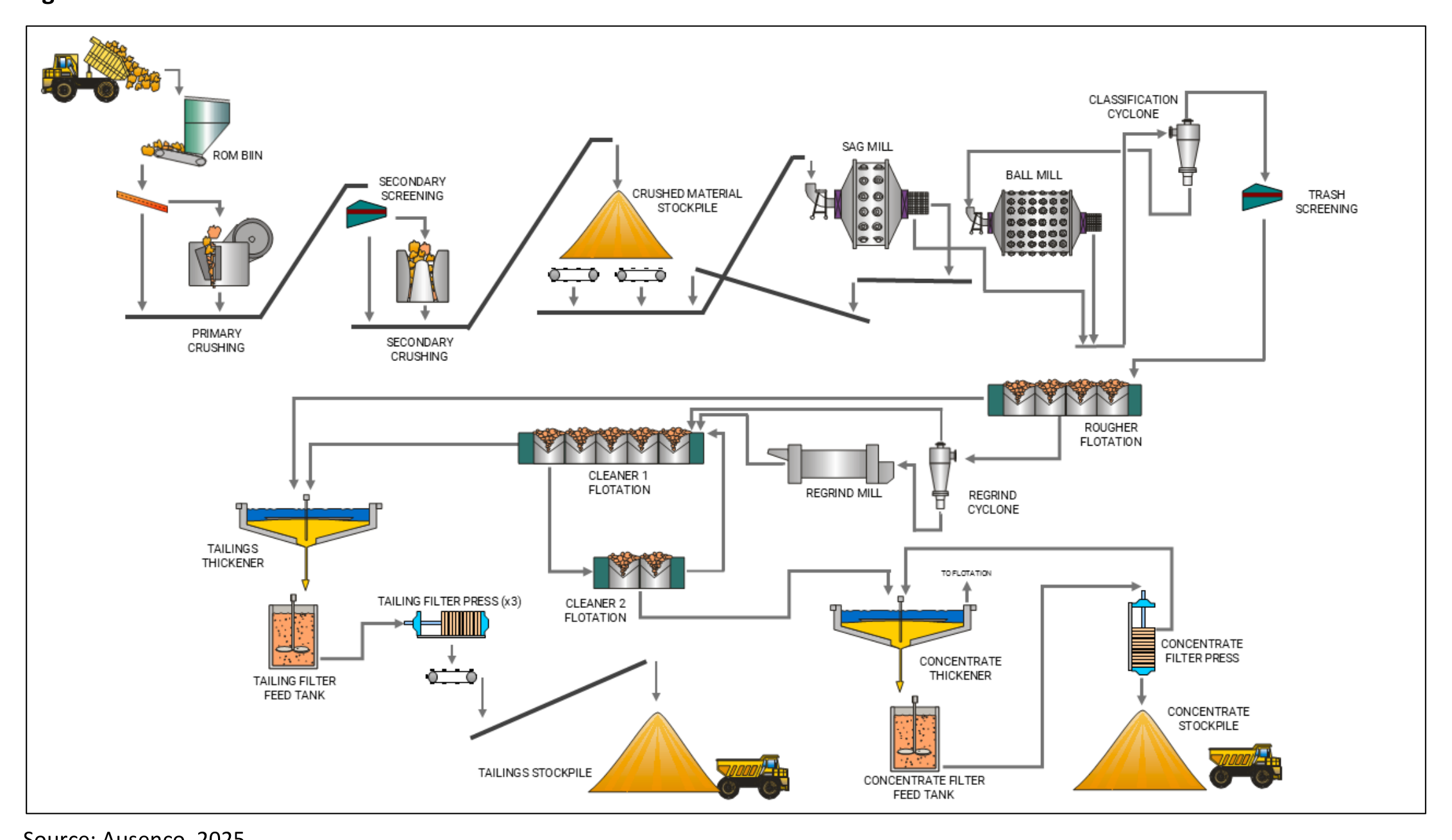
The November 2025 NI 43-101 technical report on XXIX Metal's Opémiska project in Quebec designs a 4.6 Mt/y concentrator with two-stage crushing, a pair of 8.3 MW mills, rougher and two-stage cleaner flotation, and plate-and-frame filtration of concentrate and tailings.
The Opémiska Project lies next to the community of Chapais in Quebec, about 480 km north of Montreal, and is held by XXIX Metal Corp. Ausenco Engineering Canada led the NI 43-101 Technical Report and Preliminary Economic Analysis, with an effective date of October 17, 2025 and a report date of November 27, 2025. The flowsheet was selected on the basis of preliminary testwork, historical operating data and economic modelling, and it uses standard concentrator technology. The plant would treat 4.6 Mt/y, or 12,500 t/d, over an 18-year life, at a design head grade of 0.92% copper, 0.32 g/t gold and 1.41 g/t silver. Design recoveries are 92% for copper, 83% for gold and 82% for silver.
Critical Data
| Parameter | Value | Unit | Notes |
|---|---|---|---|
| Plant throughput | 4.6 | Mt/y | 12,500 t/d |
| Life of mine | 18 | y | Not applicable |
| Copper head grade, design | 0.92 | % | Gold 0.32 g/t, silver 1.41 g/t |
| Copper recovery, design | 92 | % | Gold 83%, silver 82% |
| Crushing feed / product | 423 / 36 | mm F80 / P80 | 808 dry t/h |
| Crushing availability | 65 | % | 5,694 h/y |
| Grinding availability | 92 | % | 566 dry t/h |
| Bond ball mill work index | 20.0 | kWh/t | Rod mill 23.0, crusher 26.1 |
| Primary grind | 105 | µm P80 | 35% solids in cyclone overflow |
| Ball mill circulating load | 350 | % | Not applicable |
| Regrind product | 30 | µm P80 | 13 kWh/t |
| Rougher flotation cells | 4 | cells | 130 m3 each |
| Concentrate filter cake | 9.5 | % moisture | Target |
| Tailings filter cake | 15 | % moisture | Target |
| Installed process load | 31.2 | MW | Not applicable |
Overview
The process plant has a comminution circuit with two-stage crushing, a semi-autogenous (SAG) mill and a ball mill with cyclone classification, rougher flotation with regrind, two stages of cleaner flotation, concentrate handling and tailings handling. Concentrate is thickened, pressed and trucked to contracted smelters. Tailings are thickened and filtered on plate-and-frame presses to about 15% moisture, then stockpiled and hauled to a tailings storage facility.
Key Process Stages
Crushing and stockpiling
Run-of-mine material is dumped in a feed bin, withdrawn by apron feeder and sent over a vibrating grizzly. Coarse oversize goes to a primary jaw crusher, and a rock breaker deals with oversize rocks. Grizzly undersize and jaw product go by sacrificial conveyor to a double-deck secondary screen with 60 mm and 28 mm apertures. Oversize goes to a secondary cone crusher, and cone discharge rejoins screen undersize on the way to a crushed material stockpile with 12 hours of live capacity.
Grinding
Apron feeders reclaim crushed material to a 28 ft by 23 ft EGL SAG mill of 8.3 MW, which discharges to a trommel screen. Oversize pebbles return to the SAG mill, which the design puts at 14% of fresh feed. Undersize goes to a cyclone cluster in closed circuit with a 22 ft by 33 ft EGL ball mill, also 8.3 MW, with a design circulating load of 350%. Ball mill trommel oversize and grinding media fragments go to a scats bunker. Hydrated lime added to the ball mill raises slurry pH to 10.5 ahead of flotation, and cyclone overflow passes a trash screen.
Rougher flotation and regrind
Four conventional 130 m3 cells in series float the rougher concentrate, and rougher stage recovery is designed at 11%. Concentrate is classified in a cyclone cluster, and the underflow goes to a horizontal 1.12 MW regrind mill. The mill has internal classification, so it runs in open circuit with media retained inside. Cyclone overflow at 30 µm bypasses the mill and joins its discharge in the first cleaner feed pumpbox. Aero 3894, a thionocarbamate collector, and methyl isobutyl carbinol (MIBC) frother are added, and lime holds pH at 10.5.
Cleaner flotation
The first cleaner bank has five 20 m3 cells, and the second cleaner has two 20 m3 cells. First cleaner tailings join rougher tailings and go to the tailings thickener. Second cleaner tailings recycle to the first cleaner feed to prevent losses. Stage recoveries are designed at 48% for cleaner 1 and 70% for cleaner 2. Lime, collector and frother are also dosed in the cleaning circuit.
Concentrate dewatering
A high-rate thickener with flocculant feeds a vertical plate and frame filter press. Thickener overflow returns to flotation and filtrate returns to the thickener. Dewatered concentrate is stockpiled and loaded on covered trucks for delivery to contracted smelters on local roads.
Tailings dewatering
Flotation tailings go to a tailings thickener, whose overflow is recycled as process water. Underflow goes to a filter feed tank and then to one of three horizontal plate and frame presses, and the cake leaves at about 15% moisture on conveyors to a stockpile. Wash water and press water return to the thickener through a filtrate transfer tank.
Additional Interesting Data and Summary
Annual reagent use is 5,745 t of hydrated lime, 161 t of Aero 3894, 138 t of MIBC and 91 t of flocculant. Grinding media use is 2,760 t of SAG media, 2,806 t of ball mill media and 110 t of regrind media. Tailings filter cloths are replaced at 4,320 units a year, and maintenance liners include four jaw liner sets and eight cone liner sets a year.
Raw water comes from lakes in the area at 70 m3/h, covering flocculant dosing, concentrate filter cloth washing, reagent mixing, fire and gland water, with gland water at 24 m3/h. Process water use is 1,665 m3/h from internal recycle, with 11 m3/h make-up. Reagent areas are separated so incompatible reagents are not mixed, and tanks have level indicators, alarms and sumps for spillage control.
Key Processes
- Two-stage crushing with a double-deck screen
- SAG mill and ball mill grinding with cyclones
- Rougher flotation with open-circuit regrind
- Two stages of cleaner flotation
- Concentrate thickening and pressure filtration
- Tailings thickening and filtration
Source: Opémiska Project, NI 43-101 Technical Report and Preliminary Economic Analysis, Quebec, Canada, November 27, 2025.
