

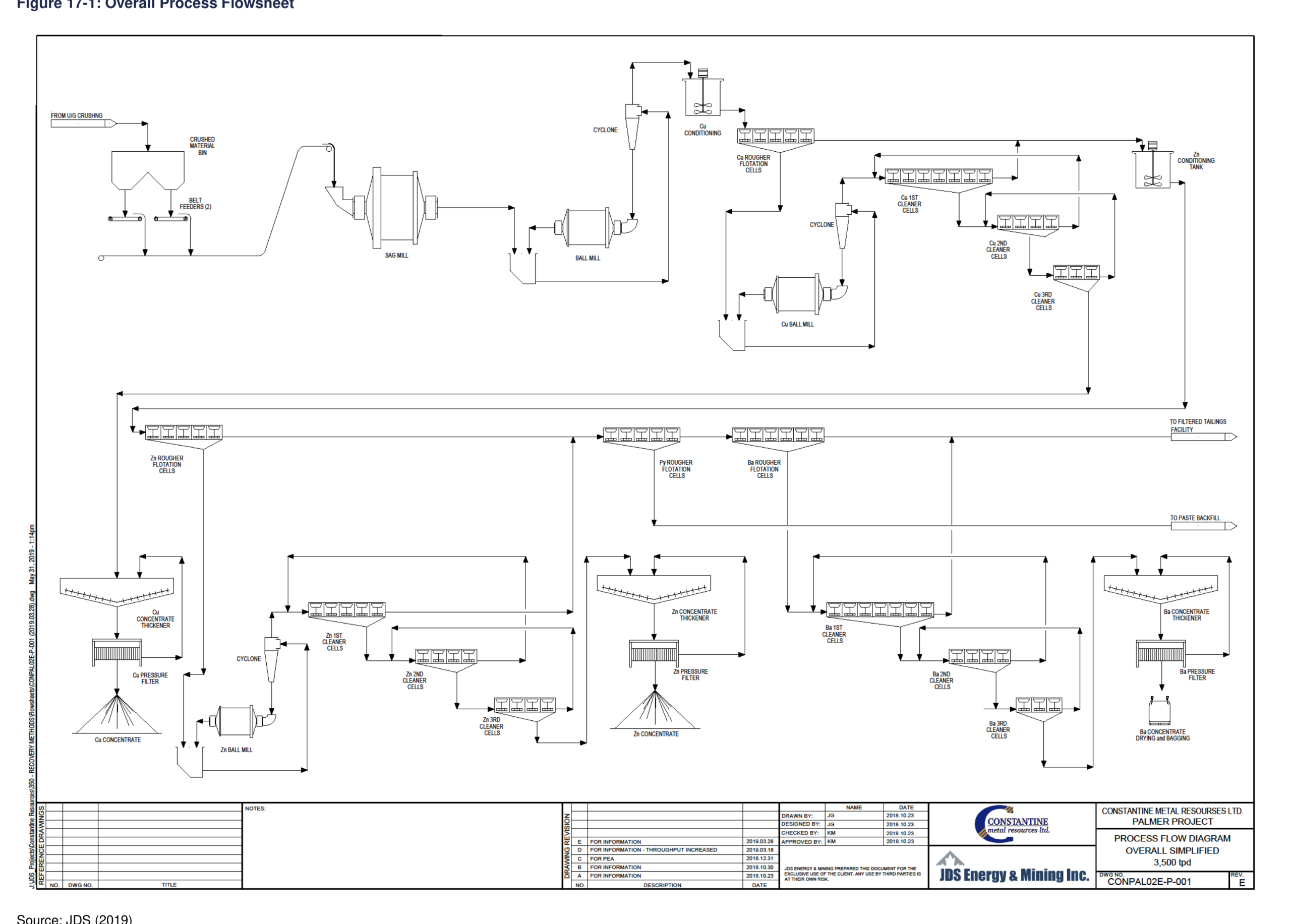
The July 2019 preliminary economic assessment for Constantine's Palmer project in Alaska describes an open circuit SAG mill, a 72 µm grind, three saleable concentrates and tailings sent to a paste plant or a filtered tailings facility.
Palmer is a copper, zinc, barite, gold and silver project in Alaska, USA. JDS Energy & Mining prepared the NI 43-101 technical report for Constantine Metal Resources Ltd. with a report date of July 18, 2019. The Palmer deposit will make copper, zinc and barium concentrates. A recent metallurgical test program at SGS in Burnaby, BC demonstrated that standard copper, zinc, pyrite and barite sequential flotation can produce saleable concentrates, and the results were used to develop the process design criteria, mass balance, equipment list, flowsheet and operating costs. Underground material at average life-of-mine head grades of 0.81% copper, 4.24% zinc, 13.31% barium, 0.33 g/t gold and 49.56 g/t silver gives a total throughput of 3,500 t/d for the first few years of mine life. The same flowsheet will be used for the AG Zone deposit, expected to be mined at the end of the Palmer deposit.
Critical Data
| Parameter | Value | Unit | Notes |
|---|---|---|---|
| Plant throughput | 3,500 | t/d | 159 t/h at 92% availability |
| Operating schedule | 24 / 365 | hours per day / days per year | Plant |
| Crushing product | 110 | mm P80 | One stage, underground jaw crusher |
| SAG mill | 4.9 x 2.7 | m | 895 kW, open circuit, T80 about 800 µm |
| Ball mill | 1,119 | kW | Reverse closed circuit, 300% circulating load |
| Grind size | 72 | µm P80 | Target |
| Copper rougher cells | 5 | x 30 m3 | 18 minutes design residence time |
| Copper regrind | 35 | µm P80 | 24% mass pull |
| Zinc rougher cells | 5 | x 20 m3 | 14 minutes design residence time |
| Zinc regrind | 50 | µm P80 | 25% mass pull |
| Copper concentrate | 24.5 | % Cu | Cu recovery 88.9% (main), 78.9% (AG Zone) |
| Zinc concentrate | 61.3 | % Zn | Zn recovery 93.1% (main), 88.1% (AG Zone) |
| Barite concentrate | 52.3 | % Ba | Ba recovery 91.1% |
| Gold and silver recovery to copper concentrate | 49.5 / 70.8 | % Au / % Ag | Test work |
| Concentrate moisture | 8 | % | Barite dried to 1% moisture |
| Live crushed stockpile | 2,500 | t | 24 hours |
Overview
The process plant has grinding, copper, zinc, pyrite and barite flotation circuits. The copper, zinc and barite circuits each include rougher and cleaner flotation, with a regrind for copper and zinc and three cleaning stages. The pyrite circuit makes a rougher concentrate that is mixed with cement to make paste for deposition underground. The three saleable concentrates are dewatered in thickeners and pressure filters to a target moisture of 8%. Copper and zinc concentrates are loaded into bulk concentrate trucks, and the barite concentrate is dried, bagged and trucked to Haines for barging to Prince Rupert, BC.
Key Process Stages
Crushing and grinding
Primary crushing is underground and reduces the material to P80 110 mm. A SAG mill in open circuit of 4.9 m by 2.7 m and 895 kW makes a transfer size of about 800 µm, and a ball mill in reverse closed circuit with a hydrocyclone cluster produces the target 72 µm P80. The ore has a Bond ball mill work index of 6.9 kWh/t and a SMC Axb of 89.6.
Copper and zinc flotation
Copper roughing uses five 30 m3 cells for 18 minutes of design residence time. Rougher concentrate is reground in a ball mill in closed circuit to 35 µm P80 and cleaned in three stages with 7, 4 and 3 cells and retention times of 32, 16 and 20 minutes. Zinc roughing uses five 20 m3 cells for 14 minutes, and rougher concentrate is reground to 50 µm and cleaned in three stages with design times of 28, 16 and 16 minutes. The cleaner times come from laboratory times scaled by 4.0.
Pyrite and barite flotation
The pyrite circuit makes a rougher concentrate in five 30 m3 cells with 18 minutes of design residence time, thickened in an 11 m thickener, filtered and sent to paste mixing. The barite circuit has six 10 m3 rougher cells with 10 minutes of design residence time, then three cleaning stages with 7, 4 and 4 cells of 10 m3 each and design times of 28, 16 and 16 minutes, and a 14 m thickener ahead of its pressure filter. Barite rougher and first cleaner tailings are designated final tailings. The zinc cleaners have 5, 4 and 4 cells of 20, 10 and 5 m3.
Concentrate dewatering
Copper concentrate is thickened in a 6 m high-rate thickener to 55% underflow solids and pressure filtered to 8% moisture. Zinc concentrate uses an 11 m high-rate thickener at the same density and moisture target. The barite concentrate, dewatered with a 14 m thickener and pressure filter to 8%, is dried to a target of 1% moisture before bagging.
Tailings and paste
Pyrite concentrate, called paste, and the barite rougher and first cleaner tailings are pumped to the paste plant for dewatering and filtration. The filtered final tailings are trucked to a filtered tailings facility or mixed with pyrite concentrate as paste for deposition underground.
Additional Interesting Data and Summary
The design criteria and mass balance describe annual production capabilities, mass flows, capacities and availability, and consumption rates for consumables are in the operating cost estimate. The report notes that test work values come from SGS and Base Met programs in 2018, and the main recovery figures are from locked-cycle test LCT1.
Thickener loading rates are 0.26 t/h per square metre for copper and 0.27 for zinc and barite, using high-rate thickeners and pressure filtration, both described as industry standard. The rougher flotation times are scaled from laboratory times by a factor of 2.0 and the cleaner times by 4.0, which are industry-standard factors.
Key Processes
- Underground jaw crushing
- SAG milling in open circuit with reverse closed circuit ball milling
- Copper flotation with regrind and three-stage cleaning
- Zinc flotation with regrind and three-stage cleaning
- Pyrite flotation for paste backfill
- Barite flotation with drying and bagging
- Pressure filtration of concentrates and tailings
Source: NI 43-101 Technical Report, Palmer Project, Alaska, USA, July 18, 2019.
