

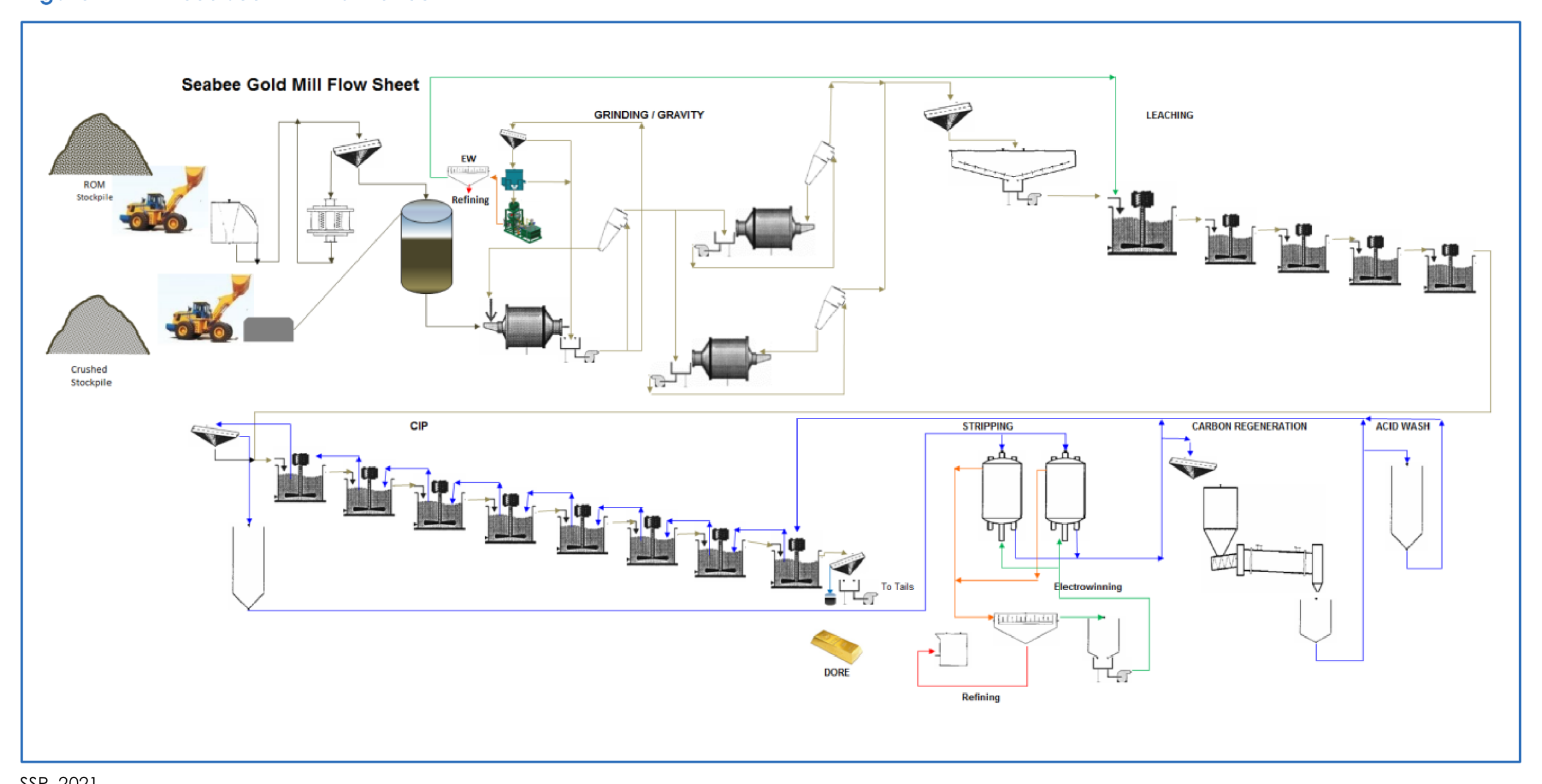
SSR Mining's 2021 technical report on the Seabee Gold Operation describes a small, fly-in mill that has run since 1991, now treating Santoy ore at about 1,180 tpd with gravity concentration, cyanide leaching and carbon-in-pulp at over 98% recovery.
The Seabee Gold Operation lies at the north end of Laonil Lake in Saskatchewan, about 125 km northeast of La Ronge. SSR Mining Inc. holds it 100% through SGO Mining Inc., having acquired it with Claude Resources in May 2016. The technical report, effective 31 December 2021, covers an operating underground gold operation. The Seabee mine produced from 1991 until it was depleted in 2018, and the Santoy mine has been in continuous commercial production since 2014. Both have fed the same mill beside the Seabee shaft. Workers fly in to a 1,275 m airstrip, and a 60 km winter road from Brabant Lake brings heavy supplies. In 2021 the mill treated 382,478 t at 9.92 g/t gold and produced 120,030 oz at 98.4% recovery.
Critical Data
| Parameter | Value | Unit | Notes |
|---|---|---|---|
| Mill start-up | Late 1991 | Not applicable | Seabee mine commenced December 1991 |
| Original capacity | 500 | tpd | Expanded to 1,000 tpd with a third mill |
| Daily rate, 2021 | 1,180 | tpd | 382,478 t for the year |
| Head grade, 2021 | 9.92 | g/t Au | Santoy ore |
| Gold recovery, 2021 | 98.4 | % | 120,030 oz produced |
| Mill operating time | 94.6 | % | Monthly average since 2014 |
| Crushed product size | Minus 20 | mm | Jaw and cone crushing |
| Primary ball mill | 2.9 m x 3.7 m | Not applicable | Closed circuit with cyclones |
| Secondary mills | 2 | Not applicable | 2.7 m x 2.6 m |
| Grind size | 80% passing 200 | mesh | Leach feed |
| Gravity share of gold | About 65 | % | Knelson and Acacia circuit |
| Leach time | 39 | hours | Five tanks at nominal capacity |
| CIP tanks | 8 | Not applicable | About 17.2 t of carbon |
| Water recycled | 96 | % | Of mill requirements |
Overview
The Seabee mill uses a conventional flowsheet. Ore is crushed in two stages and ground in three ball mills, and a gravity circuit takes coarse gold from the primary mill circulating load. The rest of the gold is leached with cyanide in five agitated tanks and adsorbed in eight carbon-in-pulp (CIP) tanks. Loaded carbon is stripped at atmospheric pressure and electrowon, and the gravity and CIP gold are smelted together into doré on site. The mill first ran on diesel power and joined the Saskatchewan grid in 1992.
The plant started at 500 tpd and reached 1,000 tpd with a third grinding mill. It has since been pushed above that rate, averaging more than 1,100 tpd from 2018 onward.
Key Process Stages
Crushing
A jaw crusher handles primary crushing, followed by a cone crusher in closed circuit with a triple deck screen. The minus 20 mm product goes by conveyor to an ore bin with 400 t of live capacity. To add surge capacity for crusher breakdowns and maintenance, fine crushed ore is also stockpiled and fed back in through the original crusher feed point.
Grinding
A 2.9 m by 3.7 m ball mill does the primary grinding. Two 2.7 m by 2.6 m secondary mills finish the grind to 80% passing 200 mesh. All mills run in closed circuit with hydrocyclones. Lime goes into the grinding circuit to hold pH and free cyanide for leaching. A 12 m thickener raises the ground slurry to 48% solids ahead of the leach.
Gravity recovery
Part of the primary mill cyclone underflow goes to Knelson concentrators, with further upgrading on a vibrating table. Gravity gold makes up about 65% of total gold recovered. Two Knelson concentrators and an Acacia reactor, installed in 2017, leach the gravity concentrate in a separate intensive cyanide and electrowinning circuit. The report says optimisation of the Acacia circuit was continuing, and further additions to the gravity circuit were being installed to raise gravity recovery and ease the load on the leach circuit.
Leaching and carbon in pulp
The leach train has five agitated tanks: one 14.6 m by 14.6 m and four 8.8 m by 8.8 m. Air goes into every tank, and cyanide into the first, to keep enough free cyanide to finish dissolving the gold. At nominal capacity the tanks give 39 hours of leaching. Eight CIP tanks, each 3.4 m across and 4.6 m high, hold about 17.2 t of carbon behind launder screens and give about three hours of contact. Loaded carbon is advanced regularly to the strip circuit.
Elution, regeneration and refining
Before elution, hydrochloric acid washes calcium and other acid-soluble impurities off the carbon. Stripping takes place at atmospheric pressure with a heated caustic and isopropyl alcohol solution over about three days. A single electrowinning cell plates the gold onto stainless steel cathodes. After elution the carbon is heated and attrited in a rotary kiln and screened to remove fines before it returns to the CIP tanks. The CIP and gravity gold are refined together in a gas-fired furnace and poured as doré.
Water and tailings
The mill runs mostly on recycled water. About 96% of its needs come from recycle within the grinding circuit and reclaim from the tailings management area. Any tailings solution released to the environment first passes cyanide destruction to keep the water within release standards.
Additional Interesting Data and Summary
Mill records since 2006 show steady improvement in grade and recovery. Recovery rose from 93.6% in 2006 to above 98% from 2019. Head grade climbed from about 5 to 6 g/t in the late 2000s to about 10 g/t in 2020 and 2021. Gold output reached 110,864 oz in 2019, fell to 81,540 oz in 2020 on lower throughput, and hit 120,030 oz in 2021.
The site's climate is close to subarctic, with long, dry, cold winters averaging -24 °C and annual precipitation of about 486 mm.
Key Processes
- Jaw and cone crushing with triple deck screening to minus 20 mm
- Three-mill ball grinding in closed circuit with cyclones
- Knelson gravity concentration with tabling and Acacia intensive leaching
- Thickening ahead of five-tank agitated cyanide leaching
- Eight-tank carbon-in-pulp adsorption
- Acid washing, atmospheric caustic-alcohol stripping and electrowinning
- Rotary kiln carbon regeneration
- Cyanide destruction on released tailings water
Source: Seabee 2021 Technical Report, Seabee Gold Operation, Saskatchewan, Canada, 31 December 2021.
Project website: Seabee Gold Operation
