

Technical report with an effective date of October 6, 2014, prepared for Franco-Nevada Corporation, describing two operating copper concentrators,Candelaria (75,000 t/d nominal capacity) and Pedro Aguirre Cerda (3,800 t/d design capacity),plus tailings storage and proposed new facilities in Atacama Province, Chile.
Report context
This technical report was prepared by SRK Consulting (Canada) Inc. for Franco-Nevada Corporation and Franco-Nevada (Barbados) Corporation. It covers the Candelaria and Ojos del Salado copper projects, which comprise two separate processing plants: the Candelaria processing plant, which started production in 1995, and the Pedro Aguirre Cerda (PAC) processing plant, operated by Minera Ojos del Salado, which has been in operation since 1929. The Candelaria plant receives ore from the Candelaria open pit and the Candelaria Norte and Alcaparrosa underground mines. The PAC plant receives ore from the Santos underground mine. Both plants have been operating for several years and, other than matters discussed in the report, operate with adequate energy, water and process materials.
Processing route
Candelaria processing plant
The Candelaria plant operates a conventional flowsheet incorporating crushing, two parallel process lines for grinding and flotation, reclaim of process water from the tailings storage facility, final concentrate filtration, and shipping of bulk copper concentrates.
Run-of-mine ore is trucked to a primary gyratory crusher (60 in x 89 in). The crushed product is conveyed by an overland conveyor belt system to a coarse ore stockpile with a combined live and dead capacity of 500,000 tonnes. Grinding takes place in multi-stage closed circuit using SAG mills, ball mills and pebble crushing.
Mill processing line 1 includes one SAG mill (36 ft x 15 ft), three pebble crushers, two ball mills (20 ft x 30 ft), and two 10-hydrocyclone clusters. Flotation on line 1 comprises 14 rougher cells (3,000 ft³ each), one regrind mill (14 ft x 22 ft), four column cells, and three flotation cells (3,000 ft³ each).
Mill processing line 2 includes one SAG mill (36 ft x 15 ft), three pebble crushers, two ball mills (20 ft x 30 ft), and two 10-hydrocyclone clusters. Flotation on line 2 comprises 10 rougher cells (4,500 ft³ each), one vertical regrind mill (800 HP), four column cells, and six flotation cells (4,500 ft³ each).
Multi-stage flotation using mechanical cells, regrind mills and column cells produces a copper concentrate containing gold and silver as credit metals. Final concentrate is thickened in three 100 ft diameter thickeners, filtered through eight ceramic filters, and stored on site (5,000 tonnes total capacity) before being trucked to the shipping port at Punta Padrones, near Caldera, which has 45,000 tonnes of storage capacity.
Final flotation tails are thickened in two 400 ft diameter tailings thickeners and disposed of in a rockfill embankment tailings storage facility. Process water is reclaimed from the tailings reclaim pond and seepage collection system for reuse.
A multi-stage flotation circuit using an arrangement of mechanical cells, regrind mill, and column cells produces copper concentrate. Final copper flotation concentrate with gold and silver by-product metals is thickened, filtered, and stored on site before being trucked to Candelaria’s shipping port located in Punta Padrones, near Caldera.
PAC processing plant (Ojos del Salado)
The PAC concentrator processes 3,800 tonnes per day of fresh feed from the Santos underground mine.
The crushing plant comprises a primary jaw crusher (48 in x 60 in), a secondary cone crusher (Symons 7 ft standard), and two tertiary cone crushers (Symons 7 ft short head) in closed circuit.
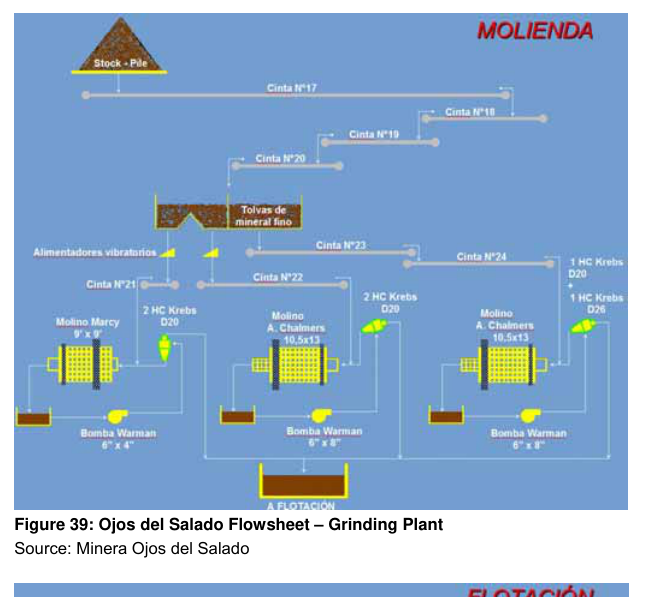
The grinding plant has three ball mills (one 9 ft x 9 ft, and two 10.5 ft x 13 ft) operating in parallel and in direct closed circuit with hydrocyclone classification.
The flotation plant uses conventional multi-stage, mechanical, self-aspired and forced-air flotation cells (1,500, 300, and 100 ft³), regrind milling, and column cells for the final concentrate cleaning stage. Final concentrate is thickened and filtered using a 30 m³ ceramic disc filter.
Final flotation tailings from the PAC plant are pumped unthickened to the main Candelaria tailings storage facility.
Reagents
Both plants use a suite of surface modifiers commonly used in the base metals industry. At Candelaria:
- Primary collector (AP3894, Cytec): 6–12 g/t
- Secondary collector (Hostaflot-Lib K, Sansil-Clariant): 3–8 g/t
- Frother (Nalflote 9837, Nalco): 3–10 g/t
- Lime (Inacal): 400–545 g/t
- Flocculant for concentrate (Optimer 9876, Nalco): 2–5 g/t
- Flocculant for tailings (SNF 228, SNF): 5–10 g/t
Tailings storage
The current Candelaria tailings storage facility receives flotation tails from both the Candelaria and Ojos del Salado plants. Candelaria flotation tails are thickened and pumped at an average solids concentration of 50.1%. Ojos del Salado flotation tails are pumped unthickened at an average solids concentration of 35.3%. The facility has five embankment dams,three built with mine waste material (Main dam, North dam, South dam) and two built from borrow material (Caledonia and Decidida). Dams have filter systems comprising varying combinations of granular material, geotextile and/or HDPE liner on the upstream slope. Downstream slopes are 1.6(H):1.0(V) and upstream slopes are 1.8(H):1.0(V), except for the Decidida dam where both slopes are 1.8(H):1.0(V). All dam construction uses the downstream method. The remaining storage capacity is estimated at 43 million m³, sufficient until end of 2017 at current throughput, when the dam reaches its permitted height of 800 m above sea level.
A proposed new tailings management facility, Los Diques, is located to the west of the open pit and plant sites. It has a total available tailings capacity of 600 million tonnes to a final crest elevation of 873 m above sea level, exceeding the current mine life requirements. The facility would have three embankments built from mine waste material with transition and filter, a geomembrane on the upstream slope, and a grout curtain for the north and south embankments. A slurry trench and drain wall with wells would collect seepage water for recirculation. The Los Diques facility was a key part of the “Candelaria 2030 – Project Operational Continuity” environmental impact assessment submitted in September 2013 and under review at the time of the report.
To mitigate risk if Los Diques permitting and construction is not completed before the existing facility is full, Minera Candelaria is considering two options: reducing the existing dam freeboard from 5.0 to 1.5 metres (providing another 13–15 months of capacity) and/or raising the existing facility by an additional 4.0 metres to a crest height of 804 m above sea level (providing another 12–14 months of capacity, subject to further permitting).
Additional processing
Since 2008, tailings from the Candelaria processing plant have been treated under an agreement with Compania Minera del Pacifico S.A. (CMP) to produce a magnetite concentrate. CMP operates a magnetite extraction plant located west of the plant site and south of the tailings storage facility. The recovered magnetite concentrate is piped to CMP’s port near Caldera, and remaining tailings are deposited in the Candelaria tailings storage facility. Freeport reported this by-product revenue as worth US$33 million in 2013.
Key reported parameters
| Parameter | Value | Basis |
|---|---|---|
| Candelaria plant nominal capacity | 75,000 t/d fresh feed | Design |
| Historical average throughput (2000–2013) | ~68,600 t/d (25 Mt/y) at 93% utilization | Measured |
| Candelaria copper recovery (2000–2013 average) | 94.2% | Measured |
| Candelaria gold recovery (2000–2013 average) | 75.4% | Measured |
| Candelaria silver recovery (2000–2013 average) | 82.6% | Measured |
| Typical copper concentrate grade (2000–2013) | 30.1% Cu, 5.4 g/t Au, 90 g/t Ag | Measured |
| Concentrate moisture after filtration | 7.6% | Measured |
| Fresh make-up water ratio (2012) | 0.34 m³/t fresh ore | Measured |
| PAC plant design capacity | 3,800 t/d | Design |
| PAC historical head grade | 0.85% Cu | Measured |
| PAC copper recovery | 93.5% | Measured |
| PAC concentrate grade (weighted average 2010–2012) | 29.7% Cu, 5.6 g/t Au, 71 g/t Ag | Measured |
| Candelaria tails solids concentration to TSF | 50.1% | Measured |
| Ojos del Salado tails solids concentration to TSF | 35.3% (unthickened) | Measured |
| Existing TSF remaining capacity | 43 million m³ | Estimated |
| Los Diques proposed capacity | 600 million tonnes | Design |
| Los Diques final crest elevation | 873 m above sea level | Design |
| Primary collector consumption range | 6–12 g/t | Operating range |
| Lime consumption range | 400–545 g/t | Operating range |
Technical qualifications
This profile is based on a technical report with an effective date of October 6, 2014 and signature date of March 20, 2015, prepared for Franco-Nevada Corporation. The report describes historical and current operations at two existing processing plants; it is not a feasibility study or a proposal for new processing facilities. The Los Diques tailings facility is a proposed project that was under environmental review at the time of the report. All metallurgical recoveries and concentrate grades are historical averages from specified periods, not forecasts or guarantees. The report notes that Minera Candelaria has an agreement with a third party (CMP) for magnetite recovery, and that Freeport reported the associated revenue. The report also notes that a new tailings storage facility will be required over the projected life-of-mine plan.
Source: Technical Report for the Compañía Contractual Minera Candelaria and Compañía Contractual Minera Ojos del Salado Copper Projects, Atacama Province, Region III, Chile, effective date October 6, 2014, signature date March 20, 2015, SRK Project Number 3CF016.001, Section 16 Recovery Methods (original Markdown lines 4695–4987).
