

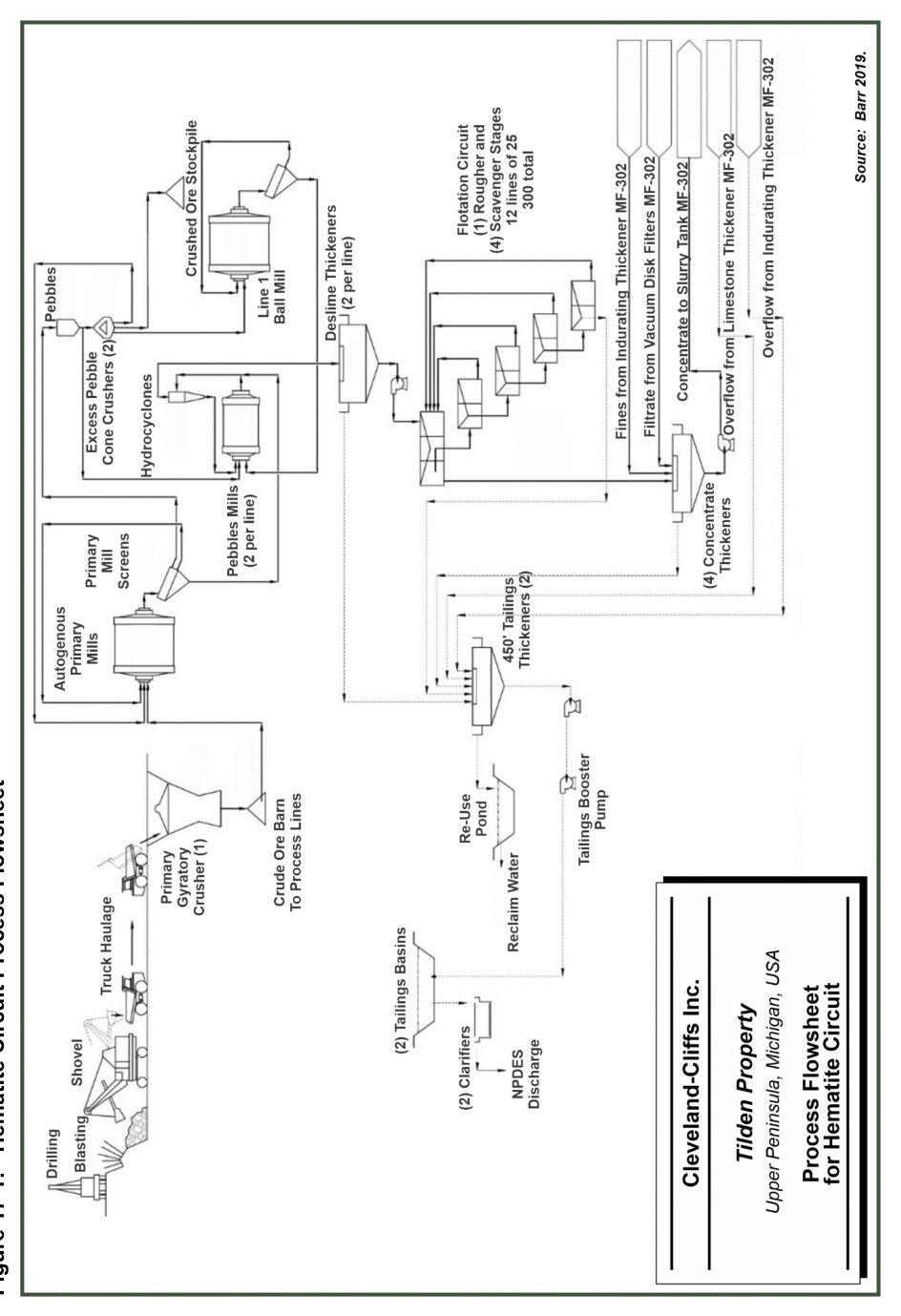
The 2024 technical report on Cleveland-Cliffs' Tilden property in Michigan describes eleven autogenous mills, selective flocculation ahead of silica flotation, and a grate-kiln pellet plant that fires fluxed pellets.
Tilden is an open pit iron ore operation in the Upper Peninsula of Michigan, about five miles south of Ishpeming. The owner, Tilden Mining Company L.C., is a wholly owned subsidiary of Cleveland-Cliffs Inc. The NI 43-101 technical report by SLR, effective December 31, 2021 and signed August 16, 2024, gives the concentrator a nominal capacity of 7.7 million long tons (MLT) a year of fluxed pellets. The plant was designed to campaign either hematite-dominant or magnetite ore, but not both at once. Magnetite processing at the concentrator ceased in 2009, so the remaining reserves are treated in hematite-based flotation circuits. The report gives the annual feed as about 20.3 MLT of crude ore, wet, which yields 8.0 MLT of fluxed concentrate and 7.5 MLT of fluxed pellets.
Critical Data
| Parameter | Value | Unit | Notes |
|---|---|---|---|
| Nominal pellet capacity | 7.7 | MLT/y | Fluxed pellets |
| Crude ore processed | About 20.3 | MLT/y wet | Annual |
| Fluxed concentrate | 8.0 | MLT/y wet | Annual |
| Fluxed pellets | 7.5 | MLT/y wet | Annual |
| Head grade, 2014 to 2020 | 33.4 to 34.8 | % Fe | Crude ore |
| Iron recovery | 66.0 to 72.3 | % | To flotation concentrate |
| Concentrate grade | 62.5 to 63.7 | % Fe | 2014 to 2020 range of annual averages |
| Primary crusher | 60 x 109 | in | Gyratory, nominal minus 9 in |
| Primary AG mills | 11 | Not applicable | 27 ft x 14.5 ft, 5,720 hp each |
| Pebble mills | 2 per AG mill | Not applicable | 15.5 ft x 32 ft |
| Final grind | 80 to 85 | % passing 25 µm | Cyclone overflow |
| Rougher flotation | 12 lines x 10 cells | 500 ft3 | Amine collector |
| Concentrate filter cake | About 11.5 | % moisture | 9 ft disc vacuum filters |
| Balling drums | 14 | Not applicable | 12 ft x 33 ft, about 12 rpm |
| Kilns | 2 | Not applicable | 25 ft x 160 ft |
Overview
Tilden's flowsheet is built around comminution, selective flocculation and reverse flotation. The report names the selective flocculation and desliming step ahead of flotation as the unique feature of the plant, since it removes slime contaminants that would otherwise cause serious problems in later stages. Ore is crushed in one gyratory crusher, ground in autogenous mills and pebble mills, deslimed with starch, and floated with an amine collector to remove silica. The concentrate is thickened, filtered, mixed with fluxstone slurry, balled and fired in a grate-kiln-cooler system.
Key Process Stages
Comminution
A 60 inch by 109 inch Allis-Chalmers gyratory crusher, run by the mining department, makes a nominal minus 9 inch product that is conveyed to the ore storage building. Primary grinding uses eleven 27 ft by 14.5 ft autogenous mills, each driven by two synchronous motors with a combined 5,720 hp. Each mill discharges to a triple-deck screen. The minus 1.5 inch by plus 0.5 inch fraction serves as grinding media for the pebble mills, with the excess sent to the pebble crushers or back to the primary mill. The minus 0.5 inch by plus 2 mm fraction returns to the primary mill, and the minus 2 mm fraction goes on. Each AG mill feeds two 15.5 ft by 32 ft pebble mills, running in closed circuit with nine 15 inch cyclones to make a final grind of 80% to 85% passing 25 µm. Caustic soda and slaked lime control pH ahead of desliming and flotation.
Desliming
Starch and a dispersant are added to the slurry, which goes to the deslime thickeners. The starch selectively flocculates and depresses the iron oxides, and the siliceous slimes are dispersed and removed. Thickener overflow, which carries the waste, goes to the tailings thickeners, and the settled slimes go to the tailings pond. Thickener underflow is conditioned with more starch and sent to flotation.
Flotation
Flotation is arranged in twelve lines. Each line has ten 500 ft3 rougher cells that float silica-rich tailings away from the iron minerals with an amine collector. Rougher concentrate is the final upgraded iron concentrate and goes to the concentrate thickener. Rougher tailings are scavenged in four stages with fifteen 500 ft3 cells per line. Scavenger concentrate returns to the head of the rougher circuit, and scavenger tailings are pumped to the tailings thickeners.
Dewatering and fluxstone
Concentrate is thickened to about 65% to 70% solids in two 150 ft and two 180 ft Eimco thickeners, neutralized to pH 7.0 with carbon dioxide, and filtered on 9 ft disc vacuum filters to about 11.5% moisture. Filtered concentrate goes straight to the pellet plant, to a thermal drying circuit or to a stockpile. Dolomite and calcite fluxstone arrives by truck and is ground in two 15.5 ft by 30 ft ball mills. The slurry is added to the concentrate before filtering to ensure even mixing.
Pellet plant
Part of the concentrate, together with concentrate reclaimed from stockpiles, is dried in a rotary dryer and combined with filtered concentrate. The balling feed targets 9.5% moisture. Fourteen rotary drums, 12 ft by 33 ft and turning at about 12 rpm, make green balls with bentonite as the binder. A vibrating seed screen returns undersize to the drums. Green balls are loaded on the grate at a nominal bed depth of seven inches and pass 19 wind boxes: 3.5 bays of updraft drying, 7.5 bays of downdraft drying and eight bays of downdraft preheating. They then discharge into one of two 25 ft by 160 ft rotary kilns heated by pulverized coal, natural gas or both, and are cooled in two rotary coolers. Pellets go to rail loadout or to an outdoor stockpile of about 2 MLT, and are hauled by rail to a dock in Marquette, Michigan or directly to customers. Chips and fines screened from the stockpile are sold as a secondary product.
Additional Interesting Data and Summary
When magnetite was campaigned, from 1989 to 2009, the circuit added magnetic separation in two places. Screen undersize from each AG mill went to low-intensity cobbing, the cobber tail went to tailings, and the magnetic fraction continued to the pebble mills. After two stages of desliming, a finisher stage of low-intensity magnetic separation fed the silica flotation. Tilden magnetite ore was also processed at the Empire Mine from 2010 until the Empire Mine was indefinitely idled in 2016.
Plant performance for 2014 to 2020 shows crude head grades of 33.4% to 34.8% iron, with iron recovery to flotation concentrate averaging between 66.0% and 72.3%. The major equipment list also includes 42 vacuum disc filters and two 450 ft dewatering thickeners.
Key Processes
- Gyratory crushing to nominal minus 9 inches
- Autogenous grinding with screening and pebble mill regrinding in closed circuit with cyclones
- Selective flocculation and desliming with starch
- Reverse flotation of silica with an amine collector, with four stages of scavenging
- Thickening, carbon dioxide neutralization and disc vacuum filtration
- Fluxstone grinding and slurry blending
- Drum balling with bentonite
- Grate-kiln-cooler induration
Source: NI 43-101 Technical Report, Tilden Property, Michigan, USA, December 31, 2021.
Project website: Tilden Mine
