

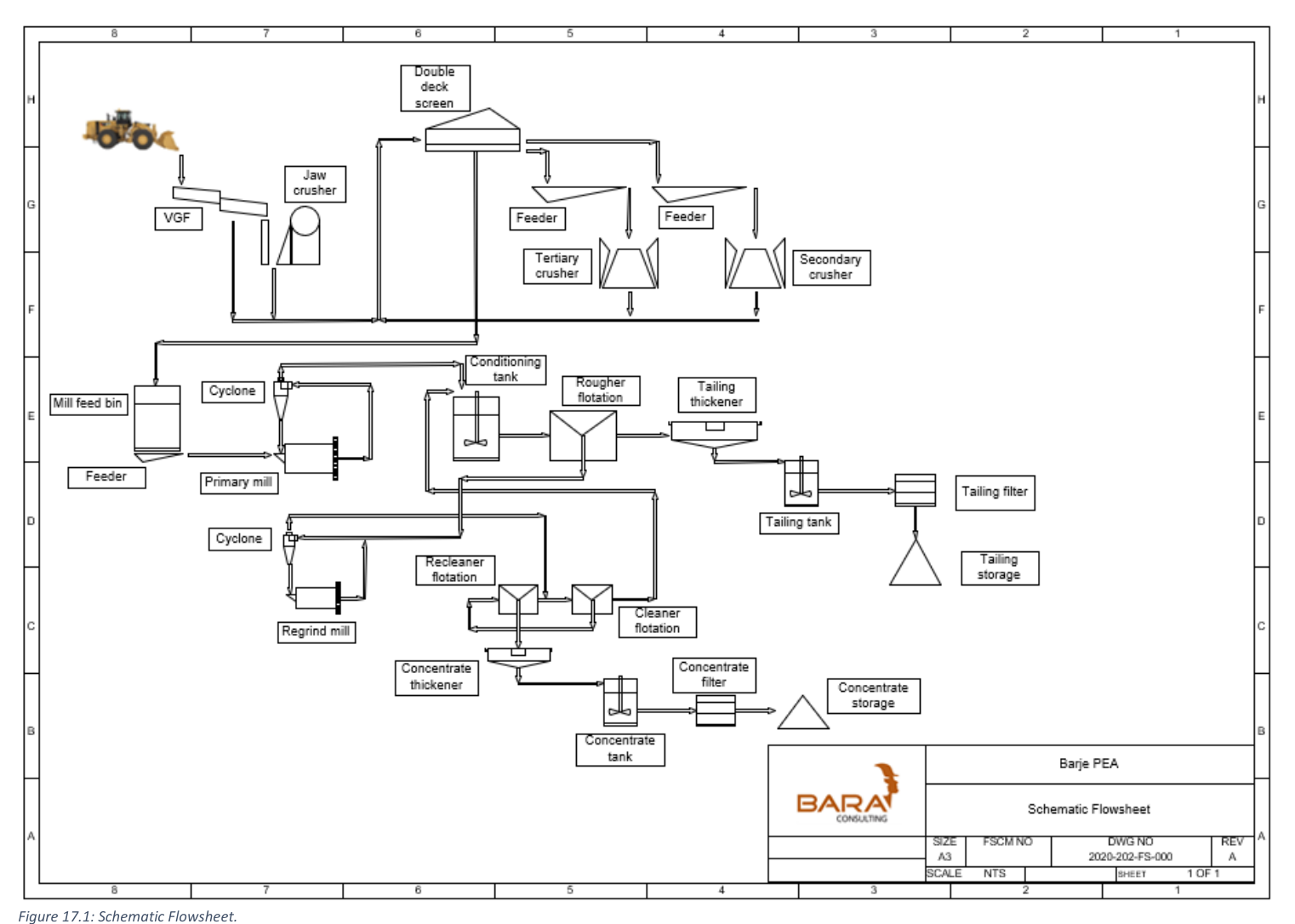
Medgold's March 2021 preliminary economic assessment for the Tlamino project describes a 625,000 t/y plant with three-stage crushing, ball milling to 80 µm, rougher and two-stage cleaner flotation, regrinding to 30 µm and filtered tailings.
Tlamino is a gold and silver project in southeast Serbia, principally in the district of Pčinja. Addison Mining Services prepared the Preliminary Economic Assessment and NI 43-101 Technical Report for the Medgold Tlamino Project Licences, with an effective date of January 7, 2021 and a signature date of March 11, 2021, for Medgold Resources Corp. Laboratory testing for the assessment showed that bulk sulphide flotation can make a concentrate with gold and silver contents at grades that are commercially attractive to international markets, so bulk sulphide flotation was adopted. No comminution testing has been done. Ball milling with feed prepared by three-stage crushing and screening is assumed, as a simple and robust option, and the report says alternative comminution methods should be investigated in later test work.
Critical Data
| Parameter | Value | Unit | Notes |
|---|---|---|---|
| Annual tonnage | 625,000 | t/y | Assumption |
| Crushing feed rate | 96 | t/h | 75% utilisation, 6,534 h/y |
| Milling feed rate | 77 | t/h | 93% wet plant utilisation, 8,102 h/y |
| Feed gold | 3.90 | g/t | Test work |
| Feed silver | 68 | g/t | Test work |
| Feed lead and zinc | 0.32 / 0.66 | % | Test work |
| Feed arsenic | 1.20 | % | Test work |
| Feed sulphide sulphur | 3.14 | % | Test work |
| ROM feed size | 250 | mm d80 | Assumption, d100 600 mm |
| Crusher product | 10 | mm P80 | Assumption |
| Mill circuit product | 80 | µm P80 | As used in the test work |
| Mill discharge solids | 70 | % | Typical |
| Cyclone overflow density | 35 | % solids | Assumption |
| Regrind | 30 | µm P80 | Rougher concentrate |
| Mass pull, rougher / cleaner 1 / cleaner 2 | 11.7 / 7.7 / 7.0 | % | Test work |
| Recovery to final concentrate | 83.4 / 82.4 | % Au / % Ag | Test work |
| Low-grade share of feed | 37 | % | Over the life of mine |
Overview
The flowsheet has crushing, a ball mill in closed circuit with hydrocyclones, conditioning with flotation reagents, rougher flotation, regrinding of rougher concentrate, two stages of cleaning and recleaning, concentrate thickening and pressure filtration, and tailings thickening and pressure filtration to a dry-stack tailings storage facility (TSF). Gravity concentration by Knelson concentrator was tested in the laboratory without any increase in recovery or concentrate grade, so it is not in the proposed flowsheet. A rougher stage followed by two stages of cleaning is enough to make an acceptable concentrate.
Key Process Stages
Crushing
ROM material is hauled by truck to a storage and blending stockpile, reclaimed by front-end loader and tipped into a bin. A vibrating grizzly feeder scalps coarse material to a jaw crusher. Undersize from the feeder joins the jaw discharge on a conveyor to a double deck vibrating screen. Top deck oversize goes to a secondary cone crusher and lower deck oversize to a tertiary cone crusher. The combined crusher discharges return to the screen, and screen undersize with a nominal P80 of 10 mm is the final crushed product.
Milling and flotation
A ball mill in closed circuit with hydrocyclones takes crusher product from the bin, with underflow returning to the mill and overflow advancing to flotation at a P80 of 80 µm. Overflow enters an agitated conditioning tank with potassium amyl xanthate (PAX) as a sulphide collector and methyl isobutyl carbinol (MIBC) as a frother. Rougher concentrate is pumped to a hydrocyclone whose underflow goes to a regrind ball mill, giving a P80 of 30 µm, and whose overflow advances to cleaner flotation. Cleaner concentrate passes to a recleaner cell. Recleaner tailing enters the first cleaner with the rougher concentrate, and cleaner tailing returns to the rougher. PAX and MIBC are added to the cleaner stages as required.
Treatment of the cleaner tail
In the laboratory tests the cleaner tailing did not return to the rougher, because only single batch tests were performed. The PEA assumes that returning it is not detrimental to rougher flotation and will therefore help recovery, and the report says this should be confirmed through locked cycle tests.
Dewatering and tailings
Recleaner concentrate is the final product. It is thickened in a conventional thickener, stored in an agitated tank, filtered in a pressure filter and stored and blended in a shed before road transport off site. Rougher tailing is densified in a high-rate thickener, stored in an agitated tank and dewatered in a pressure filter. The filter cake is trucked to the TSF. Water recovered by the thickeners and filters returns to the mill circuit. The dry-stack TSF is meant to improve geotechnical properties and reduce environmental impacts.
Two feed types
High-grade breccia and low-grade schist will be processed separately to maximise revenue from the concentrate made from the high-grade material, and low-grade material will be stockpiled and processed in campaigns. The laboratory work shows the same grind size and flotation parameters suit both material types. Low-grade material is 37% of total plant feed over the life of mine and ranges from 0.9% to 63.1% annually, with the highest fractions in each of the last two years. Campaigns of treating low-grade feedstocks of around three months are envisaged.
Additional Interesting Data and Summary
Some minor changes to the flotation circuit configuration may be needed to handle the lower rougher concentrate quantity and cleaner flows when treating low-grade material. Optimisation of the milling and flotation for each rock type will confirm how far adjustments are needed.
The process design criteria table marks which values come from laboratory test work and which are assumptions or calculations. Test work values include feed composition and the mass pulls and recoveries, while the annual tonnage, feed size and crusher product size are assumptions.
Key Processes
- Three-stage crushing and screening
- Ball milling in closed circuit with hydrocyclones
- Bulk sulphide rougher flotation with PAX collector
- Regrinding to 30 µm and two-stage cleaning
- Thickening and pressure filtration of concentrate
- Thickening and pressure filtration of tailings for dry stacking
Source: Preliminary Economic Assessment and NI 43-101 Technical Report for the Medgold Tlamino Project Licences, Serbia, March 11, 2021.
Project website: Tlamino Project
