

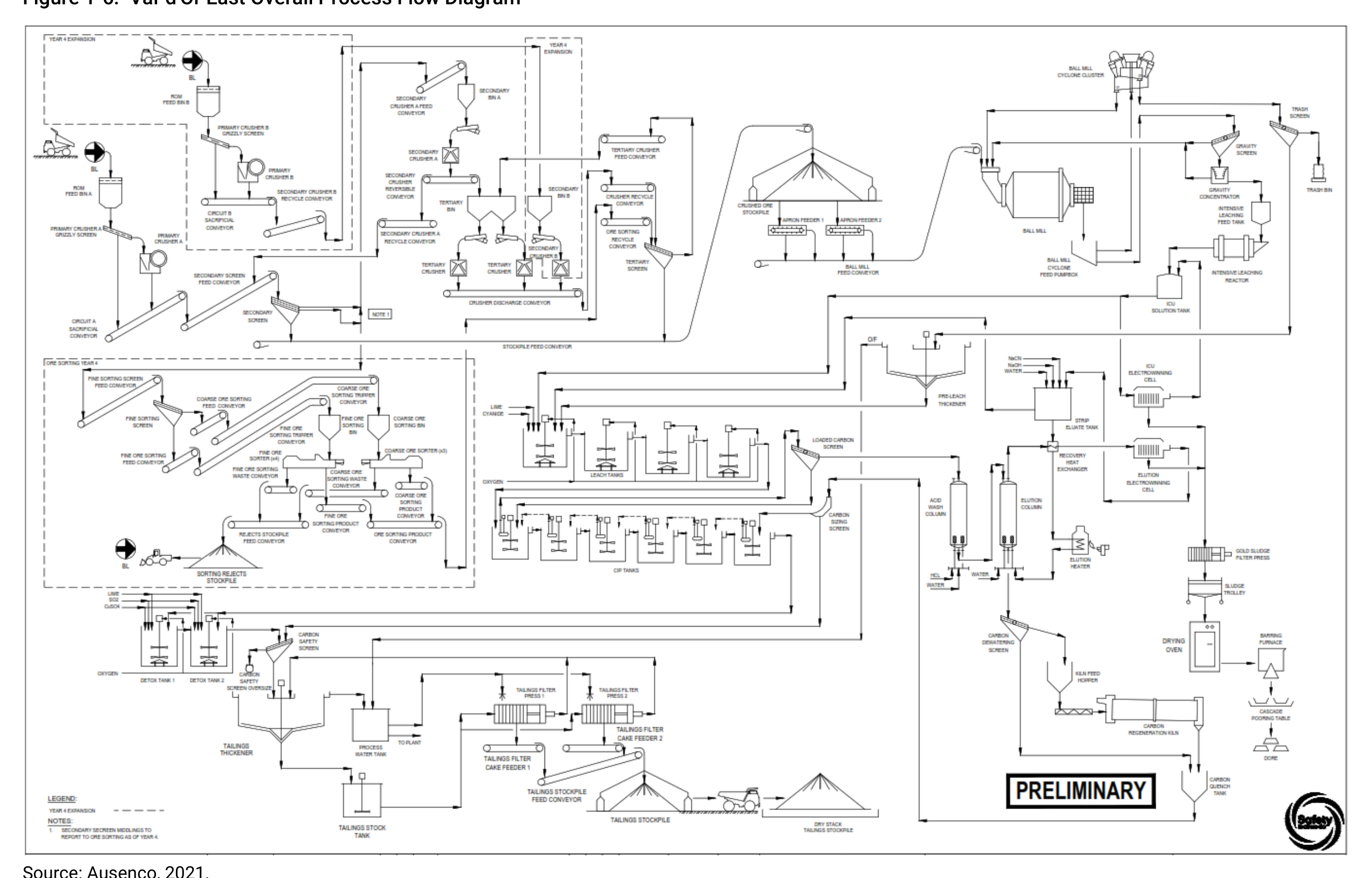
Ausenco's 2021 preliminary economic assessment for Probe Metals' Val-d'Or East project in Quebec plans a three-stage crush, ball mill, gravity and CIP flowsheet at 3.65 Mt/y, with a second crushing circuit and X-ray transmission sorters raising feed grade from Year 4.
The Val-d'Or East Project in Quebec, Canada belongs to Probe Metals Inc. and has an NI 43-101 Technical Report and Preliminary Economic Assessment prepared by Ausenco Engineering Canada, with an effective date of September 7, 2021. The flowsheet was selected from preliminary testwork and financial evaluations, using standard technologies widely used in gold processing plants. A process plant of 10,000 t/d, or 3,650,000 t/y, runs in two phases. Phase 1 treats run-of-mine material through three-stage crushing, ball milling, gravity recovery, leaching and carbon-in-pulp (CIP), with no ore sorting. Phase 2 expands the crushing circuit in Year 4 with particle ore sorting, so crushing throughput rises while the plant feed rate stays constant at a higher gold grade. Design recovery is 94.7% overall, 50% from the gravity circuit and 44.7% from the CIP and elution circuit.
Critical Data
| Parameter | Value | Unit | Notes |
|---|---|---|---|
| Plant throughput | 3,650,000 | t/y | 10,000 t/d |
| Crushing throughput, Phase 2 | 16,746 | t/d | Circuit A 10,000 t/d, Circuit B 6,746 t/d |
| Crushing availability | 65 | % | 5,694 h/y |
| Grinding availability | 92 | % | 8,059 h/y |
| Tailings filtration availability | 82 | % | 7,183 h/y |
| Design milling rate | 453 | t/h | Dry |
| Peak ROM head grade | 2.51 | g/t Au | Not applicable |
| Crushed product | 7.7 | mm P80 | 8 mm in Phase 2 |
| Primary grind | 75 | µm P80 | 350% circulating load |
| Bond ball mill work index | 11.7 | kWh/t | Crusher work index 20.0 kWh/t |
| Leach and CIP tanks | 9 | tanks | Three leach, six CIP |
| Leach and adsorption time | 48 | h | Report text |
| Carbon batch | 6 | t | AARL elution |
| Cyanide detoxification | 1.0 | h | SO2 and oxygen at pH 8.5 |
| Mill feed stockpile | 10,000 | t | 24 hours live |
Overview
Three-stage crushing feeds a covered stockpile, a ball mill in closed circuit with cyclones and a semi-continuous centrifugal gravity concentrator. Gravity concentrate goes to intensive leaching and electrowinning. Cyclone overflow goes through a trash screen, a pre-leach thickener, three leach tanks and six CIP tanks. Loaded carbon is acid washed, eluted in an Anglo American Research Laboratory (AARL) circuit, and the gold is electrowon and smelted to doré. Tailings are detoxified, thickened, filtered and dry stacked.
Key Process Stages
Crushing and ore sorting
In Phase 1, haul trucks tip ROM material into a feed bin, with stockpile blending to stabilize grade and hardness. A vibrating grizzly sends oversize to a primary jaw crusher, and undersize bypasses it. Secondary and tertiary crushing follows, with one jaw, one secondary cone and two tertiary cone crushers. In Year 4, Circuit A feeds sub-grade material to ore sorting, and middlings from the secondary screen pass to a fine sorting screen, then to three coarse sorters for minus 75 plus 25 mm and four fine sorters for minus 25 plus 12 mm, all X-ray transmission (XRT) units. Rejects go to a waste stockpile and a waste rock facility, and sorted product returns at the tertiary screen. Circuit B, a second primary and secondary crusher in open circuit, lets high-grade material bypass sorting and go straight to the ball mill circuit.
Grinding and gravity
Two apron feeders reclaim crushed rock from the stockpile to a ball mill, which receives quicklime on its feed conveyor and acts as a lime slaker to raise slurry pH before leaching. Mill discharge goes to a hydrocyclone cluster that classifies at 75 µm, with underflow returning to the mill. The gravity circuit takes a rate equal to 100% of fresh feed. A screen protects the centrifugal concentrator from oversize that would block fluidization openings, and the concentrator operates semi-continuously. Free gold is flushed with water to the intensive leach reactor module.
Leaching and CIP
Overflow passes a trash screen to a pre-leach thickener that raises density to 55% solids, with flocculant. Underflow feeds the first of three leach tanks of 5,647 m3 each, followed by six CIP tanks of 538 m3 each. Oxygen is injected into the leach tanks, hydrated lime holds pH above 10.5 to prevent hydrogen cyanide formation, and sodium cyanide is added to the first leach tank. Carbon moves counter-current from the sixth tank to the first.
Elution, intensive leaching and gold room
A 6 t acid wash column and a 6 t elution column strip gold with sodium cyanide and sodium hydroxide. Barren carbon is regenerated in a rotary kiln at about 700 °C, cooled with water and returned. In the intensive leach reactor, gravity concentrate is leached batchwise with sodium hydroxide, sodium cyanide and a leach accelerant, and tailings solids return to grinding. Two electrowinning cells, one for elution solution and one for intensive leach solution, deposit gold, which is washed off, filter pressed, dried, mixed with flux and poured into bars.
Cyanide detoxification and tailings
CIP tailings are detoxified with liquid SO2 and oxygen at pH 8.5, with copper sulphate as catalyst and lime to raise pH, in tanks of 309 m3 live volume each. The slurry then passes a carbon safety screen to a tailings thickener, and overflow returns as process water. Underflow goes to a tailings stock tank and plate and frame pressure filters, with a 12-hour filter cake stockpile. Carbon safety screen oversize is collected in bags for reuse.
Additional Interesting Data and Summary
The design table lists four leach stages of 42 hours and six CIP stages of 6 hours, while the process description gives three leach tanks and six CIP tanks with 48 hours total residence. Crushing feed is up to 800 mm from the open pit and 400 mm from underground, and the 3CB comminution circuit is the name given to the three-stage crushing and ball mill arrangement. Water services cover process, treated, fire and gland water, plus potable water treatment and air services.
The Phase 2 expansion does not change the plant feed rate. It increases the grade by rejecting sub-grade material, and the sorter waste is hauled away rather than milled.
Key Processes
- Three-stage crushing
- XRT particle ore sorting in Phase 2
- Ball mill grinding with cyclone classification
- Centrifugal gravity concentration with intensive leaching
- Leach and carbon-in-pulp adsorption
- AARL elution with electrowinning and smelting
- SO2 and oxygen cyanide detoxification
- Tailings filtration and dry stacking
Source: Val-d'Or East Project NI 43-101 Technical Report & Preliminary Economic Assessment, Quebec, Canada, September 7, 2021.
