

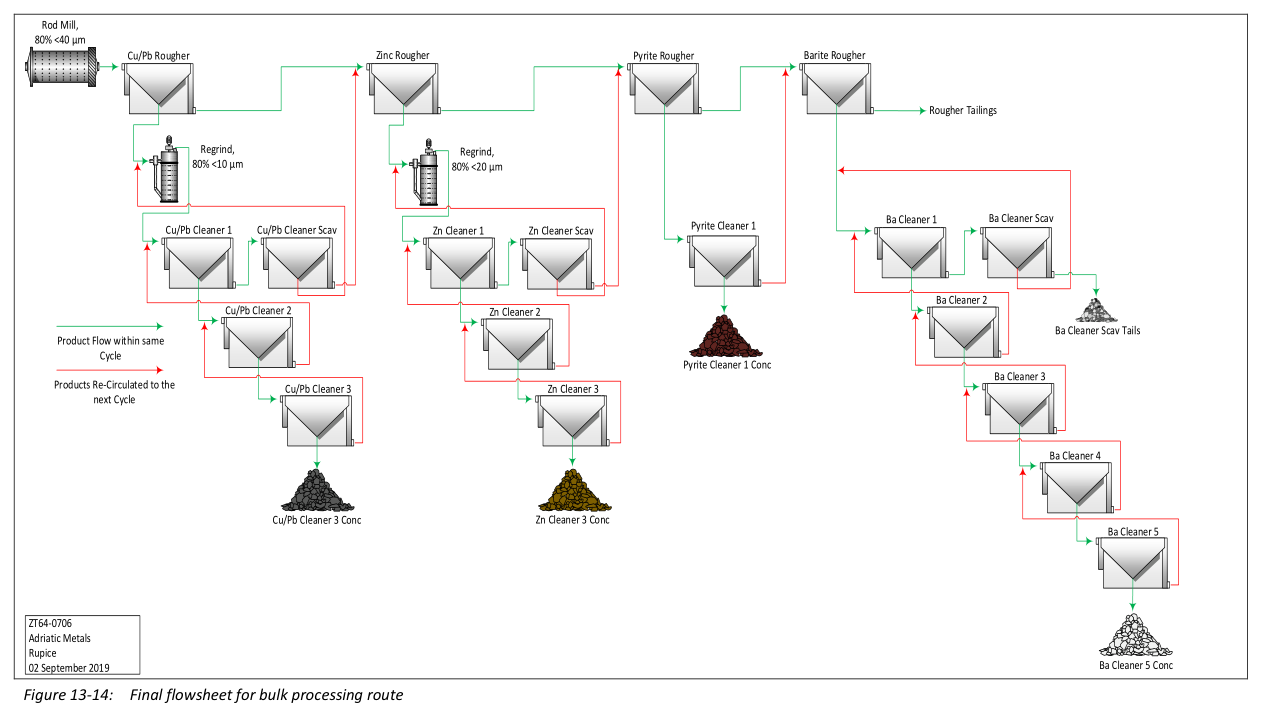
The report describes a conceptual process plant design for treating sulphide mineralisation from the Rupice and Veovača deposits by differential flotation to produce copper-lead, zinc, and barite concentrates.
Report context
This technical report, dated 2019, presents a preliminary economic assessment (PEA) for the Vareš Polymetallic Project in Bosnia and Herzegovina. The processing sections describe a conceptual design for a 0.8 Mtpa facility intended to treat copper, lead, zinc, silver, gold and barite feed from the Rupice deposit, with Veovača material to be processed at a later date. The flowsheet was developed from testwork outlined in Section 13 of the report and represents a conventional differential flotation processing facility.
Processing route
Process route
The optimal process route for treating the Veovača and Rupice sulphide mineralisation is differential flotation to produce separate saleable copper-lead, zinc, and barite concentrates with gold and silver credits.
Design philosophy and basis
The process plant has been designed to treat up to 800 ktpa of feed from the Rupice deposit, with Veovača being processed at a later date. The flowsheet represents a conventional copper-lead, zinc and barite differential flotation processing facility developed from testwork. The primary aims in the design include providing a simple, reliable, low cost processing route; incorporating a robust metallurgical flowsheet ensuring adequate recoveries and flexibility for minor changes in mineralised material types; developing a single flowsheet enabling processing of both open pittable material from Veovača and underground material from Rupice to produce saleable concentrates; ensuring tailings and discharges are environmentally acceptable; constructing with new equipment; and incorporating sufficient automation.
The process plant design was developed to show the values obtained for the Rupice materials balances derived from locked cycle testwork. The Rupice mineralisation requires additional process stages to accommodate additional copper content, an additional pyrite float stage, and the possibility of a future separation stage of the bulk (copper-lead) concentrate into separate copper and lead concentrates. At present, the flowsheet is based upon the sale of a bulk copper-lead concentrate when processing Rupice mineralised material, or a lead concentrate in the future when processing Veovača.
Process description
Following crushing and grinding, the flotation plant consists of three circuits: a copper-lead stream, a zinc stream, and a barite stream. The process includes: two-stage crushing and screening; fine crushed feed storage; rod ball mill grinding and classification; copper-lead rougher/scavenger flotation; copper-lead concentrate regrind; copper-lead two/three-stage closed cycle cleaner flotation; zinc rougher/scavenger flotation; zinc regrind stage; zinc three-stage closed cycle cleaner flotation; pyrite rougher; pyrite single cleaner; barite rougher; barite five-stage closed cycle cleaner flotation; concentrate thickening, filtering, storage and dispatch; tailings thickening and filtration; reagent mixing, storage and distribution; and services for air, water and power.
Process equipment selection
The processing facility will treat feed material at the rate of nominally 100 tonnes per hour, equating to an annual throughput of 800,000 tpa. It is assumed the two major deposit types will be processed separately, with the higher grade Rupice feed being processed for approximately the first 10 years, followed by the lower-grade material from Veovača.
All new equipment has been selected and costed, though suitable second-hand equipment will be considered for major equipment items. The basis for the mass balance is the overall metallurgical balance presented and locked cycle testwork completed on composite samples from both deposits. Run-of-mine material will be crushed to nominally -25 mm and stockpiled. Processing equipment has been selected and sized according to the design criteria and preliminary mass balance.
Historical operating data
No historical operating data for a processing facility at this project is presented in the report sections provided.
Testwork basis
The flowsheet was developed from testwork outlined in Section 13 of the report. The process plant design was developed to show values obtained for the Rupice materials balances derived from locked cycle testwork completed by Wardell Armstrong on composite samples from both deposits.
Key reported parameters
The following design criteria were generated from laboratory testwork, as well as using data from CSA Global's experience and information supplied with respect to the proposed development strategy.
| Item | Unit | Veovača (Design) | Rupice (Design) | Basis |
|---|---|---|---|---|
| Mill throughput | tpa | 800,000 | 800,000 | Assumed |
| Mill throughput | tpd | 2,222 | 2,222 | Calculated |
| Mill throughput | tph | 100 | 100 | Calculated |
| Mill availability | % | 92.5 | 92.5 | Assumed |
| Deposit SG | 3.80 | 3.80 | Testwork | |
| Bond Ball Mill Work Index | kWh/t | 12.31 | 8.54 | Testwork |
| Rod Mill discharge density | %w/w | 75 | 75 | Calculated |
| Ball Mill discharge density | %w/w | 75 | 75 | Calculated |
| Mill recirculating load | % | 250 | 250 | Assumed |
| Cyclone overflow 80% passing | µm | 40 | 40 | Testwork |
| Copper-lead rougher residence time | min | 25 | 25 | Testwork |
| Copper-lead regrind size 80% passing | µm | 20 | 10 | Testwork |
| Copper-lead number of cleaning stages | # | 2 | 3 | Testwork |
| Zinc rougher residence time | min | 40 | 40 | Testwork |
| Zinc regrind size 80% passing | µm | 20 | 20 | Testwork |
| Zinc number of cleaning stages | # | 2 | 3 | Testwork |
| Barite rougher residence time | min | 30 | 30 | Testwork |
| Barite number of cleaning stages | # | 2 | 5 | Testwork |
Project website: https://dpmmetals.com/news-media/news-releases/dundee-precious-metals-announces-proposed-acquisit-10180/
Note: Basis categories are Testwork, Calculated, or Assumed as stated in the source report.
Technical qualifications
This report presents a preliminary economic assessment (PEA) and the process plant design represents a conceptual design intended to satisfy local authorities that the environment can be protected. The study is at a conceptual level. The design criteria have been generated from various laboratory testwork, as well as using data from CSA Global's experience and information supplied with respect to the proposed development strategy. The processing equipment list is based on information from currently available suppliers and in the event of a contract it will be necessary to define the precise equipment specification on a performance basis.
Source: Vareš Polymetallic Project , 2019 Technical Report, Section 17 Recovery Methods, CSA Global Report No: R499.2019.
