

This report describes the uranium recovery methods and processing facilities at the Inkai operation, including demonstrated capacities and an ongoing expansion project.
Report context
The 2024 Inkai Operation Technical Report documents the processing facilities and recovery methods at the Inkai operation in Kazakhstan, which uses in-situ recovery (ISR) techniques. The report includes information on three surface processing facilities, reagent consumption estimates, historical uranium recovery performance, and an expansion project designed to increase production capacity. The annual production target stated in the expansion plans is at least 10.4 million pounds U₃O₈.
Processing route
Surface processing facilities
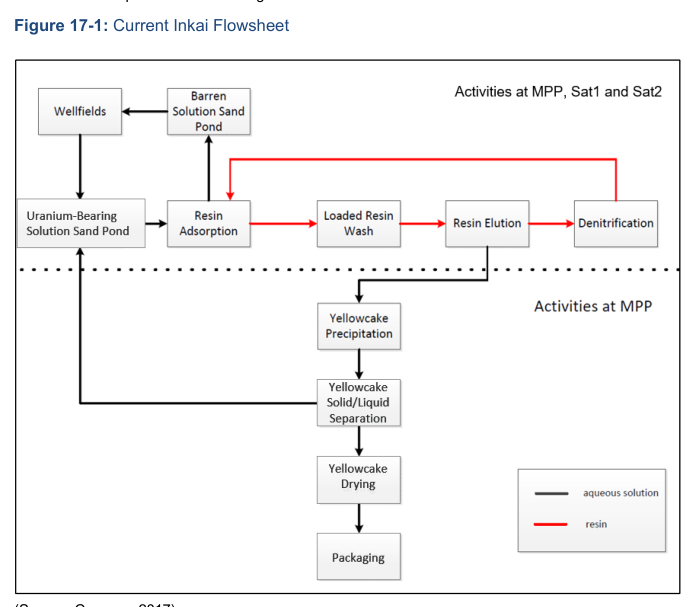
The Inkai operation includes three surface processing facilities: the Main Processing Plant (MPP), Sat1, and Sat2. The MPP circuit includes ion exchange (IX) units with adsorption and elution columns, plus yellowcake precipitation, thickening, drying, and packaging process units. Both Sat1 and Sat2 consist of adsorption and elution equipment. All eluate from Sat1 and Sat2 is transported to the MPP for uranium peroxide production.
Ion exchange resin adsorption (loading)
Wellfield acid solution containing the leached uranium (UBS) is pumped from selected wellfields via pipelines to a settling pond and then to the IX circuits for adsorption. Uranyl sulphate anions are selectively adsorbed onto solid synthetic IX resin beads with fixed ionic sites. Once a resin column is fully loaded, it is isolated from the continuous circuit for elution or transferred with push water to an elution vessel. At the MPP, UBS can be directed to one of several adsorption column trains; at Sat1, UBS reports to either an adsorption column train or a semi-batch adsorption column; at Sat2, UBS reports to a semi-batch adsorption column.
Resin elution (stripping)
Uranium adsorbed onto IX resin is desorbed using ammonium nitrate. At the MPP and Sat1, loaded resin can either be retained in the vessel for elution or hydraulically conveyed to a dedicated elution vessel. Loaded resin can also be transferred between these two plants based on available capacity. At Sat2, loaded resin is hydraulically transferred from the adsorption vessel to an elution vessel. The resulting eluate is stored in tanks.
Denitrification
After elution, the resin must be converted from nitrate form back to sulphate form for reuse. This is achieved by contacting the resin with sulphuric acid and process water in a denitrification vessel at each plant.
Precipitation
Eluate is directed to the precipitation circuit at the MPP. Hydrogen peroxide is added to induce precipitation, and pH is adjusted through addition of anhydrous ammonia. The tanks operate in a cascade configuration for sufficient retention time. The final yellowcake slurry is discharged into a thickener.
Yellowcake product thickening and filtration
The slurry is thickened to approximately 35% solids and pumped to filter presses, where it is washed and dewatered to approximately 65% solids.
Drying and packaging
Dewatered yellowcake is pumped into rotary vacuum dryers. The vacuum dryers are totally enclosed during the drying cycle to assure zero emissions; off-gases and steam are filtered and condensed. Once cooled, a measured amount of dried yellowcake is transferred through a rotary valve into drums before shipping.
Expansion project
Engineering work for a process expansion to support nominal production of at least 10.4 million pounds U₃O₈ per year has been completed and construction is in progress. The project includes upgrading yellowcake filtration and packaging units and adding a pre-dryer and calciner. After completion, total expected production capacity is approximately 13 million pounds per year from leaching and IX and approximately 12 million pounds per year from calcining and packaging. Following completion, use of toll milling services is not expected to be required.
Key reported parameters
| Parameter | Value | Basis |
|---|---|---|
| MPP demonstrated IX capacity | 2.7 million lbs U₃O₈/yr | Historical monthly process data |
| MPP drying/packaging capacity | 8.3 million lbs U₃O₈/yr | Demonstrated |
| Sat1 demonstrated IX capacity | 6.3 million lbs U₃O₈/yr as eluate | Demonstrated |
| Sat2 demonstrated IX capacity | 4.5 million lbs U₃O₈/yr as eluate | Demonstrated |
| Plant recovery from UBS | ~98% | Average since 2015 |
| Overall uranium recovery (LOM) | 85% | Expected for remainder of LOM |
| Sulphuric acid consumption (current) | 165,000 t/yr | Estimated |
| Sulphuric acid consumption (expansion) | 200,000 t/yr | Estimated |
| Ammonium nitrate (current) | 8,300 t/yr | Estimated |
| Ammonium nitrate (expansion) | 9,300,200 t/yr | Estimated |
| Anhydrous ammonia (current) | 720 t/yr | Estimated |
| Anhydrous ammonia (expansion) | 900 t/yr | Estimated |
| Ion exchange resin (current) | 60 m³/yr | Estimated |
| Ion exchange resin (expansion) | 70 m³/yr | Estimated |
| Hydrogen peroxide (current) | 550 t/yr | Estimated |
| Hydrogen peroxide (expansion) | 700 t/yr | Estimated |
| Technical water (current) | 600,000 m³/yr | Estimated |
| Technical water (expansion) | 700,000 m³/yr | Estimated |
| Electrical energy (current) | ~55,000 MWh | Estimated |
| Electrical energy (increased production) | ~70,000 MWh | Projected |
| Post-expansion capacity (leaching/IX) | ~13 million lbs U₃O₈/yr | Expected |
| Post-expansion capacity (calcining/packaging) | ~12 million lbs U₃O₈/yr | Expected |
Project website: https://www.cameco.com/businesses/uranium-operations/kazakhstan/inkai
Technical qualifications
The demonstrated capacity estimates are based on periods when higher head grades were attained during production in the specific block. They were estimated using Inkai monthly process summaries, and represent actual operating data. All current and projected reagent consumption figures are estimates. The expansion project figures represent proposed design expectations rather than demonstrated performance.
Source: 2024 Inkai Operation Technical Report, Sections 17.1, 17.3, and 17.4.
