

Abasca Resources has filed a preliminary economic assessment for the Loki Flake Graphite Deposit at the Key Lake South Project in Saskatchewan, Canada, outlining a conventional flotation plant designed to preserve graphite flake size through separate treatment of coarse and fine streams.
Article Body
The Loki Flake Graphite Deposit sits within the Key Lake South Project in Saskatchewan, Canada, which is a preliminary economic assessment stage project. The principal economic mineral is graphite, occurring within a strongly graphitic shear zone. The deposit will be mined using conventional open pit mining methods and processed in a conventional flotation plant that produces a graphite concentrate.
Critical Data
| Parameter | Value | Unit | Notes |
|---|---|---|---|
| Nominal plant throughput | 2,750 | t/d | Design value |
| Average annual throughput | 1.0 | million tonnes | At full capacity, design value |
| Specific gravity | 2.67 | g/cm³ | Test work result |
| Bond Work Index | 13.6 | kWh/t | Test work result |
| Abrasion Index | 0.061 | g | Test work result |
| Head grade | 7.27 | % Cg | From mine plan |
| Average LOM recovery | 92.3 | % | Calculation |
| Concentrate grade | 95 | % Cg | Test work result |
| Annual concentrate production | 66,450 | t/a, dry | LOM average, calculation |
| Static grizzly screen aperture | 500 | mm | Design value |
| Fine re-grind media | 20 | Not stated | For regrind mill, manually added |
| Nominal plant throughput for reagent estimates | 2,750 | t/d | Basis for Table 17-2 values |
Overview
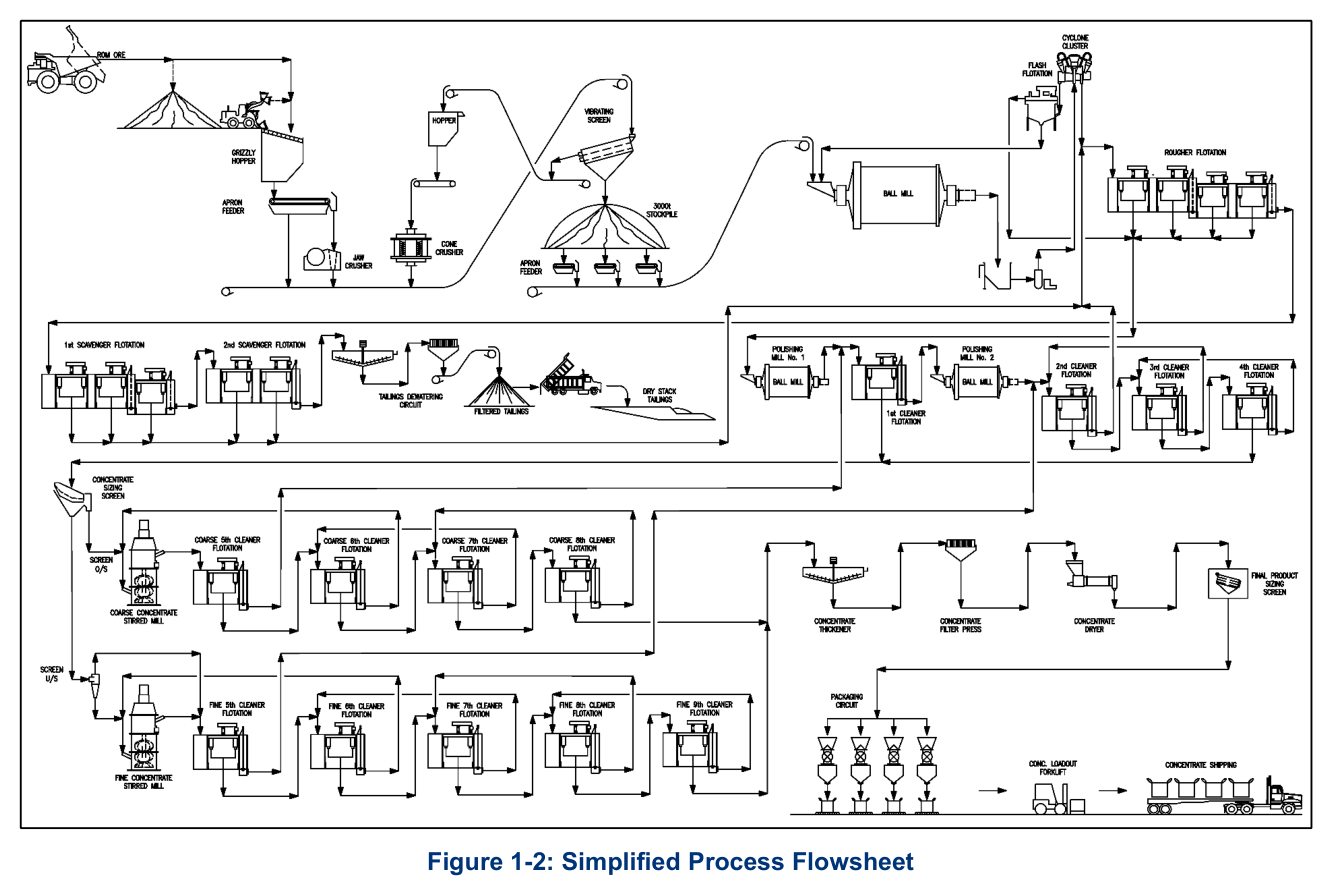
The processing plant will use a flowsheet designed with the principal objective of maximizing graphite flake preservation. The process has been organized to handle coarse and fine concentrate streams separately, which permits optimization of concentrate quality and recovery across the graphite flake size distribution. The simplified process flowsheet is shown in Figure 17-1 of the technical report.
The metallurgical test work detailed in Section 13.0 of the report, together with the mine plan described in Section 16.0, forms the basis for the selection of recovery methods for the Project. The process flowsheet has been designed to maximize graphite flake preservation while maintaining high recovery.
Key Process Stages
Run of mine material will be transported from the open pit to the processing plant where it will be dumped into a jaw crusher receiving pocket. A static grizzly screen with a 500 mm aperture will retain oversize material, which will be broken using a hydraulic rock breaker. The comminution circuit has been sized and selected based on the comminution test work results.
The grinding circuit incorporates a coarse and fine upgrading circuit arrangement. The flotation process uses a conventional configuration, with the first cleaner flotation stage occurring in three 10 m³ bulk cleaner cells. The regrind circuit includes a fine regrind mill with grinding media manually added at a rate of 20 units.
The combined final graphite concentrate from the coarse and fine upgrading circuits will undergo three stages of dewatering: thickening, filtration, and drying. The dewatering stages remove water from the concentrate to produce a final product suitable for handling and transport.
Reagent consumption estimates at the nominal plant throughput of 2,750 t/d are summarized in Table 17-2 of the report. The values are rounded and preliminary in nature. Major process consumables include grinding media, flotation reagents, and maintenance spares for the crushing, grinding, flotation, reagent handling, and assay systems. Maintenance spares will be maintained to support plant operations.
All reagent systems will be labelled in accordance with Workplace Hazardous Materials Information Systems requirements, and operating personnel will receive WHMIS and reagent-handling training. The process plant will be controlled using a distributed control system integrated with PC-based operator control stations located in the central control room and operated by process operators.
Additional Interesting Data and Summary
Two separate water supply systems for fresh and process water will support the operations. Process water will be supplied to the plant site, delivered to a freshwater storage tank, and distributed by pumping. All freshwater pipelines outside heated buildings will be buried below frost depth to prevent freezing.
The simplified process flowsheet is shown in Figure 17-1 of the technical report and detailed in the following sections. The major design criteria used for the processing plant design are listed in Table 17-1, which includes plant feed characteristics, operating schedule, and performance specifications.
The processing plant is designed at a nominal throughput of 2,750 t/d for an average annual throughput of 1.0 million tonnes at full capacity. The plant feed characteristics include a specific gravity of 2.67 g/cm³, Bond Work Index of 13.6 kWh/t, and Abrasion Index of 0.061 g, all from test work results. The head grade of 7.27% Cg comes from the mine plan, while the average LOM recovery of 92.3% is a calculation. The concentrate grade of 95% Cg derives from test work results, and the annual concentrate production of 66,450 t/a dry is calculated as a LOM average.
The process flowsheet has been designed to maximize graphite flake preservation while maintaining the targeted recovery. Separate treatment of coarse and fine concentrate streams allows optimization of concentrate quality and recovery across the graphite flake size distribution.
Source: Preliminary Economic Assessment, NI 43-101 Technical Report, for the Loki Flake Graphite Deposit, Key Lake South Project, Saskatchewan, Canada, August 19, 2026. Project website: Key Lake South Project
