

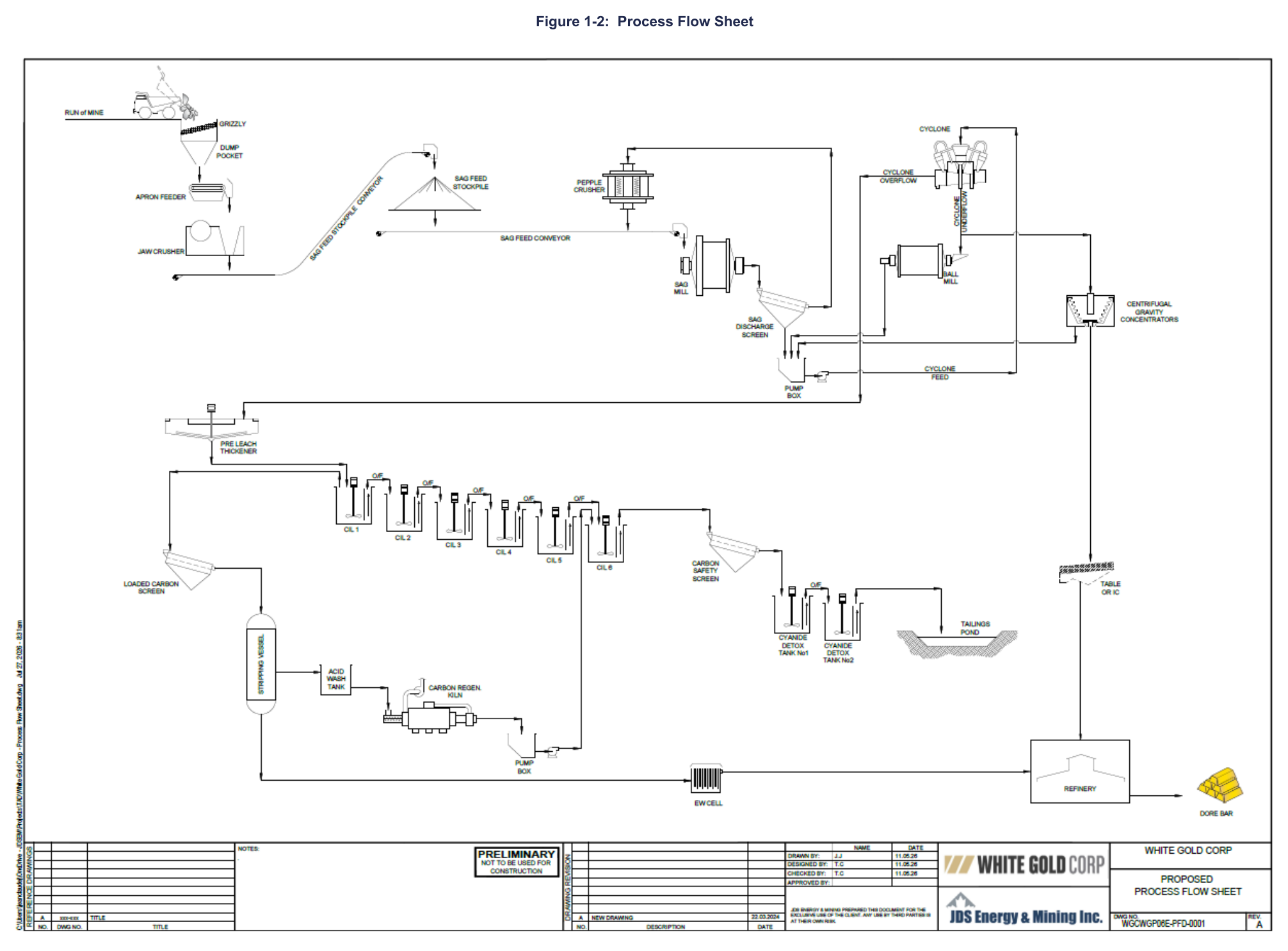
The White Gold Project is a gold project located in Canada's Yukon Territory, with the site currently at the preliminary economic assessment stage rather than in production. The technical report prepared for White Gold Corp. describes a conventional gold processing facility designed to handle 12,000 t/d of mineralized material through a circuit incorporating crushing, semi-autogenous grinding (SAG), ball milling, gravity concentration, and carbon-in-leach (CIL) gold recovery. The process design draws on testwork described elsewhere in the report, specifically the improved recovery achieved using CIL technologies over conventional leaching approaches.
Process Description and Recovery Methods
The processing plant flowsheet begins with primary crushing using a feeder and a C160 or equivalently sized jaw crusher. Grinding media for the SAG and ball mills are received and handled within the process plant area. The design incorporates a conventional gold processing facility that has been sized to treat the planned throughput of mineralized material.
Plant Design Criteria
The process design criteria, summarized in Table 17-1, specify the key performance parameters for the plant. Gold recovery expectations differ by deposit source. For material from the Golden Saddle and VG deposits, leach recovery is designed at 92% based on testwork results. Material from the Arc and Ryan's Surprise deposits shows a lower design recovery of 72.5%, also derived from testwork. The leach feed thickener underflow density is another design parameter established through testwork, while the cyanide detox tank retention time is set at 120 minutes as a design basis value.
Plant Design
The plant design for the White Gold Project incorporates a typical CIL circuit arrangement. The flowsheet can be seen in Figure 17-1, which presents the process design criteria in graphical form.
Reagent consumption is an important consideration for the operation. Lime is delivered and used within the process, and Table 17-2 lists the reagents with their delivered forms and daily usage rates. The cyanide handling system consists of a dedicated isotainer integrated with a controlled dissolution system for the contained receipt and preparation of cyanide material for subsequent use within the process.
Tailings Management
The White Gold Project is designed to manage mill tailings within a conventional tailings storage facility (TSF). The TSF provides containment for tailings solids and associated process water. Material reporting to the TSF is retained within the tailings pond to the extent practicable, with reclaim water recovered from the pond and returned to the mill for reuse in the process.
Water Management
Water management within the process plant focuses on maximizing reclaim water recovery from the tailings storage facility. The reclaim water recovered from the pond is returned to the mill for reuse in the process, reducing the overall fresh water demand for the operation.
Process Plant Personnel
The processing plant will be operated and maintained by a dedicated team that includes mill operations, mill maintenance, and mill technical staff, including the assay laboratory personnel. Table 17-3 details the personnel requirements, with the mill foreman position staffed by two individuals. The staffing structure accounts for the operational requirements of the continuous process plant.
Additional Interesting Data and Summary
The White Gold Project processing facility incorporates a conventional gold recovery flowsheet that has been designed based on the metallurgical characteristics of the various deposits feeding the plant. The design shows the differing recovery characteristics between deposit types, with the Golden Saddle and VG materials showing higher expected gold recovery compared to the Arc and Ryan's Surprise deposits.
The process design criteria established for the plant include specific recovery expectations for each deposit type, which have been incorporated into the overall process design. The selection of CIL technology over conventional leaching methods was driven by the improved recovery demonstrated during testwork programs described in Section 13 of the technical report.
Operational considerations for the plant include the handling and preparation of reagents, with particular attention given to cyanide management through the controlled dissolution system. The tailings storage facility plays a central role in the water management strategy, with reclaim water being returned to the mill circuit to minimize fresh water consumption.
Material stockpiling and rehandling strategies have been incorporated into the design to meet mill feed processing requirements and maximize target grades throughout the life of mine. This approach allows the operation to manage grade variability from the different deposits feeding the processing facility.
| Parameter | Value |
|---|---|
| Plant Throughput (design) | 12,000 t/d |
| Gold Recovery, Golden Saddle/VG (design) | 92.0% |
| Gold Recovery, Arc/Ryan's Surprise (design) | 72.5% |
| Cyanide Detox Tank Retention Time (design) | 120 min |
| Leach Feed Thickener Underflow Density (design) | Not stated |
| Communition Circuit | SAG and ball mills |
| Recovery Circuit | Gravity concentration, CIL |
| Tailings Management | Conventional TSF |
Source: Preliminary Economic Assessment for the White Gold Project, [date of technical report]. Project website: White Gold Project
