

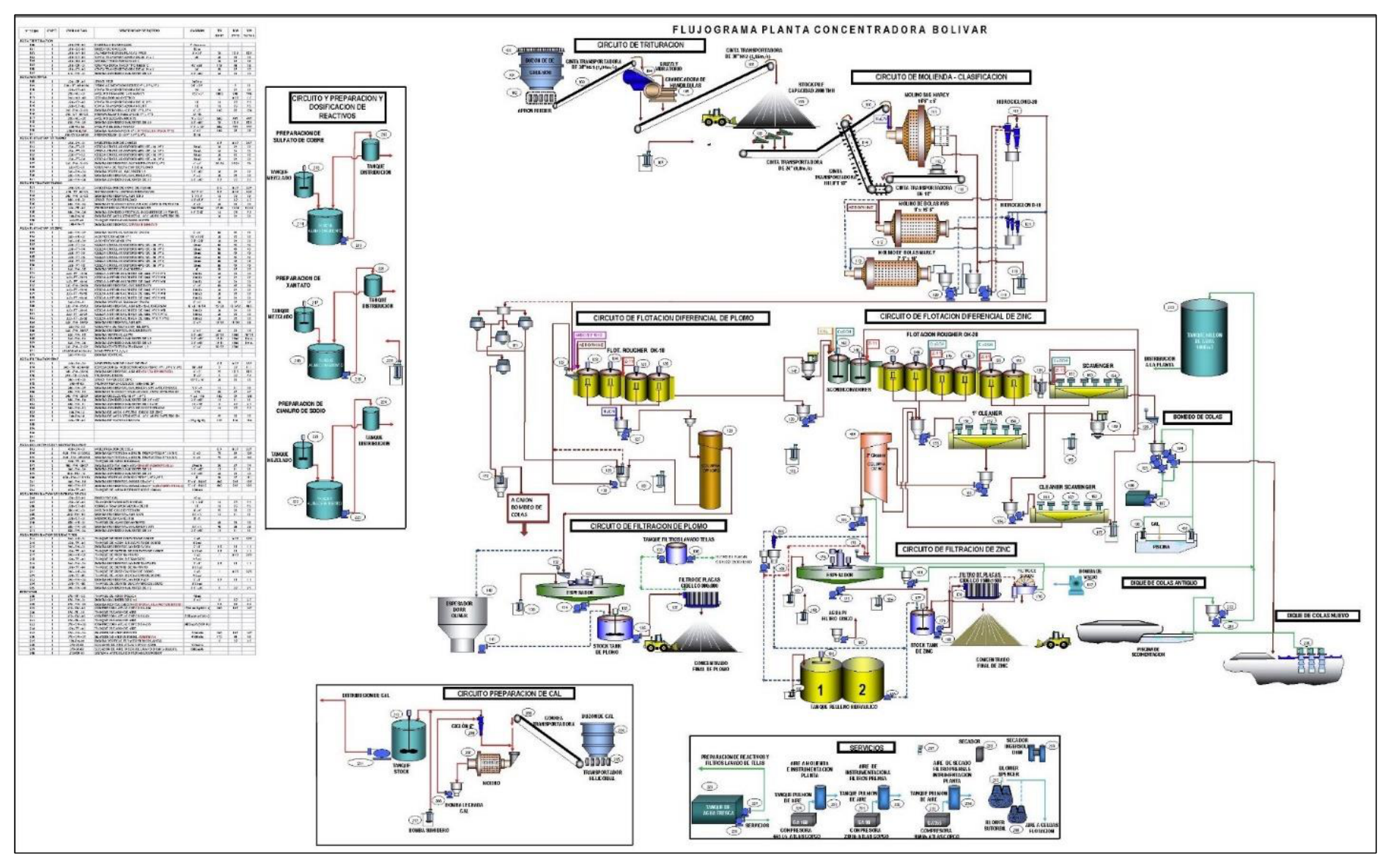
Santacruz Silver's Bolivar concentrator near Antequera has produced lead and zinc concentrates since 1993, and it treats ore bought from independent miners in separate campaigns.
The Bolivar mine is an operating underground silver, lead and zinc mine in the municipality of Antequera, Oruro state, Bolivia, at about 4,014 metres above sea level. It lies 75 km by paved road from Oruro City. The state company COMIBOL owns the mine, and its exclusive mining rights are held through the Illapa joint venture. Illapa, an indirect wholly owned subsidiary of Santacruz Silver Mining Ltd., holds 45% and COMIBOL 55%. Santacruz acquired the interest from Glencore in March 2022, and Sinchi Wayra runs the mine. The technical report by JDS Energy & Mining, effective January 1, 2024, is the first declaration of resources and reserves for Bolivar under Santacruz. Mining at Bolivar goes back more than 200 years, and the current mine layout dates from 1993.
Critical Data
| Parameter | Value | Unit | Notes |
|---|---|---|---|
| Mill start-up | 1993 | Not applicable | Continuous operation since |
| Design rate, company feed | 1,150 | t/d | Summary cites a 1,100 t/d plant |
| Design rate, toll feed | 800 | t/d | Processed separately |
| Target company feed share | 80 to 85 | % | Toll feed 15% to 20% |
| Primary crusher | 40 x 30 | in | Jaw crusher |
| SAG mill | 15.5 ft x 6 ft | Not applicable | Trommel returns oversize |
| Ball mills | 2 | Not applicable | 11 ft x 15.5 ft and 7 ft 5 in x 16 ft |
| Lead rougher cells | 4 | Not applicable | 10 m3 tank cells |
| Zinc rougher cells | 6 | Not applicable | 20 m3 Outotec tank cells |
| Lead concentrate grade | Above 20 | % Pb | After column cleaning |
| Zinc concentrate grade | 53 | % Zn | Company feed, 44% for toll feed |
| Cut-off recovery assumptions | 91 / 70 / 89.7 | % Zn / % Pb / % Ag | Used for resource cut-off grade |
| Lead concentrate thickener | 40 | ft | Diameter |
| Zinc concentrate thickener | 60 | ft | Diameter |
Overview
The Bolivar mill crushes and grinds the ore and then floats lead and zinc in sequence into two concentrates, both rich in silver. Glencore buys both concentrates, which travel by truck to a rail loading point about 10 km from the mine and then overseas through Antofagasta, Chile. Zinc concentrate ships in bulk. Bolivian law requires the lead concentrate to be bagged.
The mill has two feed sources. Company ore comes from the Bolivar underground mine. Toll feed is bought from independent miners by San Lucas, a Santacruz company, often in lots of 1 or 2 t that are weighed and sampled one by one and then combined on a toll stockpile. The two feeds are usually run on different days. When both run on the same day, the mill shuts down between them so that each can be measured on its own. Each feed has its own reagent scheme, mainly because the toll feed contains pyrrhotite and the company ore generally does not.
The recoveries used in the report come from plant results between August 2020 and July 2021. Lead, zinc and silver recoveries for company feed are expressed as equations tied to feed grade.
Key Process Stages
Crushing
Haul trucks bring the ore to surface and tip it into the crusher feed bin. A vibrating grizzly feeder passes it to a 40 inch by 30 inch jaw crusher, which discharges onto the mill feed stockpile.
Grinding
An underground vibratory feeder reclaims the coarse ore stockpile into a 15.5 ft by 6 ft SAG mill. A trommel screen on the mill returns oversize to the SAG feed. The fine slurry is pumped to a pack of CAVEX 400 mm cyclones, and the cyclone underflow is split between two ball mills, one 11 ft by 15.5 ft and one 7 ft 5 in by 16 ft.
Lead flotation
Ground slurry goes to conditioning tanks, where Aerophine 3418A, Aero 3477 and lime are added. The lead rougher has four 10 m3 tank cells. Sodium isopropyl xanthate is added after the first two cells to help float lead and silver. A zinc cyanide solution is added to the rougher concentrate, which is pumped to a cleaner column 1.5 m in diameter and 8 m high. The column lifts the concentrate above 20% lead. Cleaner column tailings go to final tailings, and rougher tailings move on to the zinc circuit.
Zinc flotation
Lead rougher tailings pass through two conditioning tanks, where lime and copper sulphate activate the sphalerite, with sodium isopropyl xanthate again as collector. The zinc rougher has six 20 m3 Outotec tank cells. Six 200 ft3 Denver cells, 34 m3 in total, scavenge the rougher tailings.
Concentrate from the first four rougher cells goes to a first cleaner bank of six 100 ft3 Denver cells. Concentrate from the last two rougher cells and the scavengers goes to a cleaner scavenger bank of the same size, whose concentrate also feeds the first cleaner. First cleaner tailings return to the head of the zinc circuit. First cleaner concentrate is pumped to a second cleaner column 2 m in diameter and 8 m high. Its concentrate goes to the zinc thickener, and its tailings return to the first cleaner.
Dewatering and tailings
Lead concentrate settles in a 40 ft thickener and is filtered in a 24 plate pressure filter with 1 m plates, then bagged. Zinc concentrate settles in a 60 ft thickener and is filtered either in a 44 plate pressure filter with 1.5 m plates or in a six-disc filter 6 ft in diameter. Both thickeners return overflow to the process water tank.
Bolivar has two tailings storage facilities. The original one is decommissioned, and the operating dam was being raised to extend its capacity to 2024. Wood Engineering supervises both dams to Canadian Dam Association guidelines, and Knight Piésold carried out a recent external audit.
Additional Interesting Data and Summary
In the recovery estimates, the lead concentrate carries about 12% zinc on company feed and 11% on toll feed. Zinc concentrate grades 53% zinc on company feed and 44% on toll feed. Zinc in the lead concentrate and lead in the zinc concentrate are not paid, so the report leaves them out of the total recoveries.
Company feed grades are measured daily from samples of cyclone overflow, concentrates and final tailings. Each month the plant reconciles production against measured feed tonnage using concentrate sold and final tailings. Toll feed is reconciled the same way.
The mine works as part of a townsite with two camps, homes, a hospital and a school, and most workers live in the town or in nearby Antequera. ENDE supplies grid power. A dammed reservoir supplies drinking water, which is treated and distributed for three hours a day. The operating and former tailings dikes sit 3.5 km from the industrial area.
Key Processes
- Jaw crushing to a mill feed stockpile
- SAG milling with trommel and cyclone classification
- Ball milling in two parallel mills
- Lead rougher flotation with column cleaning
- Copper sulphate activation and zinc rougher, scavenger and cleaner flotation
- Column cleaning of zinc concentrate
- Thickening and pressure or disc filtration of both concentrates
- Separate campaign processing of company ore and toll feed
Source: NI 43-101 Technical Report on the Advanced Project, Bolivar Mining Operations, Antequera, Bolivia, January 1, 2024.
Project website: Bolivar Mine
