

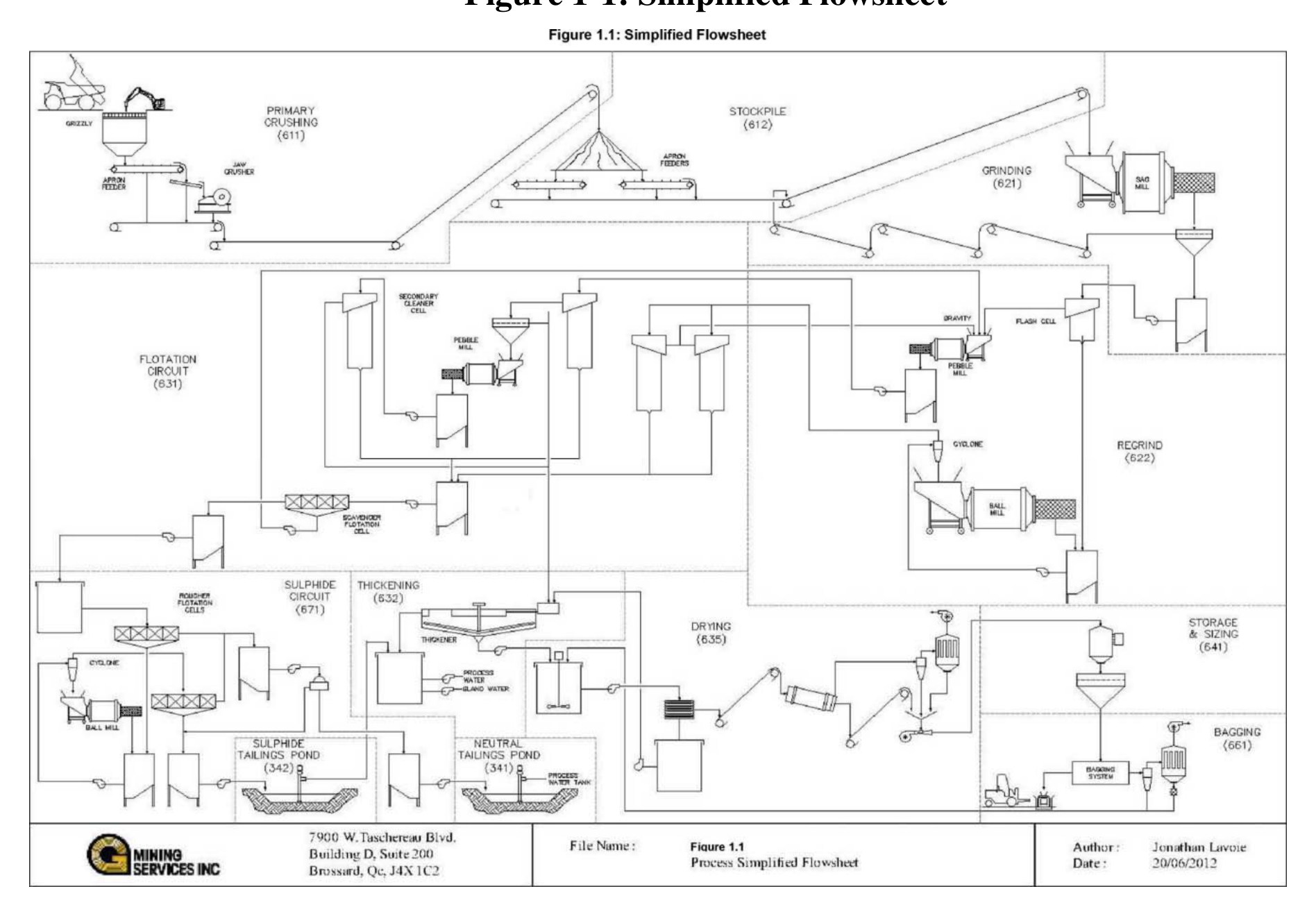
Northern Graphite's 2013 expansion study for Bissett Creek in Ontario planned a flotation plant that recovers coarse flakes early, polishes them in lightly loaded pebble mills and screens the dried product into four size classes.
The Bissett Creek graphite project is in Renfrew County, Ontario, about 15 km from the Trans-Canada Highway between Deep River and Mattawa, and roughly 200 km west of Ottawa. Northern Graphite Corporation held 100% of the large flake deposit. The preliminary economic assessment, dated 6 December 2013, looked at an expansion case for a development project already covered by a 2012 feasibility study and its 2013 update. Mill feed would start at 1 Mtpa and rise to 2 Mtpa from the third year of operation, over a 22 year mine life. The report does not give a construction start date. Over that life the plant would treat 39.4 Mt averaging 1.84% graphitic carbon (Cg) and produce an average of 33,183 t of concentrate a year.
Critical Data
| Parameter | Value | Unit | Notes |
|---|---|---|---|
| Initial plant throughput | 1,000,000 | t/yr | 2,975 t/day |
| Expanded plant throughput | 2,000,000 | t/yr | 5,950 t/day from Year 3 |
| Plant circuit throughput | 104 | t/h | Per design criteria |
| Plant availability | 92 | % | 365 days, 24 hours |
| Crushing circuit throughput | 315 | t/h | 33% utilization |
| Life of mine feed | 39.4 | Mt | 1.84% Cg average |
| First five years head grade | 2.24 | % Cg | 7,283,000 t milled |
| Concentrate production | 33,183 | t/yr | Life of mine average |
| Target concentrate grade | 95 | % Cg | After cleaning |
| SAG mill | 9 ft x 18 ft | Not applicable | 900 kW |
| Regrind ball mill | 10 ft x 16 ft | Not applicable | 700 kW |
| Filter cake moisture | About 15 | % | Larox filter press |
| Dried product moisture | Less than 1 | % | Rotary dryer |
| Kerosene consumption | 159 | g/t | Graphite collector |
| Mine life | 22 | years | At the stated feed rates |
Overview
The design criteria come from SGS Lakefield test work in 2010 and 2011, which repeated work done in the 1980s, and from a pilot plant that confirmed recovery, grade and flake size. The report describes every process in the flowsheet as well established in the mineral processing industry.
The aim is to liberate and recover large flakes without breaking them. Ore is crushed and given a coarse SAG grind. A flash flotation cell takes the coarse flakes straight away. The rest is classified, reground and floated in columns. Cleaner concentrates are polished in pebble mills with a light charge of small media, so flake surfaces are cleaned and the flakes stay large. Final concentrate is thickened, filtered, dried, screened into size fractions and bagged. A sulphide flotation and magnetic separation circuit then treats the tailings so most of them can be stored as chemically neutral material.
Key Process Stages
Crushing and reclaim
Run-of-mine feed travels about 2.1 km from the pit and is tipped into the crusher hopper or stockpiled for a wheel loader. A grizzly with 600 mm openings scalps the oversize, and a hydraulic rock breaker handles large rocks. A 140 t hopper feeds an 11 m apron feeder and an inclined bar scalper. Scalper oversize goes to a 1,220 mm by 1,524 mm, 150 kW jaw crusher. Crushed ore and fines move by conveyor to a stockpile with 2,500 t of live capacity. Two apron feeders in a tunnel under the pile feed the SAG mill conveyor.
Grinding and flash flotation
The 900 kW SAG mill discharges onto two double deck vibrating screens, one running and one on standby, with 4.8 mm top deck and 1.2 mm by 25 mm bottom deck openings. Oversize returns to the mill by conveyor. Undersize is pumped to an 8 m3 Outotec SkimAir-240 flash flotation cell. The report says the coarse initial grind is needed to free the large flakes and limit flake breakage.
Rougher circuit
Flash cell tailings go to four 15 inch cyclones, three running. Cyclone underflow feeds the 700 kW regrind ball mill, and overflow feeds two rougher flotation columns, each 1.83 m in diameter and 10 m high. Rougher tailings pass through scavenger cells to final tailings.
Polishing and cleaning
Flash cell concentrate is reground in a 150 kW, 7 ft by 10 ft pebble mill run in open circuit with a light load. The preferred media are small, low density, non-metallic Cylpebs of about 12.5 mm. This milling polishes the flake surfaces so that flotation cleaners can bring the concentrate to 95% Cg. The mill discharge feeds a primary cleaner column, 1.22 m across and 6 m high.
Primary cleaner concentrate passes two 210 µm Derrick screens. Oversize goes straight to the concentrate thickener as final product. Undersize goes through a second 150 kW pebble mill and a secondary cleaner column of the same size, and that concentrate also joins final product. Cleaner tailings feed a scavenger bank, whose concentrate goes back to the primary pebble mill.
Dewatering, drying and sizing
A 5 m high rate thickener settles the concentrate. Diaphragm pumps send it to a four hour holding tank, and a 158 m2, 12 chamber Larox filter press makes a cake at about 15% moisture. A 1.22 m by 8.53 m rotary dryer takes it below 1%. A pneumatic system lifts the dry graphite to a 25 t bin, and two lines of three Derrick screens split it at 48, 80 and 100 mesh. The four products go to their own bins, with a fifth as overflow, and then to a bagging system that fills 1 t bags. A blending system allows custom products.
Sulphide removal from tailings
Tailings management requires that sulphides be removed before storage. Graphite tailings are conditioned for two minutes with potassium amyl xanthate and floated in a four-cell rougher. Rougher tailings then pass a magnetic separator that removes pyrrhotite. Together these steps remove more than 50% of the sulphides. The neutral tailings go to their own pond. The sulphide concentrate and magnetic product go to a much smaller pond and are stored under water to limit acid rock drainage.
Additional Interesting Data and Summary
Reagent use is modest. Kerosene runs at 159 g/t, MIBC frother at 88 g/t, PAX at 100 g/t and flocculant at 10 g/t. Kerosene is dosed into the SAG mill feed and the flotation pump boxes as needed.
Process water comes from thickener overflow, and fresh water is reclaimed from the neutral tailings pond. In winter, heat recovered from the power generators keeps the water from freezing. Two 94 kW compressors supply instrument and service air, two 38 kW compressors feed the flotation columns, and blowers serve the flotation cells.
In the first five years, concentrate output averages 23,690 t a year, at a mine cash cost of CAD 687 per tonne of concentrate. Once the high grade material is exhausted in Year 14, the plant switches to stockpiled low grade ore, about 14.6 Mt at 1.27% Cg. The project also has access to a paved road and a natural gas pipeline 15 km away.
Key Processes
- Grizzly scalping, rock breaking and jaw crushing
- Coarse SAG grinding with double deck screening
- Flash flotation of liberated large flakes
- Cyclone classification, ball mill regrinding and column rougher flotation
- Light-load pebble mill polishing ahead of column cleaners
- Thickening, pressure filtration and rotary drying
- Screening into four flake size classes and bagging
- Sulphide flotation and magnetic removal of pyrrhotite from tailings
Source: Northern Graphite Corporation, Bissett Creek Project, Preliminary Economic Assessment, NI 43-101F1 Technical Report, 6 December, 2013.
Project website: Bissett Creek Graphite Project
