

Allied Critical Metals' 2026 study for the former Borralha mine designs a 1.4 Mtpa plant that rejects 40% of the feed by dense media separation and splits wolframite, scheelite and cassiterite with magnetic and electrostatic separators.
The Borralha tungsten project covers the past-producing Borralha tungsten-tin mine in the Parish of Salto, District of Vila Real, northern Portugal. It lies about 3 km south of the Venda Nova Dam and 40 km east of Braga. Allied Critical Metals Inc. holds the project through its Portuguese subsidiaries ACM Tungsten and PanMetals, under Mining License C-167 covering 382.48 hectares. Registered title was held in trust by Minerália, with transfer to PanMetals expected in 2026. The preliminary economic assessment, effective April 14, 2026, is the first PEA on the property and supersedes a December 2025 report. Borralha is an early stage project, and the report gives no construction schedule. The plant would make saleable tungsten, copper and tin concentrates.
Critical Data
| Parameter | Value | Unit | Notes |
|---|---|---|---|
| Plant throughput | 1,400,000 | t/yr | Design basis |
| Crushing rate | 226.8 | t/h | 14 h/day, 87.5% availability |
| Downstream process rate | 147.1 | t/h | 24 h/day, 94.4% availability |
| Operating days | 360 | days per year | Crushing and process plant |
| Crushed product size | 6 | mm | Three-stage crushing |
| DMS feed size | 6 to 2 | mm | Coarse fraction |
| DMS mass rejection | About 40 | % | Coarse tailings |
| Gravity circuit feed | Below 1 | mm | After ball mill regrind |
| Tungsten concentrate | 4,452 | t/yr | Estimated grade 65% WO3 |
| Copper concentrate | 3,618 | t/yr | Estimated grade 21% Cu |
| Tin concentrate | 146 | t/yr | Estimated grade 50% Sn |
| Flotation pH | About 5 | Not applicable | Sulphuric acid |
| Paste thickener underflow | About 70 | % solids | Before cement addition |
Overview
The target minerals are wolframite and scheelite for tungsten, chalcopyrite for copper and cassiterite for tin. Wolframite has the coarsest grain size, chalcopyrite comes next, and scheelite and cassiterite are finest. The plant recovers them in that order.
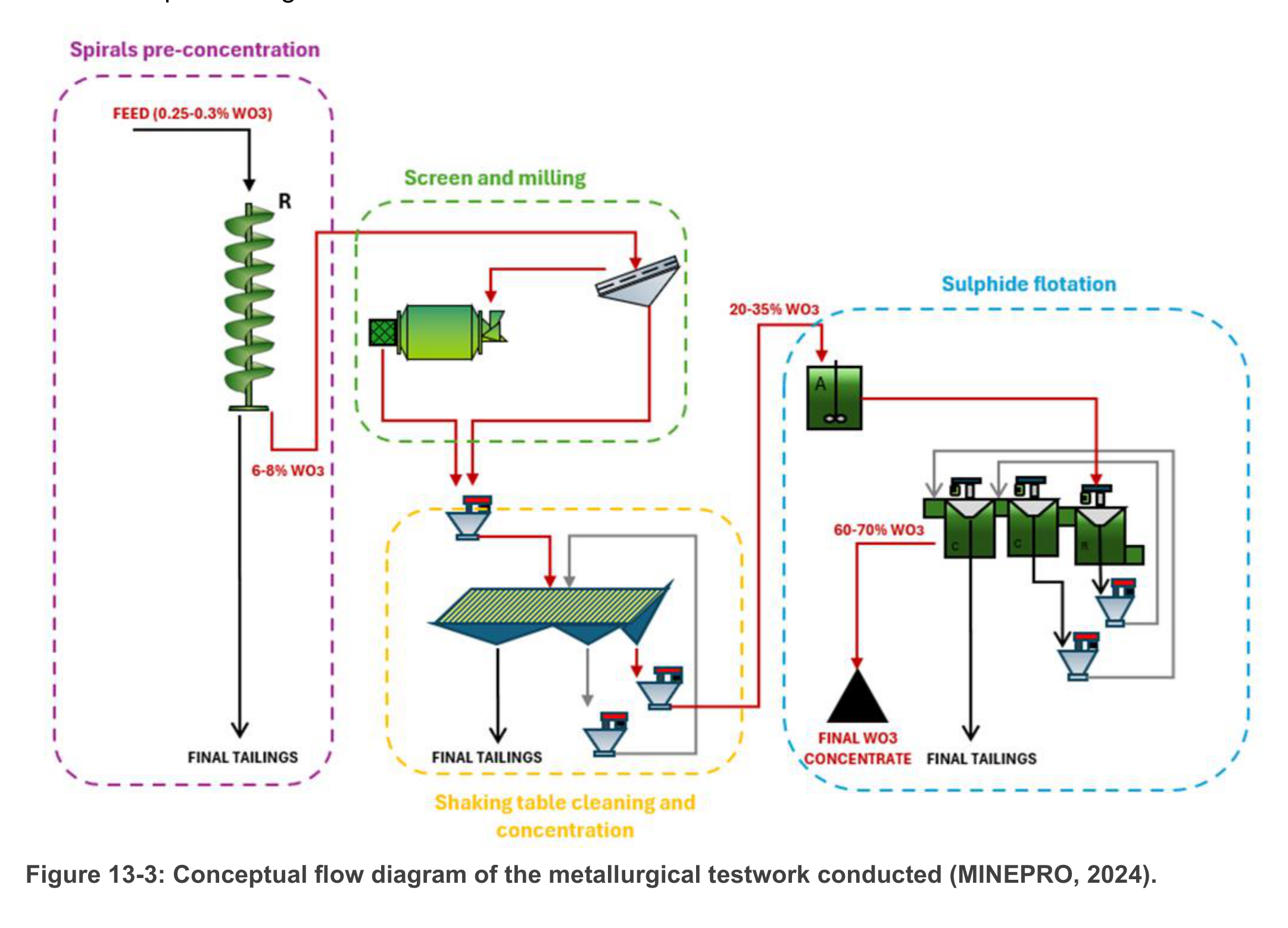
Magnetic separation of wolframite worked on Borralha samples in the past, but the report calls it costly in energy and equipment. The new design uses gravity as the main tool for wolframite and keeps magnetic separation for the final cleaning stage. Ore is crushed to 6 mm, and the 6 to 2 mm fraction goes through dense media separation (DMS). DMS sinks and fines are ground to 1 mm and concentrated on spirals, shaking tables and ultrafine gravity units. The gravity concentrate is floated to remove sulphides and make a copper concentrate. Drying, magnetic separation and electrostatic separation then upgrade the tungsten product and pull out a tin concentrate.
The report calls the concentrate grades early estimates that still need confirmation by more test work.
Key Process Stages
Crushing
A jaw crusher inside the mine takes run-of-mine ore of up to about 500 mm down to a nominal 100 mm, with a grizzly letting finer material bypass the crusher. Conveyors lift the product to a surface silo. A double deck screen splits it at 35 mm and 6 mm. The two coarse fractions go to secondary and tertiary cone crushers in closed circuit with the screen until everything passes 6 mm. Vibrating feeders reclaim the crushed stockpile. Enclosed conveyors and water sprays control dust.
Dense media separation
A secondary screen splits the crushed ore at 2 mm. The 6 to 2 mm fraction goes to a packaged DMS plant using magnetite or ferrosilicon medium, while the finer fraction bypasses it. Floats, about 40% of the plant feed and very low in metal, go over a dewatering screen to a coarse tailings stockpile. Sinks join the screen fines and move on to grinding. The report says this rejection cuts the load on the grinding and concentration circuits.
Grinding
A single deck screen passes material finer than 1 mm straight on. Oversize goes to a ball mill in closed circuit with the screen.
Gravity concentration
Hydrocyclones split the ground feed at 300 µm and 20 µm. The 1,000 to 300 µm fraction passes a single rougher spiral stage. Its concentrate goes to a concentrate regrind mill, and its tailings to a tailings regrind mill. The 300 to 20 µm fraction, along with the reground coarse tailings, passes rougher and scavenger spirals. Spiral concentrates are reground below 150 µm and cleaned on shaking tables, which return middlings to their own feed.
Material finer than 20 µm goes to a Falcon concentrator. Falcon concentrate is upgraded in Multi-Gravity Separators, whose tailings return to the Falcon. The MGS concentrate is already high grade and becomes one tungsten product. The table concentrate is the other.
Copper flotation
Table concentrate carries a large load of dense sulphides, mostly pyrite. A rougher stage at about pH 5, with sulphuric acid, MIBC and AERO 238, floats the sulphides. The unfloated tungsten-rich product goes to final cleaning. The sulphide float then passes three cleaner stages, with a scavenger on the first cleaner. Sodium metabisulphite depresses pyrite and copper sulphate activates chalcopyrite. The concentrate grows richer in chalcopyrite from cleaner to cleaner until cleaner 3 produces copper concentrate. Pyrite reports to the scavenger, and the scavenger underflow returns to the tungsten stream so that tungsten losses stay low.
Final tungsten and tin separation
The tungsten products are filter pressed and dried in a rotary dryer. Dry magnetic separation pulls out wolframite. The non-magnetic cassiterite and scheelite go to an electrostatic separator, which recovers cassiterite as tin concentrate and returns scheelite to the tungsten stream. Wolframite and scheelite together form the final tungsten concentrate. The copper concentrate is filtered separately.
Additional Interesting Data and Summary
All tailings streams go to a thickener that raises them to about 70% solids. Part of the underflow is filtered and part goes straight to a mixing tank, where cement is added to make paste for the mine voids. The paste plant sits near the portal. The coarse DMS rejects are stockpiled for sale to a customer, and some can go into the paste if needed.
The plant has separate process and fresh water systems. Process water from a pond supplies the DMS, mills, gravity units and flotation through low and high pressure lines with redundant pumps. Fresh water serves reagent preparation, dust suppression and fire protection. Screw compressors supply service air, and dedicated blowers serve flotation.
Hydroelectric power is available from the Venda Nova Dam facilities about 3 km north, and local rivers supply water. Spill containment basins with sump pumps sit under the process areas.
Key Processes
- In-mine jaw crushing and surface cone crushing to 6 mm
- Dense media preconcentration of the 6 to 2 mm fraction
- Ball milling to 1 mm in closed circuit with a screen
- Spiral and shaking table gravity concentration with concentrate regrinding
- Falcon and Multi-Gravity Separator treatment of ultrafines
- Sulphide rougher flotation and chalcopyrite cleaner flotation
- Drying, magnetic separation and electrostatic separation of tungsten and tin
- Thickening and cemented paste backfill of tailings
Source: NI 43-101 Technical Report, Preliminary Economic Assessment, Borralha Tungsten Project, Parish of Salto, District of Vila Real, Portugal, April 14, 2026.
Project website: Borralha Tungsten Project
