

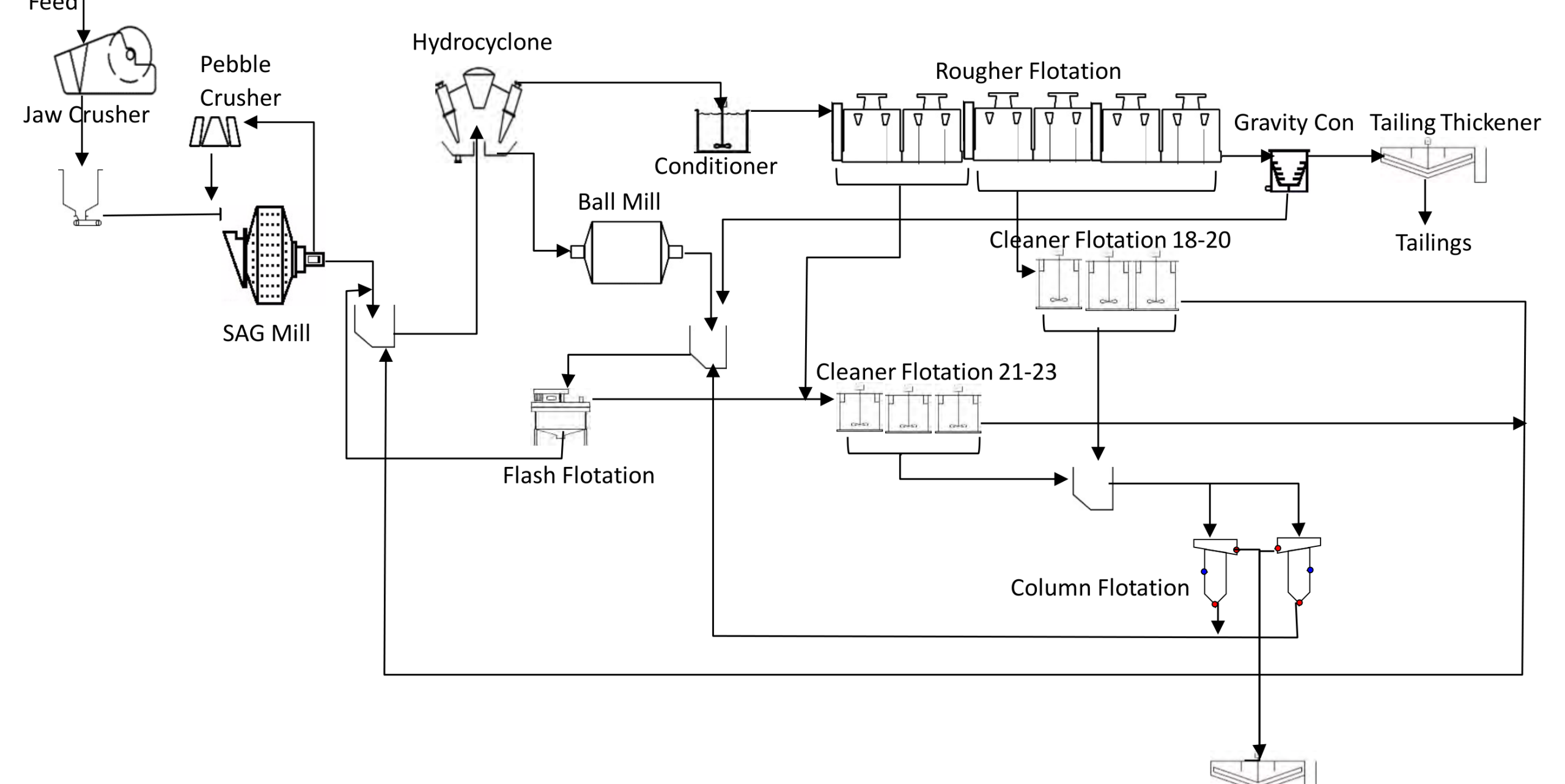
Eldorado Gold's underground mine near İzmir floats a bulk sulphide gold concentrate through flash, rougher, cleaner and column cells, and filters its tailings for dry stacking and paste backfill.
The Efemçukuru gold mine is an operating underground mine near the village of Efemçukuru in İzmir province, western Türkiye, about 20 km southwest of İzmir. Eldorado Gold Corporation owns and runs it through its wholly owned subsidiary Tüprag. Commercial production began in June 2011. The site has an underground crusher, a milling and flotation plant, a filtration and paste backfill plant and a water treatment plant. Eldorado's technical report, effective December 31, 2023, updates resources, reserves and operating data. In 2023 the plant milled 547,089 dry tonnes, more than 35% above its original design. It produced a gold concentrate with 92.7% gold recovery.
Critical Data
| Parameter | Value | Unit | Notes |
|---|---|---|---|
| Annual throughput, design | 401,500 | dry t | Original design |
| Annual throughput, 2023 | 547,089 | dry t | 1,499 t per calendar day |
| Grinding and flotation rate | 62.6 | dry t/h | Design 50.9 t/h |
| Plant availability | 97.6 | % | 2023, design 90% |
| Gold recovery | 92.7 | % | 2023, design 92% |
| Feed gold grade, 2023 | 5.64 | g/t | About 8 g/t in early years |
| Concentrate mass pull | 10.3 | % | Design 8.2% |
| Concentrate gold grade, 2023 | 51 | g/t | 172 g/t silver |
| Bond ball mill work index | 17.2 | kWh/t | 2018 test data |
| Cyclone overflow size | About 54 | µm P80 | After 2016 cyclone change |
| SAG mill | 5.5 m x 3.0 m | Not applicable | 1,500 kW variable speed |
| Ball mill | 3.6 m x 6.0 m | Not applicable | 1,500 kW variable speed |
| Crushing rate | 140 | tph | Underground jaw crusher |
| Filter cake moisture | 8.5 to 11 | % | Design 8% |
| Dry stack tailings moisture | 16 | % | Three pressure filters |
Overview
Gold at Efemçukuru occurs mainly with pyrite, galena, sphalerite and traces of chalcopyrite, so the plant runs bulk sulphide flotation and sells a gold-bearing concentrate in bags. The original flowsheet also used gravity concentration on the cleaner concentrate to make smeltable material for doré on site. That circuit recovered only about 1% of the gold and was shut down in 2018.
Today a SAG mill with a pebble crusher and a ball mill with cyclones grind the ore. A flash cell treats all of the ball mill discharge. Cyclone overflow goes to rougher-scavenger flotation and two cleaner banks, and column cells added in 2020 give a final cleaning stage. A Knelson concentrator scavenges gold from the rougher tailings. Thickened tailings are filtered. About 40% goes underground as cemented paste, and the rest is dry stacked.
Key Process Stages
Crushing and ore storage
The jaw crusher sits underground and takes ore by gravity from two run-of-mine bins with gates to hold back oversize. A scalping grizzly removes fines below 80 mm before the crusher. Its aperture was cut from the original 150 mm to 100 mm and then 80 mm in 2015. The crusher produces 80% passing 90 to 100 mm at a nominal 140 tph. A conveyor lifts the ore to two 4,200 t surface bins, and operators use the bins to blend ore types for a target gold to sulphur ratio and to limit penalty elements in the concentrate.
Grinding and classification
The 5.5 m by 3.0 m grate discharge SAG mill draws about 745 kW, around half of its 1,500 kW motor, with 125 mm balls and a 10% to 15% charge. It discharges at about 80% passing 600 µm. A 132 kW short head cone crusher breaks pebbles of up to 70 mm to 80% passing 10 to 12 mm, about 15% of fresh feed. The 3.6 m by 6.0 m overflow ball mill draws about 891 kW with 40 mm balls at a 27% charge. Media use is about 1.04 kg/t in the SAG mill and 1.37 kg/t in the ball mill. In 2016, three 381 mm cyclones were replaced with eight 250 mm units for tighter size control.
Flotation
Sulphuric acid at 1.7 kg/t brings the pulp to about pH 8. Copper sulphate activates sphalerite and pyrite, and sodium hydrosulphide cleans lightly oxidized surfaces. Sodium isobutyl xanthate at 71 g/t and Aero 8045 promoter at 50 g/t go to both the flash feed and the conditioning tank. MX 505 replaces Aero 8045 on difficult ores.
A 10 m3 Dorr-Oliver flash cell treats the ball mill discharge, together with column tailings, to catch liberated sulphides early and avoid overgrinding gold-bearing particles. Six 20 m3 Wemco tank cells form the rougher-scavenger bank. Concentrate from the first two cells goes to cleaner bank 1 and concentrate from cells 3 to 6 to cleaner bank 2, each built from 5 m3 Dorr-Oliver cells. Cleaner and flash concentrates feed two Eriez columns, 1.8 m by 8 m, which normally run in parallel and can run in series for low grade ore. Residence times are about 5 minutes in the flash cell, 49 in the rougher-scavenger, 20 and 15 in the two cleaner banks, and 30 in the columns.
Dewatering
A de-aeration tank conditions the concentrate ahead of a 5 m high rate thickener, which runs at 55% solids. A 58 m3 surge tank feeds a 42 plate filter press with 1.5 m plates, and the cake is shipped in bags of about 1.5 t. Tailings go to a 13 m high rate thickener at 55% solids. A diaphragm pump sends them to a 246 m3 surge tank and three 60 plate pressure filters.
Paste backfill
In backfill mode the filtered tailings go by reversible conveyor to a paste mixer. Cement at about 2.8 t/h for 35 dry t/h of tailings makes up roughly 8% of the paste. A larger mixer installed in 2016 and a vortex mixer added in 2017 improved paste quality and cut cleaning stops.
Additional Interesting Data and Summary
Feed grade has fallen from 8.34 g/t gold in 2014 to 5.64 g/t in 2023, while silver rose to about 20 g/t. Concentrate gold grade dropped from 75 g/t to about 51 g/t over the same period, which the report links to lower feed grade and, more importantly, a lower gold to sulphur ratio. Recovery rose from 87% during ramp-up to between 93.0% and 94.6% in recent years, helped by better understanding of the flotation and higher mill availability.
The 2018 comminution tests showed the ore is harder than assumed at design, with a Bond crushing work index of 17.0 kWh/t and an Axb of 46.4. The mill still treats more than the design rate. Process water comes from the two thickener overflows and the water treatment plant and is reused without treatment. The low sulphide content and simple reagent scheme mean it does not affect flotation.
Key Processes
- Underground jaw crushing with 80 mm scalping
- SAG milling with pebble crushing
- Ball milling with 250 mm cyclones to about 54 µm
- Flash flotation of ball mill discharge
- Rougher-scavenger, cleaner and column flotation of bulk sulphides
- Knelson gravity scavenging of rougher tailings
- Concentrate thickening and pressure filtration
- Tailings filtration for dry stacking and cemented paste backfill
Source: Technical Report, Efemçukuru Gold Mine, Türkiye, December 31, 2023.
Project website: Efemçukuru Gold Mine
