

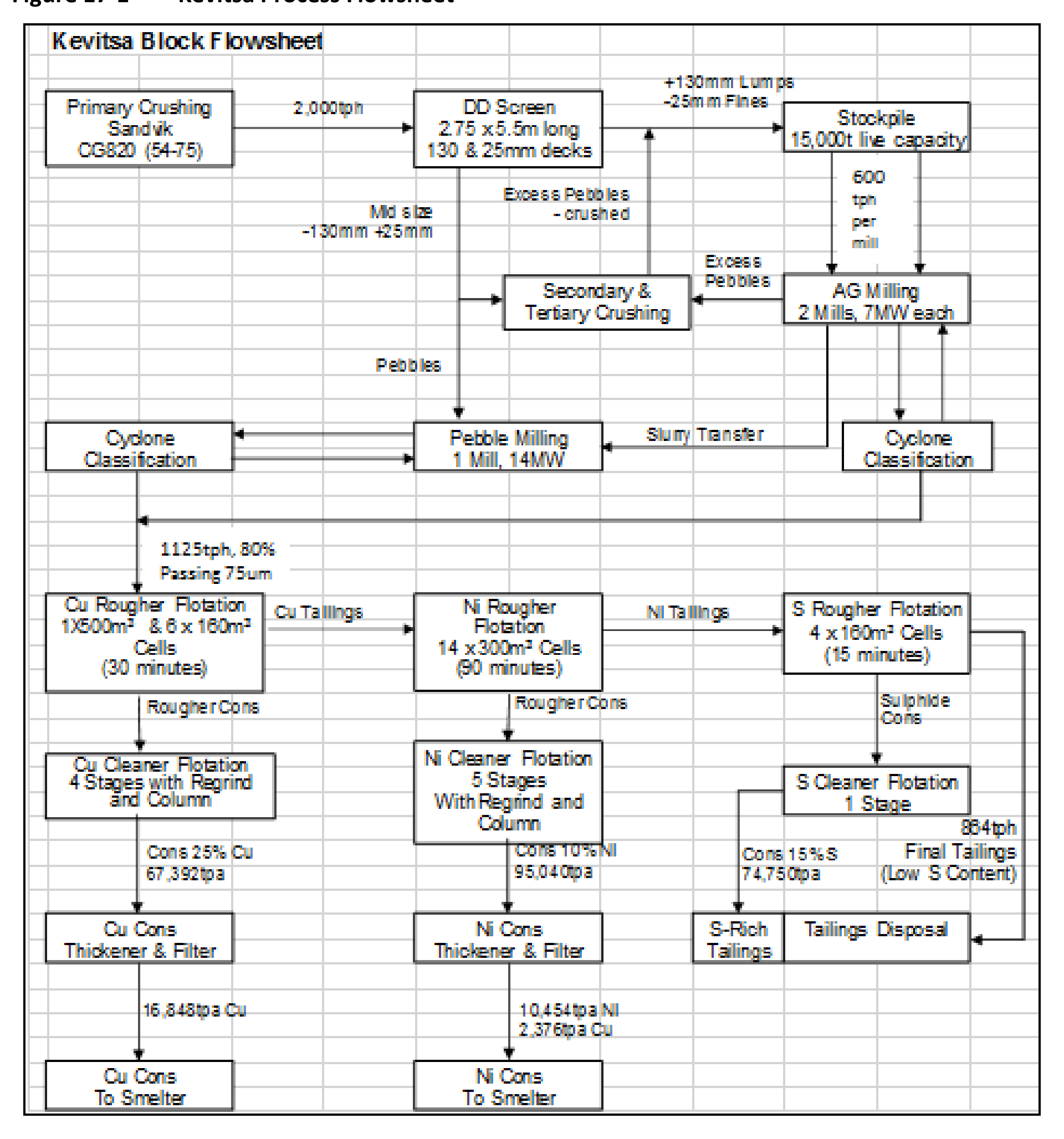
First Quantum's 2016 technical report on the Kevitsa mine describes a 9 Mtpa plant with two 7 MW autogenous mills, a pebble mill, HIG regrinding and a final sulphide flotation stage that produces low-sulphur tailings.
The Kevitsa nickel-copper-PGE mine lies in Finnish Lapland, 140 km north of the Arctic Circle, in the municipality of Sodankylä. In 2016 First Quantum Minerals Ltd operated it. Commercial production began in August 2012, and at the report date the open pit was in Stage 2 of four, with mining and processing due to end in 2033. The technical report, dated 30 March 2016, documents updated resources, reserves and operations. The plant was producing about 130,000 t a year of nickel concentrate at 11% nickel and about 115,000 t a year of copper concentrate at 25% copper. The ore averages 0.24% nickel and 0.34% copper as sulphides.
Critical Data
| Parameter | Value | Unit | Notes |
|---|---|---|---|
| Plant capacity | 9.0 | Mtpa | 1,125 tph at 8,000 h/yr |
| Front end design | 10 | Mtpa | Crushing, screening and stockpile |
| Primary crusher | Sandvik CG820 | Not applicable | Gyratory, 535 kW |
| Crushed ore stockpile | 15,000 | t live | About 16.7 hours |
| AG mills | 2 | Not applicable | 8.5 m x 8.5 m, 7 MW each |
| Pebble mill | 8.5 m x 8.5 m | Not applicable | Two 7 MW drives |
| Grind size | 75 | µm P80 | All three mills |
| Copper rougher time | About 30 | minutes | One 500 m3 and five 160 m3 cells |
| Nickel rougher-scavenger time | About 90 | minutes | Two banks of seven 300 m3 cells |
| Copper concentrate grade | 25 | % Cu | 78% recovery to copper concentrate |
| Nickel concentrate grade | 11 | % Ni | 66% of sulphide nickel |
| Nickel concentrate output | About 130,000 | t/yr | 2016 |
| Copper concentrate output | About 115,000 | t/yr | 2016 |
| Concentrate thickeners | 11 | m | Underflow 60% to 70% solids |
Overview
Kevitsa's plant follows the design of other cold-climate operations in northern Finland. A gyratory crusher feeds a double deck screen. Coarse lumps and fines go to a covered stockpile for two autogenous (AG) mills, and mid-size pebbles go to a bin as grinding media for a pebble mill of the same size. Excess pebbles are crushed and returned. The three mills grind to 75 µm.
Flotation runs in sequence. Copper floats first, with a high intensity regrind of the rougher concentrate and four cleaning stages. Nickel floats next, over a long rougher-scavenger stage because pentlandite floats slowly, followed by five cleaning stages with an intermediate regrind. A last sulphide flotation stage strips the remaining sulphides from the nickel tailings. The low-sulphur tailings can go to an unlined facility, and the sulphide-rich concentrate goes to a lined area. The main sulphides are pyrrhotite, chalcopyrite and pentlandite. Some nickel sits in silicates and goethite and cannot be floated.
Key Process Stages
Primary crushing and screening
Trucks of 240 t tip into a 400 t dump pocket, enough for 17 minutes. A Sandvik CG820 gyratory crusher with a 535 kW drive handles rock up to about 1,200 mm. It sits underground with its feed pocket at ground level, which shortens the truck climb and saves fuel and noise. A 2.8 m by 5.5 m double deck screen splits the product into coarse lumps, a 25 to 130 mm pebble fraction and fines. Controlled blasting and the top deck aperture adjust how much lump the mills receive.
Pebble handling
Mid-size pebbles pass a 60 mm screen into a bin with about 750 t live capacity, which also takes pebbles from the AG mills. A belt feeder draws pebbles at a rate set by pebble mill power draw. Excess pebbles go through two MP800 cone crushers with 600 kW drives at closed side settings of 22 mm and 12 mm, producing 80% passing 25 mm. The crushed product rejoins the stockpile feed.
AG and pebble milling
The covered stockpile is 62 m across and 24 m high. Four apron feeders, two per mill, feed the AG mills. One AG mill has variable speed from 65% to 80% of critical, and the other runs at a fixed 75%. All mills are grate discharge with rubber and steel liners. AG mill discharge at 68% to 72% solids passes a screen with 8 mm by 25 mm slots, whose oversize goes back to the pebble bin. A second pump on each AG sump transfers slurry to the pebble mill, at a rate set by mill power draw. Each AG mill has eight 380 mm cyclones, and the pebble mill has its own cluster. A PSI 500 analyser monitors the overflow from all three circuits. The pebble mill can also run as a ball mill, and adding steel balls will lift power draw to reach 9 Mtpa.
Copper flotation
Mill product flows through a sampler to a 900 m3 surge tank. The copper rougher has one 500 m3 cell and five 160 m3 TankCells, for about 30 minutes. Rougher concentrate is reground in an Outotec HIG mill with 3 mm ceramic media and ten cyclones to free and reject nickel minerals. Four cleaning stages in 17 cells and a column produce final copper concentrate. Nickel in the copper concentrate is not paid and is penalised above 0.8%. Aerophine 3418A collector, Nasfroth 240 frother, CMC depressant and lime at pH 11 to 12 make up the reagents.
Nickel and residual sulphide flotation
Copper rougher tailings and first cleaner tailings feed two parallel banks of seven 300 m3 TankCells. Nickel rougher concentrate goes straight to the third cleaner and scavenger concentrate to the first. Second cleaner concentrate is reground before the third cleaner. Five cleaning stages in 25 cells and a column produce the nickel concentrate. Sodium ethyl and sodium isopropyl xanthates serve as collectors, and hydrochloric acid lowers the pH step by step. The sulphide circuit has three 160 m3 rougher cells and four 20 m3 cleaners with potassium isoamyl xanthate.
Dewatering
Each concentrate goes to an 11 m thickener at 60% to 70% solids, a de-gritting screen and a 250 m3 surge tank holding about 24 hours of feed. An automatic Larox filter press runs a six-stage cycle of about 10 minutes and drops the cake into a walled storage bay.
Additional Interesting Data and Summary
Recovery is 66% of the sulphide nickel and 90% of the sulphide copper. Of the copper, 78% reports to the copper concentrate and 12% to the nickel concentrate. The copper circuit design assumes 0.32% copper in feed and 0.05% copper in tailings, and the nickel circuit 0.22% nickel in feed and 0.05% in tailings.
Cameras on the flotation cells measure froth velocity, and air addition controls it. Three multistage centrifugal blowers of about 7,000 m3/h each serve the large cells. The front end was built for 10 Mtpa and the stockpile feed conveyor for 2,600 tph, with an eye to future expansion to about 11 Mtpa.
Key Processes
- Underground gyratory crushing with screening into lumps, pebbles and fines
- Pebble storage and cone crushing of excess pebbles
- Two-stage autogenous and pebble milling to 75 µm
- Copper rougher flotation with HIG regrinding and four cleaning stages
- Nickel rougher-scavenger flotation with regrind and five cleaning stages
- Residual sulphide flotation for low-sulphur tailings
- Concentrate thickening and Larox pressure filtration
Source: Kevitsa Nickel Copper Mine, Lapland, Finland, NI 43-101 Technical Report, 30th March 2016.
Project website: Kevitsa Mine
