

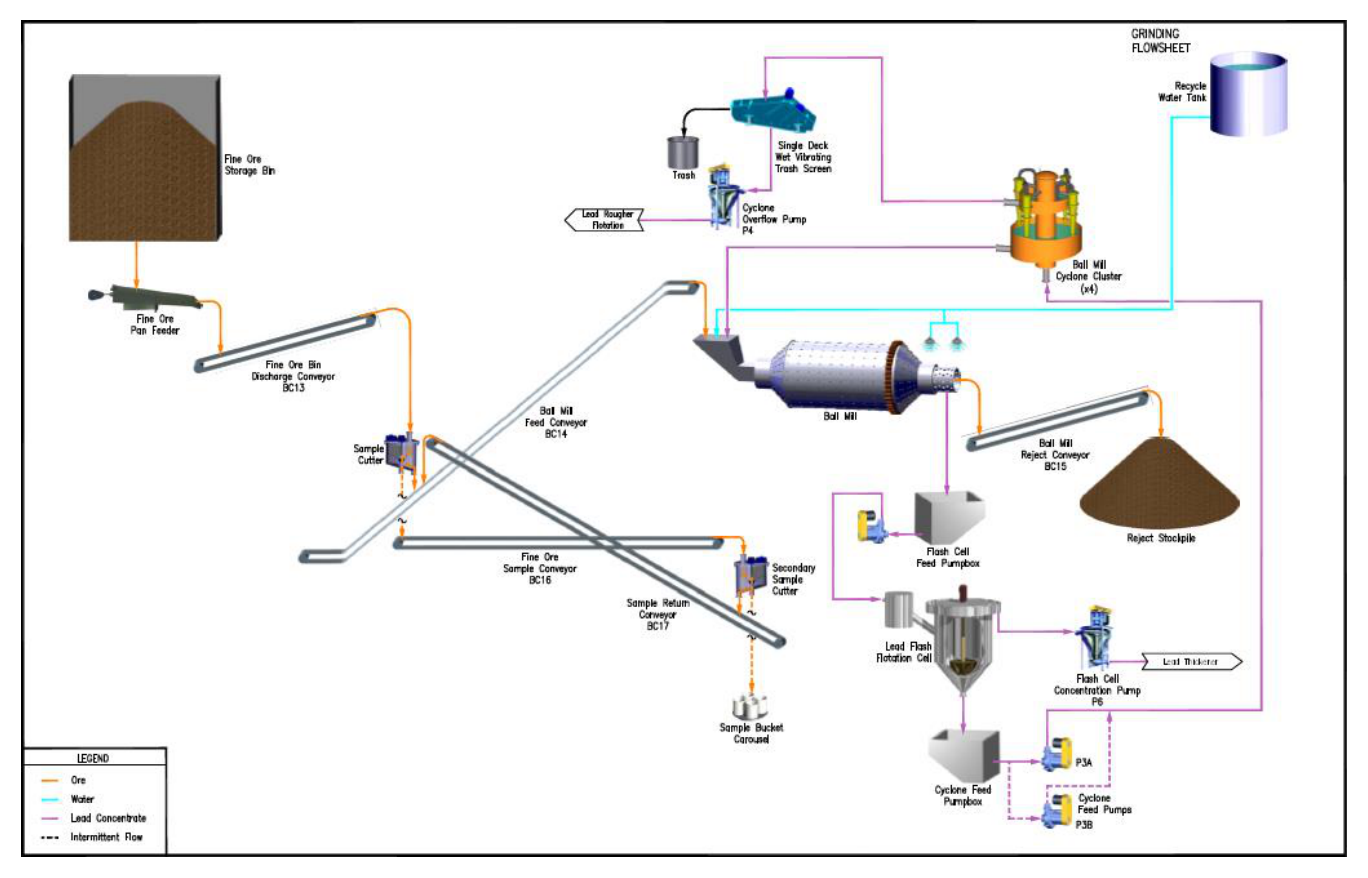
Hecla's 2013 technical report on the Lucky Friday mine at Mullan describes a 1,000 tpd crushing, ball milling and lead-zinc flotation plant in which a flash cell recovers about half the lead and silver straight from the grinding circuit.
The Lucky Friday mine lies in Shoshone County, Idaho, next to the town of Mullan and 8.5 miles east of Wallace in the Coeur d'Alene mining district. Hecla Mining Company owns it through subsidiaries: the Lucky Friday vein system outright, and the Gold Hunter vein system, where all reserves sat in 2013, through Hecla Limited and Silver Hunter Mining Company. The technical report, dated March 28, 2013, describes an underground silver, lead and zinc mine with a 1,000 tpd flotation concentrator. In 2011, two serious ground events and a shaft sinking fatality led to an MSHA withdrawal order on the Silver Shaft. The mine produced no ore in 2012 while it carried out repairs. It returned to limited production in February 2013 and planned to reach full output later that year.
Critical Data
| Parameter | Value | Unit | Notes |
|---|---|---|---|
| Concentrator capacity | 1,000 | tpd | Lead-zinc-silver flotation |
| Mill feed rate, 2007 to 2011 | 41.5 to 43.6 | dry short tons per hour | Annual averages |
| Mill operating time | 92 | % | Average |
| Crushing rate | 80 to 85 | tons per operating hour | About 50% operating time |
| Primary jaw crusher | 20 x 36 | in | Minus 12 in to minus 3 in |
| Fine ore size | About 100% passing 1/2 | in | 400 t fine ore bin |
| Ball mill | 9.5 ft x 12 ft | Not applicable | 600 hp |
| Grind size | 80% passing 150 | µm | Cyclone overflow at 40% solids |
| Flash cell recovery | About 50 | % of lead and silver | To final concentrate |
| Final lead concentrate grade | 63 | % Pb | About 100 oz/ton silver |
| Lead concentrate moisture | Below 8 | % | Vacuum drum filter |
| Zinc concentrate moisture | About 6 | % | Vacuum drum filter |
| Water treatment capacity | 375 and 750 | gpm | Two plants |
Overview
Lucky Friday uses a conventional lead-zinc flotation flowsheet, run with a real-time on-stream analyser. Ore is crushed in three stages and ground in a single ball mill. An SK-240 flash cell on the ball mill discharge pulls off coarse galena and silver minerals before they are overground. Lead is floated next in a rougher-scavenger bank with column cleaners, then zinc in a circuit of the same layout. The concentrates are thickened, filtered on vacuum drum filters and trucked daily to a smelter. Coarse tailings sands go underground as cemented backfill, and the rest of the tailings go to a tailings facility.
Bench flotation tests, mineralogy and plant trials on Lucky Friday and Gold Hunter ore support the plant design. The tests included mine water, fresh water and recycled tailings water as process water sources.
Key Process Stages
Crushing
Run-of-mine ore goes to coarse ore bins of 400 and 800 tons. Pan feeders and a belt scale meter it to a 20 by 36 inch Kue-Ken jaw crusher, which reduces it from minus 12 inches to minus 3 inches. A triple deck screen sends coarse material to a 3 foot Symons standard cone crusher, producing minus 1¼ inch. Oversize from the middle and bottom decks goes to a 3 foot short head cone crusher. Both cones return to the screen, and magnets protect each one. All product goes to a 400 ton fine ore bin at about 100% passing ½ inch. A baghouse controls dust.
Grinding and flash flotation
Two hydraulic feeders draw ore from the fine ore bin past an automatic sampler and a belt scale to the 9.5 by 12 foot ball mill. Ball mill discharge, with collector and frother, is pumped to the SK-240 flash cell. Flash cell tailings get more reagents and go to a cyclone cluster. Cyclone underflow returns to the mill. Overflow, at 40% solids and 80% passing 150 µm, is screened for trash and pumped to lead flotation. The flash cell makes final-grade concentrate of about 63% lead and over 100 oz/ton silver and recovers about half of the lead and silver. It also frees up capacity in the lead circuit, which matters most when high-grade ore is milled.
Lead flotation
Five Wemco 66D rougher cells make a concentrate of about 38% lead, which goes to the first cleaner column. Rougher tailings pass four Denver DR-24 scavenger cells, whose concentrate returns to the roughers. The first cleaner column lifts the concentrate to about 50% lead and feeds the second cleaner column. Tailings from both columns go to four Denver cleaner scavenger cells. Their concentrate feeds a third column, which normally returns its product to the first column. Second cleaner column concentrate and flash cell concentrate form the final lead concentrate, averaging 63% lead and 100 oz silver per ton.
Zinc flotation
Lead scavenger tailings pass two conditioning tanks where reagents activate the zinc. The second tank overflows into a zinc flash cell, whose concentrate goes straight to the first zinc cleaner column, so it acts as the first rougher. The zinc circuit then follows the lead circuit, with the same size cells, except that its third cleaner column sends concentrate to the final thickener. Zinc circuit tailings go to the tailings system.
Dewatering, tailings and water
Twelve foot high rate thickeners take each concentrate to about 60% solids. Air diaphragm pumps feed the underflow to vacuum drum filters, which reduce lead concentrate below 8% moisture and zinc concentrate to about 6%. Cyclones split the tailings. The coarse sand is dewatered, filtered and mixed with cement for stope backfill. Whole tailings go to a thickener and then to the tailings dam. Two water treatment plants of 375 and 750 gpm treat surplus water with sodium sulphide and flocculant, a lamella clarifier and multi-media filters before discharge to the Coeur d'Alene River.
Additional Interesting Data and Summary
Recovery estimates come from a flotation model built on plant data. It uses selection indices that link the recovery of secondary minerals and gangue to recovery of the principal mineral, and regressions of head grade against recovered grade. Lead and silver recovery to the lead concentrate and zinc recovery to the zinc concentrate each follow a linear formula of head grade.
The report notes that dust rules have tightened over seventy years of operation at Lucky Friday, and future rules could become stricter still.
Key Processes
- Three-stage crushing with jaw, standard cone and short head cone crushers
- Ball milling in closed circuit with cyclones
- Flash flotation of lead and silver in the grinding circuit
- Lead rougher, scavenger and column cleaner flotation
- Zinc activation, flash flotation and column cleaning
- Thickening and vacuum drum filtration of concentrates
- Cyclone separation of tailings sand for cemented backfill
Source: Technical Report on the Lucky Friday Mine, Shoshone County, Idaho, USA, March 28, 2013.
Project website: Lucky Friday Mine
