

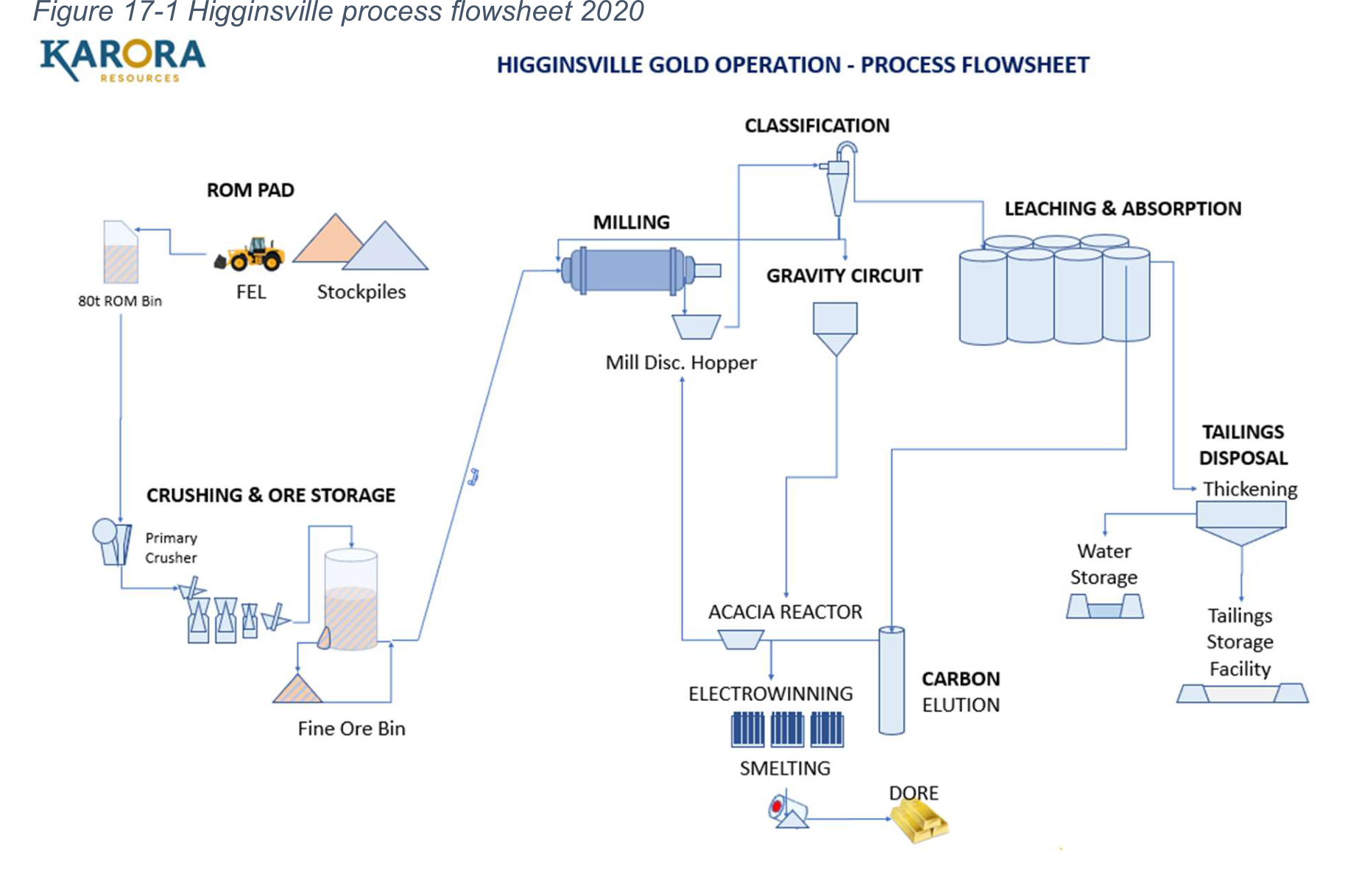
Karora's 2024 technical report on its Higginsville-Lakewood operation describes the 1.0 Mtpa Lakewood plant, bought in 2022, with contract crushing, a ball mill with twin Knelson concentrators and a leach-CIL train.
The Lakewood mill is an operating gold processing plant at Kalgoorlie in the Eastern Goldfields of Western Australia, about 65 km north of the Beta Hunt underground mine. Karora Resources Inc. bought the 1.0 Mtpa mill in July 2022. It became one half of Karora's Higginsville-Lakewood operation, alongside the 1.6 Mtpa Higginsville mill about 80 km south of Beta Hunt. The technical report, effective September 30, 2023 and dated January 4, 2024, updates resources and reserves for the operation and describes both mills. At Lakewood, toll treatment campaigns had declined because Beta Hunt ore kept the plant supplied, and throughput held at about 115 t/h while ramp-up projects continued.
Critical Data
| Parameter | Value | Unit | Notes |
|---|---|---|---|
| Lakewood mill capacity | 1.0 | Mtpa | Conventional CIL plant |
| Throughput | About 115 | t/h | Consistent, ramp-up ongoing |
| Crushed product size | 10 | mm P80 | Contract mobile crushing |
| Trommel aperture | 16 | mm | Removes scats and reject balls |
| Trash screen aperture | 0.80 | mm | 1.5 m x 3.6 m |
| Gravity screen aperture | 3.25 | mm | Two screens |
| Gravity concentrators | 2 | Not applicable | Knelson XD30 |
| Leach tank | 1,546 | m3 | 12.8 hours design residence |
| CIL tanks | 7 | Not applicable | 2,337 m3 total, 20 hours |
| Leach pH target | 9.6 | Not applicable | Cyanide up to 260 ppm |
| Carbon kiln temperature | About 700 | °C | LNG fired |
| Gold recovery since January 2022 | 91.4 to 95.7 | % | Average 93.8% |
| Average reconciled head grade | 1.76 | g/t Au | Head grade 1.76 to 2.26 g/t |
| Average tails grade | 0.15 | g/t Au | Lakewood |
Overview
Lakewood is a conventional carbon-in-leach (CIL) plant. A crushing contractor reduces the ore to 10 mm. A grate discharge ball mill in closed circuit with cyclones grinds it, and two Knelson concentrators take gravity gold from the cyclone underflow for intensive cyanidation in an Acacia reactor. The mill product is screened for trash and leached in one oxygenated tank before passing through seven CIL tanks. Loaded carbon is stripped by pressure Zadra electrowinning, and both the Zadra and Acacia gold are smelted to bullion in the gold room. Tailings pass a screen and are pumped to the tailings storage facility.
Beta Hunt ore reaches Lakewood by truck. It is classified and stockpiled by grade but is not usually blended.
Key Process Stages
Crushing
Oversize on the ROM pad is broken with a loader or excavator, and a rock breaker handles anything too large for the primary grizzly. The contractor runs mobile jaw and cone crushers and screens to produce a 10 mm product, which a radial stacker places on the ground. A front-end loader feeds the crushed ore through a belt feeder to the mill feed conveyor, and a Ramsey belt scale measures the tonnage.
Grinding and classification
Crushed ore, process water and cyclone underflow enter the ball mill feed chute. The mill runs in closed circuit with a hydrocyclone cluster. A 16 mm trommel on the discharge trunnion removes oversize ore and reject balls, which go to a scats bin, protecting the cyclone feed pumps and reducing wear on cyclones and slurry equipment. Cyclone overflow passes a 1.5 m by 3.6 m trash screen with 0.80 mm openings to remove oversize particles and plastic before leaching.
Gravity and intensive cyanidation
Cyclone underflow is screened on two gravity feed screens at 3.25 mm. Oversize returns to the cyclone feed hopper. Undersize feeds two Knelson XD30 concentrators, which run all the time. Their concentrate goes to a ConSep Acacia CS1000DM intensive dissolution module, and the pregnant solution is electrowon in a ConSep CS1000EW cell in the gold room.
Leaching and adsorption
The leach train has one 1,546 m3 leach tank followed by seven CIL tanks of 2,337 m3 combined. All tanks have dual down-pumping impellers on 55 kW drives. Oxygen can be injected into the first three tanks, with a high shear injector pump recirculating into Tank 1, which takes the first cyanide dose. Cyanide at 30% strength is added through a flow meter and control valve to the leach feed box or the first CIL tank. Design residence is 12.8 hours in leach and 20 hours in adsorption, at a pH target of 9.6 and up to 260 ppm cyanide. Haycarb activated carbon moves counter-current from the last tank to the first, and loaded carbon is pumped from the first CIL tank to elution.
Elution, refining and regeneration
Pressure Zadra elution strips the carbon, and electrowinning plates the gold onto steel wool cathodes. The cathodes are washed, and the gold concentrate is dried and smelted to bullion. Acacia gold is recovered and smelted in the same way. An LNG-fired horizontal kiln reactivates the barren carbon at about 700 °C before it returns to the circuit.
Tailings and services
Slurry from the last CIL tank passes a 0.8 mm tailings screen. Trash and carbon fines go to a self-draining bin, and the undersize is pumped through a polyethylene line to the tailings facility. The Citect control system watches line pressure for blockages or pipe failure. Process water is a mix of bore water, Lakewood tailings return water and water from Kalgoorlie Consolidated Gold Mines. Clean water and potable water are trucked in from Kalgoorlie, and power comes from the local grid.
Additional Interesting Data and Summary
Lakewood recovered between 91.4% and 95.7% of the gold from January 2022, averaging 93.8%. Reconciled and assayed head grades differed by less than 5%, and tails averaged 0.15 g/t gold.
The Higginsville mill, built in 2007 and commissioned in 2008, uses a similar flowsheet. It has four crushing stages, a 4.90 m by 6.77 m overflow ball mill, a Knelson XD40, one leach tank and six 1,000 m3 CIL tanks. It treats open pit ore from around Higginsville together with Beta Hunt underground ore. Its recovery also averaged 93.8% over the same period, at a reconciled head grade of 2.47 g/t.
Key Processes
- Contract mobile crushing to 10 mm
- Ball milling in closed circuit with cyclones and a 16 mm trommel
- Twin Knelson gravity concentration with Acacia intensive cyanidation
- Oxygen-assisted cyanide leaching in one tank
- Counter-current carbon adsorption in seven CIL tanks
- Pressure Zadra elution and electrowinning
- LNG-fired carbon reactivation
- Tailings screening and pipeline disposal
Source: NI 43-101 Technical Report, Higginsville – Lakewood Operation, Eastern Goldfields, Western Australia, September 30, 2023.
Project website: Lakewood Mill
