

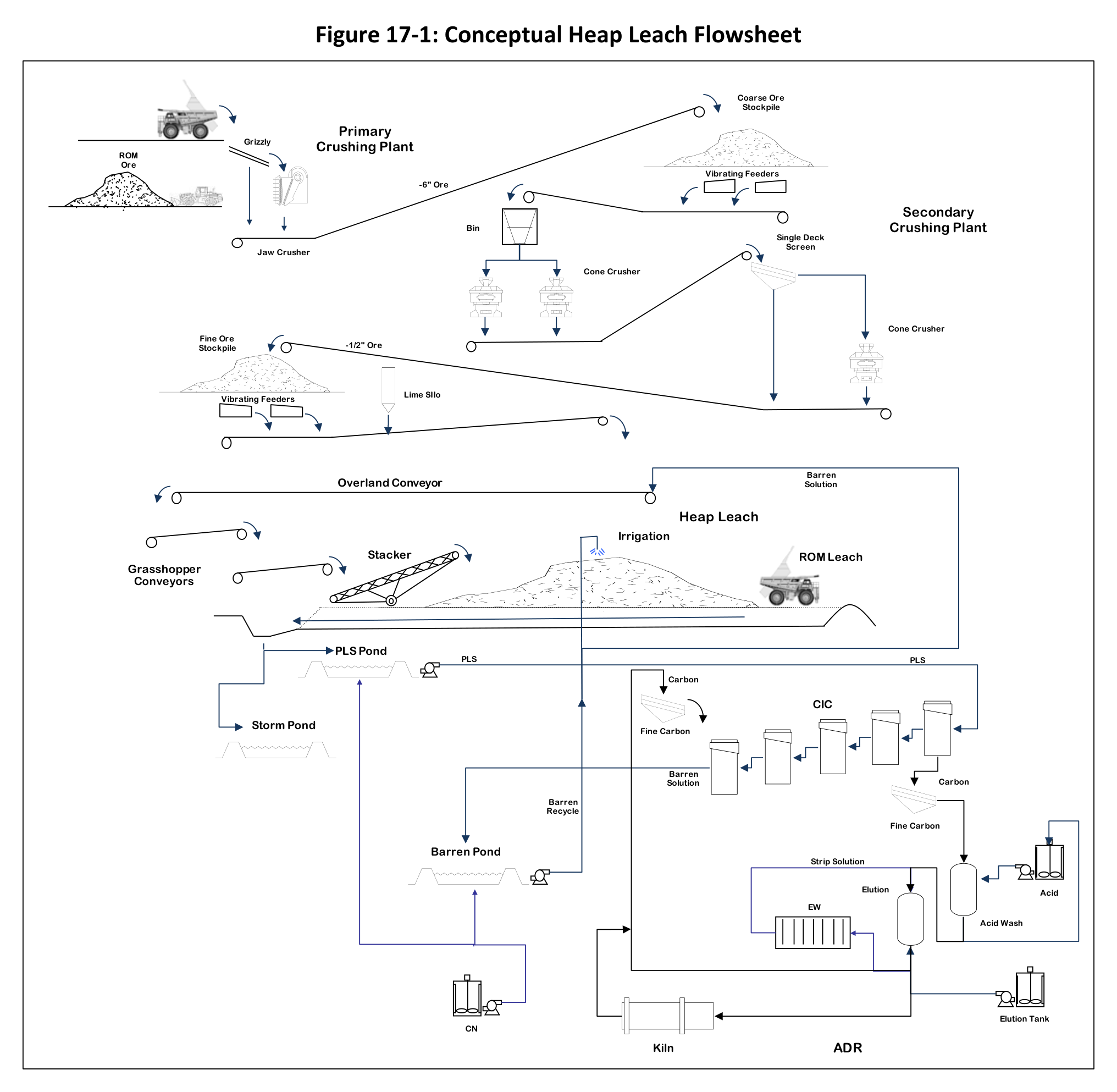
Otis Gold's 2019 preliminary economic assessment for Kilgore in Clark County designs a three-stage open circuit crushing plant, an overland conveyor down to the pad, and a carbon-in-column ADR plant with Zadra stripping.
The Kilgore gold project lies on the northern margin of the eastern Snake River Plain in Clark County, Idaho, about 5 miles west-northwest of the hamlet of Kilgore. Otis Gold Corp. held a 100% undivided interest in 614 unpatented federal lode claims covering 12,150 acres of U.S. Forest Service land. The independent technical report and preliminary economic assessment by Global Resource Engineering, effective July 30, 2019, covers an exploration stage project. It plans open pit mining with a conventional heap leach operating 24 hours a day, 365 days a year. Higher grade ore would be crushed before stacking, and lower grade ore would go to the pad as run-of-mine (ROM). The report gives no construction schedule.
Critical Data
| Parameter | Value | Unit | Notes |
|---|---|---|---|
| Crushing rate | About 15,000 | short tpd | 24 hours at 85% availability |
| Design crushing rate | 765 | tph | Primary jaw crusher |
| Primary grizzly opening | 2.5 | in | 64 mm |
| Jaw crusher product | 5 | in | Nominal, 100 mm |
| Secondary cone crushers | 2 | Not applicable | 6 ft standard, 22 mm closed side setting |
| Tertiary crusher | 6 ft short head | Not applicable | 17 mm closed side setting |
| Final crush size | 1/2 | in P80 | Open circuit |
| Agglomeration moisture target | 8 to 10 | % | About 50% of cyanide added on conveyor |
| Crushed ore lift height | 8 | m | Radial stacker |
| Irrigation rate | 12 | L/h/m2 | 0.005 gpm/ft2 |
| Primary leach period | About 90 | days | After up to 5 days of curing |
| CIC circuit | 2 trains of 5 | vessels | 4 tons of carbon each |
| Target carbon loading | 3,000 | g/t Au | Lead column |
| Column test recoveries | 64 to 94 | % | 60 day leach |
| Resource gold recovery | 80 | % | Pit optimization basis |
Overview
Kilgore's flowsheet is a standard heap leach. Lime goes onto both crushed and ROM ore before placement. Crushed ore is stacked by radial stacker from an overland conveyor and grasshopper conveyors, and ROM ore is trucked to a separate part of the pad, end-dumped and ripped with a dozer after each lift. Dilute cyanide is applied by drip emitters. Pregnant solution drains to a pond and is pumped through carbon-in-column (CIC) vessels. Loaded carbon is acid washed and stripped in a modified Zadra circuit, and electrowon gold sludge is smelted in an induction furnace.
The design places the primary crusher near the pit, about 4,000 feet uphill of the secondary plant with a drop of about 600 feet. An overland conveyor uses the slope to cut truck haulage. Crushing runs in open circuit to keep the number of screens and conveyors low.
Key Process Stages
Primary crushing
ROM ore passes over a vibrating grizzly with a 2.5 inch opening. Undersize goes straight to the jaw crusher discharge conveyor, and oversize feeds the jaw crusher, which crushes to a nominal 5 inches. The product goes by conveyor to a coarse ore stockpile.
Secondary and tertiary crushing
Three vibrating feeders under the stockpile feed a conveyor to the secondary crusher bin. Two 6 ft standard cone crushers at a 22 mm closed side setting discharge onto a common conveyor and a single deck screen with 20 mm openings. Screen undersize goes to the fine ore stockpile. Oversize goes to a 6 ft short head cone crusher at 17 mm, whose product also goes to the fine ore stockpile. The circuit produces about 80% passing ½ inch.
Conveying and stacking
Three vibrating feeders reclaim the fine ore onto the overland conveyor. Barren solution and lime are added there, delivering about half the cyanide the ore needs while keeping moisture at 8% to 10%. Grasshopper conveyors carry the ore across the lined pad, and a slewing radial stacker builds 8 m lifts in retreat. ROM lifts range from 5 to 10 m.
Heap leaching
The pad has an LLDPE liner under a layer of sized material with drainage pipes. Ore cures for up to five days before irrigation, which also keeps workers clear of active leaching areas. Emitters apply solution at 12 L/h/m2 for about 90 days of primary leaching. There is no rinse stage between lifts, since up to ten lifts are planned; rinsing happens only at closure or when the heap reaches full height. Drain pipes carry solution to perimeter ditches. These send it to the pregnant, barren or storm water ponds, and storm water can serve as make-up water. The pad would be built in phases, starting with two three-year stages.
Adsorption, desorption and recovery
Pregnant solution is pumped through two trains of five CIC vessels, each holding four tons of carbon. Recessed impeller pumps advance the carbon counter-current once the lead vessel reaches about 3,000 g/t gold. Loaded carbon passes a screen to an acid wash column using dilute nitric acid, and the spent acid is neutralized. A caustic cyanide solution strips the carbon in a modified Zadra elution column, at two strips a day. Electrowinning recovers gold and silver, and the dried sludge is smelted to doré. About half the barren carbon goes through an indirect fired kiln. Carbon fines are filtered and sent off site for recovery.
Additional Interesting Data and Summary
Column leach tests gave gold recoveries of 64% to 94% in 60 days across all material types. The tests used crush sizes from ½ inch to 3 inches and gold grades of 0.03 to 0.055 oz/ton. The deposit is moderately sensitive to crush size. Some areas show potential for ROM leaching, and others need finer crushing to hold recovery and leach speed. Cyanide use ranged from 0.6 to 5 lb/t, averaging about 2.2 lb/t, and lime use varied widely. Neither had been optimized.
Parts of the deposit carry active carbon and higher grades and may suit carbon-in-leach milling better. The PEA does not include a mill. The report says a later study could add a SAG and ball mill circuit grinding to 75 µm with CIL, sharing elution and refining with the heap leach.
Key Processes
- Vibrating grizzly scalping and jaw crushing near the pit
- Overland conveying downhill to the secondary crushing plant
- Open circuit cone crushing and screening to ½ inch
- Lime and cyanide addition on the conveyor
- Radial stacking of crushed ore and end-dumping of ROM ore
- Drip irrigation on a lined, multi-lift heap
- Carbon-in-column adsorption, nitric acid washing and Zadra elution
- Electrowinning and induction furnace smelting
Source: Independent Technical Report and Preliminary Economic Assessment, Kilgore Project, Clark County, Idaho, USA, July 30, 2019.
Project website: Kilgore Gold Project
