

Fireweed Zinc's 2018 study for the Tom and Jason deposits in eastern Yukon designs a SAG and ball mill circuit grinding to 50 µm, with rougher concentrate split between a column cell and a 3 mm ceramic media regrind.
The Macmillan Pass project, also called Tom-Jason, lies in eastern Yukon near the border with the Northwest Territories. Fireweed Zinc Ltd. owned it 100%. The preliminary economic assessment by JDS Energy & Mining, effective May 23, 2018, describes an exploration stage project that would mine the Tom and Jason zinc-lead-silver deposits underground. Ore would feed a 5,000 t/d sequential flotation plant producing separate lead and zinc concentrates for trucking to Skagway, Alaska. The plant would treat a blend of about 65% Tom and 35% Jason ore averaging 3.6% lead, 5.2% zinc and 45.8 g/t silver over the mine life. The report gives no construction schedule.
Critical Data
| Parameter | Value | Unit | Notes |
|---|---|---|---|
| Plant throughput | 5,000 | t/d | 226 t/h |
| Plant availability | 92 | % | 365 days per year |
| Crushing availability | 75 | % | Two jaw crushing circuits |
| Head grades | 3.6 / 5.2 / 45.8 | % Pb / % Zn / g/t Ag | Life of mine average |
| Crushed product size | 110 | mm P80 | 125 mm closed side setting |
| SAG mill | 6.4 m x 3.7 m | Not applicable | 1,865 kW, open circuit |
| Ball mill | 5.5 m x 9.3 m | Not applicable | 4,476 kW, reverse closed circuit |
| Bond ball mill work index | 14 | kWh/t | Test work |
| Grind size | 50 | µm P80 | Flotation feed |
| Lead regrind size | 15 | µm P80 | 400 kW stirred mill |
| Zinc regrind size | 25 | µm P80 | 400 kW stirred mill |
| Lead recovery | 75 | % | 62% Pb concentrate |
| Zinc recovery | 88.9 | % | 58.4% Zn concentrate |
| Silver recovery | 59 | % | To lead concentrate |
| Concentrate moisture | 8 | % | Pressure filters |
Overview
Locked cycle test LCT-45 from Base Metallurgical Laboratories in Kamloops forms the design basis. Standard sequential flotation gave 75% lead recovery to a 62% lead concentrate and 89% zinc recovery to a 58% zinc concentrate. Those results set the design criteria, mass balance, equipment list and operating costs.
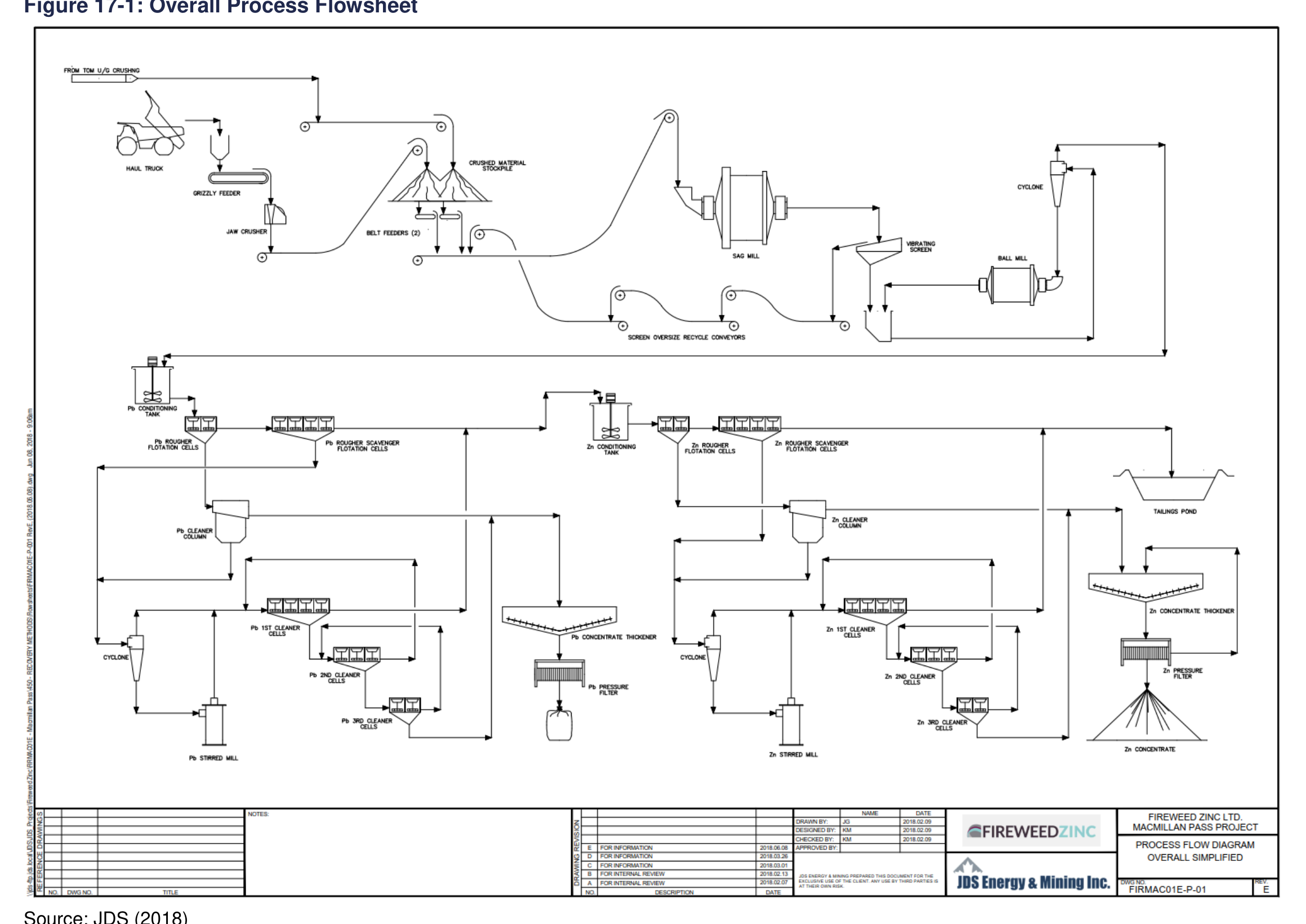
The flowsheet is conventional with a few modern features. Two jaw crushers feed a covered stockpile. A SAG mill in open circuit and a ball mill in reverse closed circuit grind to 50 µm. In each flotation circuit, concentrate from the first two rougher cells goes to a column cell that can make final concentrate directly. The remaining rougher concentrate and the column tailings are reground in a stirred mill and cleaned in three stages of tank cells. Both concentrates go through high rate thickeners and pressure filters, and the tailings are pumped to a tailings facility.
Key Process Stages
Crushing
The mine schedule calls for two crushing circuits. Tom ore is crushed underground in a 42 inch by 48 inch, 160 kW jaw crusher. Jason ore is dumped on surface through an 800 mm static grizzly, with a rock breaker for oversize, into a 25 inch by 40 inch, 90 kW jaw crusher rated at 150 t/h. Both produce about 110 mm. Conveyors deliver the ore to a 5,000 t stockpile, enough for 24 hours. Two variable speed belt feeders in a corrugated tunnel reclaim it, and each can supply the full 226 t/h.
Grinding
The SAG mill runs at 70% solids and overflows to a screen. Oversize returns on three recycle conveyors, and undersize at about 1,000 µm flows to the cyclone feed pump box with the ball mill discharge. Ten 375 mm cyclones, eight running, classify the slurry at a 300% circulating load. Underflow feeds the ball mill, and overflow at 50 µm goes to lead conditioning.
Lead flotation
A 19 m3 tank gives two minutes of conditioning with MIBC, potassium amyl xanthate, sodium cyanide to depress zinc, soda ash, zinc sulphate and PE26 to depress carbon. Six 20 m3 rougher tank cells follow. Concentrate from cells 1 and 2 goes to a 1.5 m by 8.0 m column, and the column concentrate goes straight to the lead thickener. The column tailings and the rougher concentrate from cells 3 to 6 pass densifying cyclones to a 400 kW stirred mill with 3 mm ceramic media, which grinds to 15 µm. Three cleaning stages follow, with six 5 m3 first cleaners, three 3 m3 second cleaners and two 3 m3 third cleaners. First cleaner tailings join the lead rougher tailings as zinc feed.
Zinc flotation
A 60 m3 tank gives five minutes of conditioning with MIBC, Polyfroth H57, sodium isopropyl xanthate, lime and copper sulphate. Seven 20 m3 rougher cells follow. Concentrate from cells 1 and 2 goes to a 3.0 m by 8.0 m column. The rest, with the column tailings, is reground to 25 µm in a second 400 kW stirred mill and cleaned in three stages of 10 m3 cells. Zinc rougher tailings and first cleaner tailings are the final plant tailings.
Dewatering and tailings
Lead concentrate from the column and third cleaners goes to a 7 m high rate thickener and an eight hour stock tank, then a pressure filter to about 8% moisture. It is bagged and trucked to Skagway. Zinc concentrate goes to a 12 m thickener and a pressure filter, also to about 8%. Thickener overflows return to the process water tank. Final tailings are pumped to the tailings management facility, which supplies reclaim water to the plant.
Additional Interesting Data and Summary
The design applies a scale-up factor of 2.0 to laboratory rougher times and 4.0 to cleaner times. The lead rougher therefore has 12 minutes against 6 in the laboratory. The lead cleaner stages have 24, 12 and 8 minutes, and the zinc cleaners 28, 16 and 12.
Grinding test work on two composites gave SMC Axb values of 55.8 and 80.8 and Mia values of 10.7 and 14.5 kWh/t. Reagent tanks hold one day of supply, and the reagent areas are bermed with sumps that return spills to the tailings pump box or the mix tanks.
The mine plan targets higher margin material first, at Tom East and the higher grade parts of Tom West and Jason Main, and opens Jason South later.
Key Processes
- Two jaw crushing circuits, one underground and one on surface
- Open circuit SAG milling with screen recycle
- Ball milling in reverse closed circuit to 50 µm
- Lead rougher flotation with column cleaning of early concentrate
- Stirred mill regrinding with ceramic media
- Three-stage tank cell cleaning in both circuits
- Zinc activation with copper sulphate and sequential zinc flotation
- High rate thickening and pressure filtration of concentrates
Source: NI 43-101 Technical Report, Macmillan Pass Project, Yukon Territory, Canada, May 23, 2018.
Project website: Macmillan Pass Project
