

The 2024 technical report on Cleveland-Cliffs' Northshore property in Minnesota describes remote crushing, 17 rod and ball mill sections with hydroseparation and amine flotation, and straight grate pellet furnaces at Silver Bay.
Northshore is an open pit taconite operation in northeastern Minnesota, owned by Cleveland-Cliffs Inc. through its wholly owned subsidiary Northshore Mining Company. The property combines the Peter Mitchell Mine in Babbitt with the E.W. Davis Works processing plant in Silver Bay. The NI 43-101 technical report by SLR, effective December 31, 2021 and signed August 16, 2024, describes an operation that began in 1952 and mines about 17 million long tons (MLT) of ore a year. It produces 5.0 MLT of iron ore pellets, which are shipped by freighter across the Great Lakes to Cliffs' steel mills. The concentrator makes two products: standard concentrate, and a direct reduction (DR) grade concentrate for pellets that go to direct reduced iron production.
Critical Data
| Parameter | Value | Unit | Notes |
|---|---|---|---|
| Mining rate | About 17 | MLT/y | Open pit ore |
| Pellet production | 5.0 | MLT/y | Shipped by lake freighter |
| Primary crusher | 60 x 89 | in | Gyratory at Babbitt |
| Secondary crushers | 4 | Not applicable | 30 x 70 in gyratory, product minus 4 in |
| Rail haul | 47 | mi | Babbitt to Silver Bay |
| Tertiary and quaternary crushing | Minus 0.75 | in | 7 ft shorthead cone crushers |
| Cobber tails | About 13 | % of crude ore | Discarded as coarse tailings |
| Concentrator sections | 17 | Not applicable | Plus three partial scavenging sections |
| Final grind | 90 | % passing 325 mesh | 45 µm |
| Standard concentrate | About 68 | % Fe | 4.80% pellet silica target |
| DR-grade concentrate | About 70 | % Fe | 2.00% pellet silica target |
| Magnetic iron recovery | 87.8 | % | From 32.9 weight % of feed |
| Filter cake moisture | 9.5 | % | Vacuum disc filters |
| Pellet furnaces | 4 | Not applicable | Two 240 LT/h and two 105 LT/h |
Overview
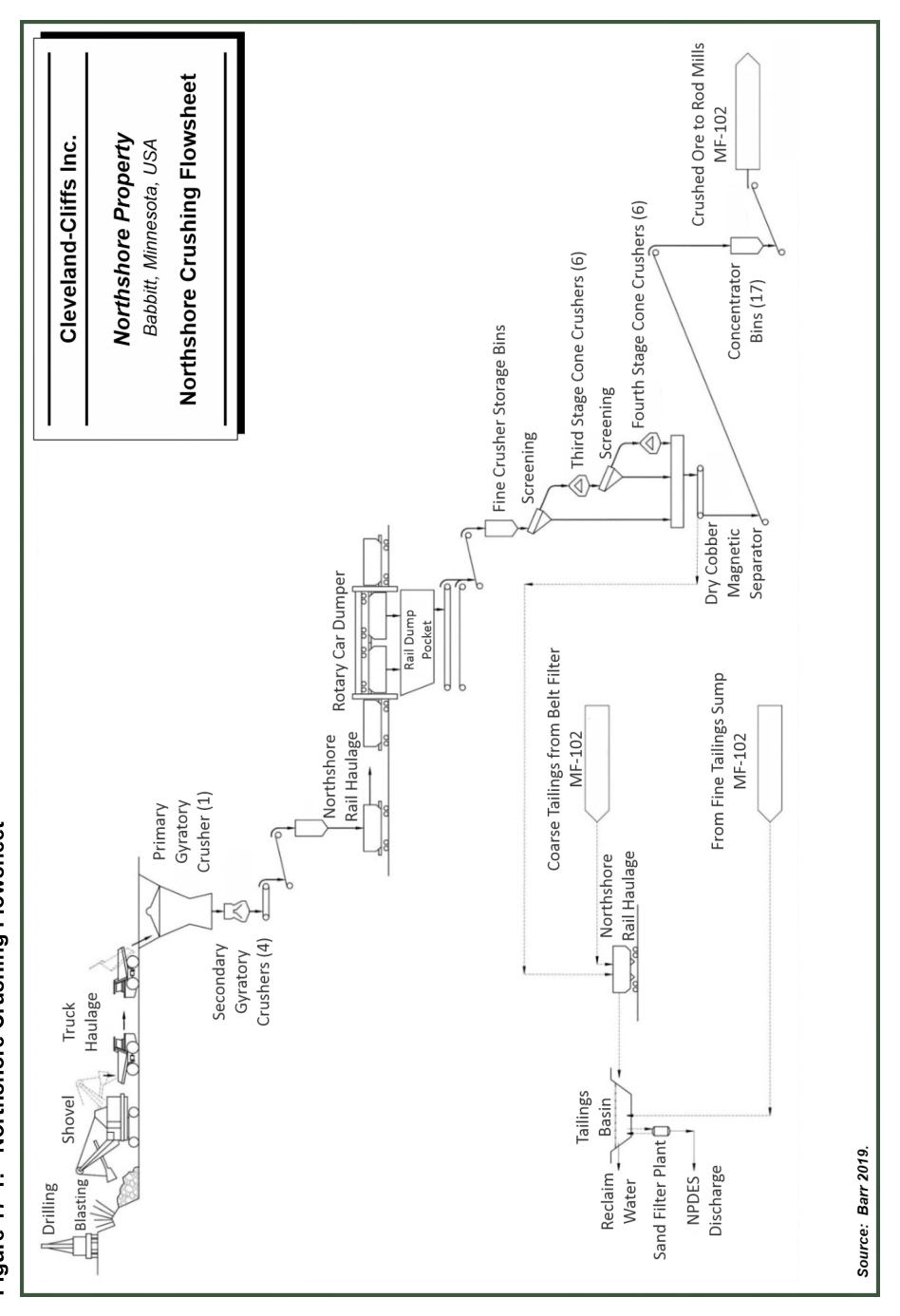
The Northshore flowsheet is a magnetite concentrator with a pellet plant, split between two sites. Mine haul trucks dump into a gyratory crusher in Babbitt, and four gyratory crushers beneath it make a minus 4 inch product that is loaded onto trains. At Silver Bay, cone crushers reduce the ore to minus 0.75 inch and dry drum magnetic separators remove a coarse reject. The remaining material is rod milled, cleaned by magnetic separation, ball milled with cyclones, and finished with hydroseparators, screens, finisher magnetic separators and reverse flotation. A thickener and vacuum disc filters dewater the concentrate before it goes to the pellet plant.
Key Process Stages
Crushing and rail transport
A 60 inch by 89 inch gyratory crusher takes crude ore directly from the haul trucks. The crushed ore falls into four 30 inch by 70 inch secondary gyratory crushers beneath it, which make a minus 4 inch product. This is conveyed to rail car loading bins and carried 47 miles to Silver Bay on a track owned by the Northshore Mining Railroad, a wholly owned Cliffs subsidiary. At Silver Bay, automated two-car dumpers and belt conveyors feed the tertiary and quaternary crushing plant silos. Nordberg 7 ft shorthead cone crushers reduce the ore to minus 0.75 inch. There are no blending facilities at the concentrator, since the report says blending is done through the choice of blast sites at the mine and the truck deliveries to the primary crusher.
Cobbing and grinding
Crushed ore passes over double-drum dry cobber magnetic separators. The cobber tails, about 13% of the crude ore, are hauled by rail and discarded as coarse final tails. The cobber concentrate has a magnetic iron target of 28.5% and goes by conveyor to rod mills running in open circuit. Rod mill discharge is treated in low-intensity drum rougher separators, and the rougher concentrate is pumped to a cluster of 10 Cavex cyclones. These run in closed circuit with two parallel ball mills to make a final grind of 90% passing 325 mesh. Ball mill discharge joins the rod mill discharge ahead of the rougher separators. The concentrator building holds 17 complete sections and three partial scavenging sections.
Hydroseparation, screening and finishing
Cyclone overflow passes through magnetizing coils, which flocculate the magnetite, and then goes to two parallel primary hydroseparators. Overflow, mostly silica, goes to the tailings launder. The heavy underflow passes through demagnetizing coils to a fine screen station with eight sets of primary and eight sets of secondary screens per section. Screen oversize returns to the rougher concentrate pumps and the cyclones. Undersize is magnetized again and fed to a finisher hydroseparator, and its underflow goes to two parallel double-drum finisher magnetic separators.
Reverse flotation
Finisher concentrate is pumped to primary flotation cells, where silica is floated with cationic amine collectors and a frother of 2-ethyl hexanol. During standard concentrate production, primary flotation tails go through a regrind magnetic separator to a regrind ball mill and then to secondary flotation cells. Secondary concentrate returns to primary flotation, and secondary tails go to the tailings launder. For DR-grade concentrate, primary and secondary tails can instead go to a scavenger sump. Soda ash is added to the process water to control hardness, because calcium would otherwise compete with the amine for silica surfaces.
Four nuclear on-line analyzers (NOLAs) measure silica in the concentrate, each serving five sections, every 20 to 30 minutes. A control loop raises the reagent dose when silica is high and lowers it when silica is low.
Scavenging
The lower silica set-point on the DR-grade sections increases reagent addition and flotation tails. To recover iron economically, middling slurry from the primary and secondary froth on each DR-grade section is sent to a sump and then to scavenger transfer pumps in the NOLA buildings. It is then transferred to a scavenger building for dewatering and storage.
Concentrate dewatering
Concentrate from the sections goes to a 40 ft thickener in the filter building and then to vacuum disc filters. Filter cake at 9.5% moisture is carried by belt conveyor to the pellet plant concentrate bins. Standard concentrate runs at about 68% Fe and 90% passing 325 mesh. DR-grade concentrate runs at about 70% Fe and 93% passing 325 mesh.
Pellet plant
The report describes the circuits linked to the newer furnaces 11 and 12. Concentrate is rolled in rubber-lined balling drums 30 ft long, turning at 5 to 12 rpm, to make green balls of plus 3/8 to 1/2 inch. A roll screen with 51 rollers sizes them. Limestone is added at the filters at 0.85 wt% for standard pellets and 0.80 wt% for DR-grade pellets. Wyoming bentonite and an organic binder are used. Bentonite adds silica, while the organic binder lowers bentonite use and silica and increases reducibility. A straight grate furnace dries, preheats and fires the pellets using natural gas at about 620,000 Btu per ton. Two 240 LT/h and two 105 LT/h furnaces are available, and their output depends on meeting customer quality targets.
Additional Interesting Data and Summary
Crude ore is magnetite taconite at about 25% magnetic iron. The concentrator averages 87.8% magnetic iron recovery into a concentrate that is 32.9 weight % of the feed. Historical concentrate output ranged from 3.1 to 5.5 MLT/y, with a 12-year average of 4.45 MLT/y. Pellet output ranged from 3.1 to 5.6 MLT/y, with a 12-year average of 4.54 MLT/y.
In 2019 Northshore completed an upgrade at Silver Bay that allows production of lower silica pellets for direct reduced iron products such as hot briquetted iron. The tailings storage facility covers about 2,500 acres, roughly seven miles by rail northwest of the plant. The report states Mineral Reserves of 822.4 MLT at 24.6% magnetic iron, supporting a 48 year mine life.
Key Processes
- Gyratory crushing at the mine and cone crushing at Silver Bay
- Dry cobber magnetic separation with rail disposal of coarse tails
- Open circuit rod milling and closed circuit ball milling with cyclones
- Hydroseparation and fine screening
- Finisher magnetic separation
- Reverse flotation of silica with cationic amine
- Scavenging of middlings in DR-grade sections
- Vacuum disc filtration, drum balling and straight grate induration
Source: NI 43-101 Technical Report, Northshore Property, Minnesota, USA, December 31, 2021.
Project website: Northshore Mine
