

The 2024 technical report on Cleveland-Cliffs' United Taconite property in Minnesota describes remote crushing at Thunderbird, a five-line magnetic separation concentrator at the Fairlane facility, and a two-line grate-kiln pellet plant.
United Taconite is an open pit taconite operation near Eveleth in northeastern Minnesota. The operator, United Taconite LLC, is a wholly owned subsidiary of Cleveland-Cliffs Inc. The property includes the Thunderbird Mine North and South, and the Fairlane processing facility. The NI 43-101 technical report by SLR, effective December 31, 2021 and signed August 16, 2024, describes an operating mine and pellet plant. Ore is crushed in two stages at the mine, carried by rail eight miles to Fairlane, crushed in two more stages, ground on five lines and concentrated magnetically. The concentrator described in the report relies on magnetic separation, screening and hydroseparation, and its process description lists no flotation step.
Critical Data
| Parameter | Value | Unit | Notes |
|---|---|---|---|
| Primary crusher | 60 x 89 | in | Gyratory, fed by 240 ton haul trucks |
| Secondary crushers | 3 | Not applicable | 30 x 70 in gyratory |
| Surge pile | 20,000 | LT | Covered conical pile |
| Primary crushing feed rate | 3,200 | LT/h | Average |
| Rail haul to Fairlane | 8 | mi | Crushed ore |
| Fine crushing throughput | 50,000 | LT/d | 3.1 kWh/LT |
| Fine crusher product | 85 to 90 | % passing 0.5 in | Fourth stage |
| Grinding lines | 5 | Not applicable | Rod mill, ball mill, magnetic separation |
| Lines 1 and 2 feed rate | 345 | LT/h each | 90% availability |
| Lines 3, 4 and 5 feed rate | 435 | LT/h each | 90% availability |
| Cobber tailings | About 35 | % of cobber feed mass | Lines 1 and 2 |
| Concentrate size | 76 to 86 | % passing 325 mesh | Final concentrate |
| Filter cake moisture | About 9.6 | % | Eight vacuum disc filters |
| Pellet Line 1 feed | 320 | LT/h | Standard grade, typical |
| Pellet Line 2 feed | 680 | LT/h | Standard grade, typical |
| Kiln gas temperature | 2,400 | °F | Natural gas or coal burners |
Overview
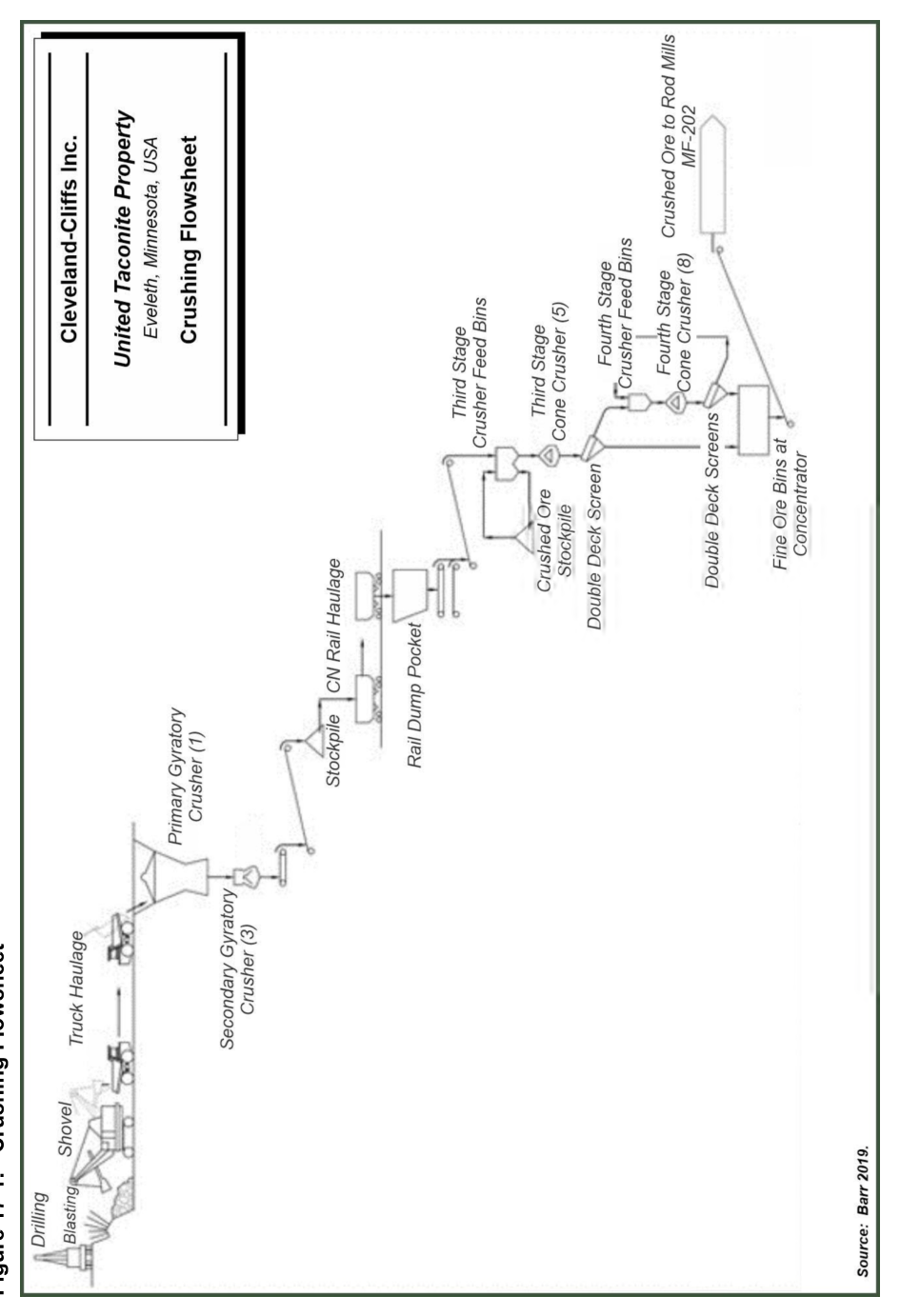
The United Taconite flowsheet splits crushing and concentrating between two sites. Crude ore blended at the Thunderbird Mine is crushed by a gyratory crusher and three secondary gyratory crushers directly beneath it, stored in a covered surge pile, and railed to the Fairlane facility. There, five Nordberg seven-foot shorthead crushers in the third stage and eight in the fourth stage reduce the ore to 85% to 90% passing 0.5 inch. Five grinding lines combine open circuit rod milling, cobber magnetic separation, closed circuit ball milling, rougher magnetic separation, cyclones, hydroseparators and finisher magnetic separators. The concentrate is thickened, filtered and pelletized on a grate-kiln-cooler.
Key Process Stages
Crushing
Haul trucks of 240 tons dump into a 60 inch by 89 inch primary gyratory crusher. Three 30 inch by 70 inch secondary gyratory crushers sit directly beneath it. The crushed ore goes to a 20,000 LT conical surge pile, which is covered to avoid handling difficulties in extremely cold weather. Apron feeders and a conveyor in a tunnel under the pile reclaim it to rail car loading silos, and trains carry it to Fairlane at an average primary feed rate of 3,200 LT/h. The third stage uses five seven-foot Nordberg shorthead crushers in parallel in open circuit, followed by screens. Their oversize feeds a fourth stage of eight shorthead crushers in closed circuit with screens. Throughput averages 50,000 LT/d, with a specific power consumption of 3.1 kWh/LT.
Grinding lines 1 and 2
Lines 1 and 2 average 345 LT/h at 90% operational availability. Each has a 14 ft by 20 ft equivalent grinding length (EGL) Nordberg overflow rod mill with a 2,000 hp motor, running in open circuit. Rod mill discharge passes two 4 ft by 10 ft, 1,200 Gauss cobber magnetic separators per line. Cobber tailings are final tailings, about 35% of the cobber feed mass, and are treated in spiral classifiers. The classifier underflow leaves as coarse tailings, and the overflow goes to two 40 ft hydroseparators and a 300 ft tailings thickener. Four 14 ft by 22 ft EGL ball mills run in closed circuit with 26 inch cyclones, with rougher magnetic separators on each ball mill discharge. Cyclone overflow goes to concentrate hydroseparators, and the heavy underflow goes to finisher magnetic separators. The finisher concentrate is classified on Derrick screens, with oversize reground and undersize sent to the pellet plant.
Grinding lines 3, 4 and 5
These lines run at 435 LT/h each. Three 15 ft by 21 ft EGL rod mills discharge through two cobber separators per line to three 17 ft by 42 ft EGL ball mills, one per line, in closed circuit with cyclones and screens. Twelve 4 ft by 10 ft rougher separators, four per line, take the ball mill discharge. The heavy product of the concentrate hydroseparators goes to Rapifine screens. Oversize is reground in the ball mill, and undersize goes to the finisher separators. Derrick screens are used after the finishers only when silica is high. A recent upgrade to Line 5 replaced the Rapifine and Derrick screens ahead of the finishers with a single Derrick Stacksizer stage.
Fluxstone grinding
When Mustang flux pellets are made, a 50/50 mixture of limestone and dolomite is ground in a 14 ft by 20 ft EGL Nordberg overflow ball mill. The discharge feeds two five-deck Derrick Stacksizer screens, with oversize returned to the mill. Undersize is thickened and pumped to the pellet plant's fluxstone slurry tank, where it is metered into the concentrate to reach the required calcium to silica ratio.
Filtering and balling
Three 45 ft thickeners raise the magnetite concentrate from 45% to 65% solids, and eight vacuum disc filters dewater it to about 9.6% moisture. Bentonite, organic reagents and limestone are used as binders, and organic binder mixed with soda ash is blended into the filter cake. Balling is done in drums with a variable-speed cutter that controls lining thickness. Line 1 has five 10 ft by 32 ft drums at 12 rpm, and Line 2 has seven at 10.8 rpm. Roll screens return oversize and undersize balls to the drums.
Induration
The grate-kiln machine dries and preheats on a grate and fires in a rotary kiln. The drying section has two down-draft zones, the first with gas at 650°F and the second at 1,000°F to 1,200°F. Balls reach 1,800°F to 1,900°F by the end of preheat, and partial oxidation of the magnetite to hematite supplies exothermic heat. Gas enters the kiln at 2,400°F. An annular cooler with a 36 inch bed finishes the oxidation, and pellets go to three storage silos and are railed to Duluth for loading into lake vessels. Production is about 20% lower when flux-grade product is made.
Additional Interesting Data and Summary
Standard-grade pellet production feeds Line 1 at 320 LT/h and Line 2 at 680 LT/h, giving average product rates of 250 and 560 LT/h. These values are typical and move with operating conditions and crude ore blends.
The report describes how soda ash and caustic soda are among the reagents used at the Fairlane facility, and that ground limestone is received by truck for standard-grade pellets and pneumatically conveyed to storage bins before being slurried at 45% solids.
Key Processes
- Gyratory crushing at Thunderbird with a covered surge pile and rail haul
- Third and fourth stage shorthead cone crushing at Fairlane
- Open circuit rod milling with cobber magnetic separation
- Closed circuit ball milling with rougher magnetic separation
- Cyclone classification, hydroseparation and screening
- Finisher magnetic separation
- Fluxstone grinding and slurry blending
- Vacuum disc filtration, drum balling and grate-kiln induration
Source: NI 43-101 Technical Report, United Taconite Property, Minnesota, USA, December 31, 2021.
Project website: United Taconite Mine
