

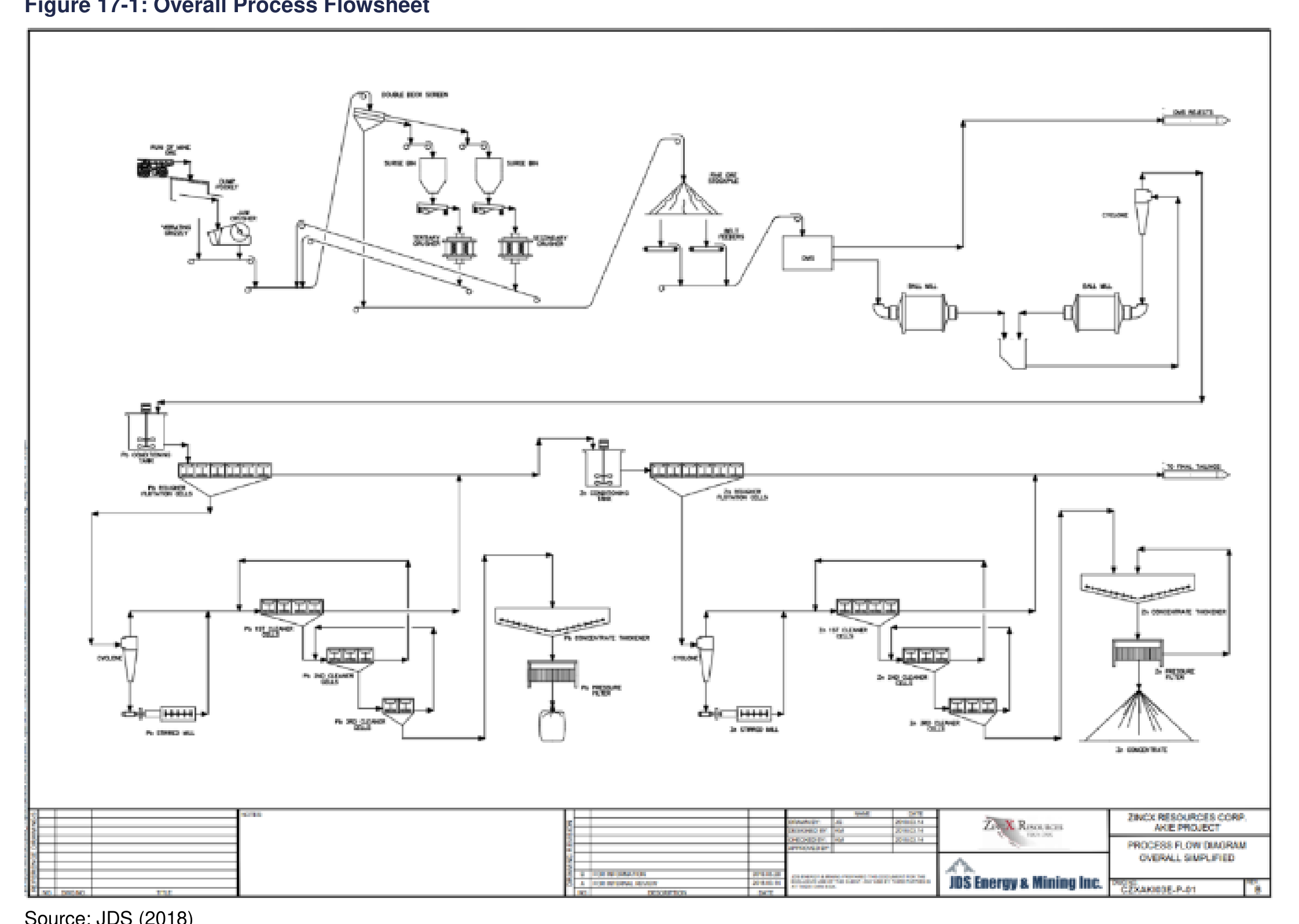
The 2018 preliminary economic assessment for ZincX's Akie project in British Columbia describes a 3,000 t/d mill fed by 4,000 t/d of crushed ore, with dense media rejection of 25% of the feed, sequential lead and zinc flotation, and filtered tailings.
Akie, also known as the Cardiac Creek project, is a zinc-lead-silver property in north-central British Columbia, Canada. It is wholly owned by ZincX Resources Corp., a Vancouver-based company formerly known as Canada Zinc Metals. The NI 43-101 technical report, prepared by JDS Energy & Mining with an effective date of 20 June 2018 and a report date of 1 August 2018, summarizes a preliminary economic assessment (PEA) for the Cardiac Creek deposit, a baritic SEDEX zinc-lead-silver body. The PEA is preliminary in nature and includes Inferred Mineral Resources that are too speculative to be classified as Mineral Reserves. The process plant design is based on a Base Metallurgical Laboratories test program that supports standard sequential lead and zinc flotation with dense media separation (DMS) as a pre-concentration step.
Critical Data
| Parameter | Value | Unit | Notes |
|---|---|---|---|
| Crushing plant throughput | 4,000 | t/d | 222 t/h at 75% availability |
| Process plant throughput | 3,000 | t/d | After 25% DMS waste rejection |
| LOM head grade, zinc | 7.63 | % Zn | 2018 mine plan |
| LOM head grade, lead | 1.48 | % Pb | 2018 mine plan |
| LOM head grade, silver | 13 | g/t Ag | 2018 mine plan |
| Crushed product size | 8.8 | mm P80 | Three-stage crushing |
| DMS cut | 2.80 | SG | Ferrosilicon medium |
| DMS stage recovery | 96.3 / 98.5 | % Pb / % Zn | 25% of feed rejected |
| Ball mills | 2 | Not applicable | 4.3 m x 7.3 m, 2,238 kW each |
| Primary grind transfer size | 250 | µm T80 | Open circuit ball mill |
| Final grind | 56 | µm P80 | Reverse closed circuit with cyclones |
| Lead regrind | 10 | µm P80 | Stirred mill |
| Zinc regrind | 15 | µm P80 | Stirred mill |
| Lead recovery | 46.2 | % | Lead concentrate at 45.1% Pb |
| Zinc recovery | 88.9 | % | Zinc concentrate at 52.4% Zn |
| Concentrate moisture | 8 | % | Pressure filters |
| Tailings moisture | 15 | % | Dry stack |
Overview
The Akie process plant is a conventional base metal flowsheet with a pre-concentration step. Ore is crushed in three stages, and DMS rejects 25% of it as waste. The rest is ground in two ball mills, then floated to make a lead concentrate and a zinc concentrate, each with three cleaning stages. Both concentrates are thickened and pressure filtered. Final tailings are filtered to 15% moisture and stacked dry.
Key Process Stages
Crushing and stockpile
A vibrating grizzly feeder and jaw crusher in open circuit make a product of 100 mm P80. Two stages of cone crushing in closed circuit with a double deck vibrating screen reduce this to 8.8 mm P80. The crushing plant runs at 4,000 t/d and 75% availability, or 222 t/h. A stockpile with 24 hours of live capacity, 4,000 t, is reclaimed by two belt feeders to the DMS circuit.
Dense media separation
Dense media cyclones use a ferrosilicon medium at a cut of 2.80 SG to pre-concentrate the sulphide minerals. The test work shows DMS rejecting 25% of the feed mass while keeping 96.3% of the lead and 98.5% of the zinc. The milling, flotation and dewatering circuits are therefore designed for 3,000 t/d rather than 4,000 t/d.
Grinding
Primary grinding uses a 4.3 m by 7.3 m, 2,238 kW ball mill in open circuit to make a transfer size of about 250 µm T80. A second, identical ball mill runs in reverse closed circuit with a hydrocyclone cluster at a circulating load of 300% to reach 56 µm P80. The Bond ball mill work index of the overall composite is 16.9 kWh/t.
Lead and zinc flotation
Lead flotation comes first. Six 20 m3 rougher cells give an installed retention time of 20 minutes. The rougher concentrate is reground in a stirred mill to 10 µm P80 and cleaned in three stages. Lead cleaner tailings return in the circuit, and the lead concentrate is the saleable product. Lead rougher tailings feed zinc flotation, where rougher concentrate is reground to 15 µm P80 and cleaned in three stages. The design scales laboratory retention times by 2.5 for roughers and 4.0 for cleaners.
Concentrate and tailings dewatering
The lead concentrate goes to a 4 m diameter high-rate thickener at 55% underflow solids and then a pressure filter to 8% moisture. The zinc concentrate goes to a 12 m thickener at 55% solids and a pressure filter to 8% moisture. Zinc rougher tailings and zinc first cleaner tailings are the final tailings. They are thickened and pressure filtered to 15% moisture and moved to a dry stack tailings facility.
Additional Interesting Data and Summary
The test work behind the design was a locked cycle test on a global composite, BL0148-LCT21. After DMS, the float feed assayed 1.9% lead and 9.6% zinc. The lead concentrate graded 45.1% lead at 46.2% recovery, and the zinc concentrate graded 52.4% zinc at 88.8% recovery. These results were used to set the concentrate grades and recoveries in the economic model.
The mineral resource estimate, with an effective date of November 2017, reported 22.7 Mt Indicated at 8.32% zinc, 1.61% lead and 14.1 g/t silver, and 7.5 Mt Inferred at 7.04% zinc, 1.24% lead and 12.0 g/t silver, at a 5% zinc cut-off.
Key Processes
- Three-stage crushing to 8.8 mm P80
- Dense media separation with 25% mass rejection
- Open circuit primary and reverse closed circuit secondary ball milling
- Sequential lead and zinc flotation with three stages of cleaning
- Stirred mill regrinding of rougher concentrates
- Thickening and pressure filtration of concentrates
- Filtering and dry stacking of final tailings
Source: NI 43-101 Technical Report, Akie Project, British Columbia, Canada, August 1, 2018.
Project website: Akie Project
