

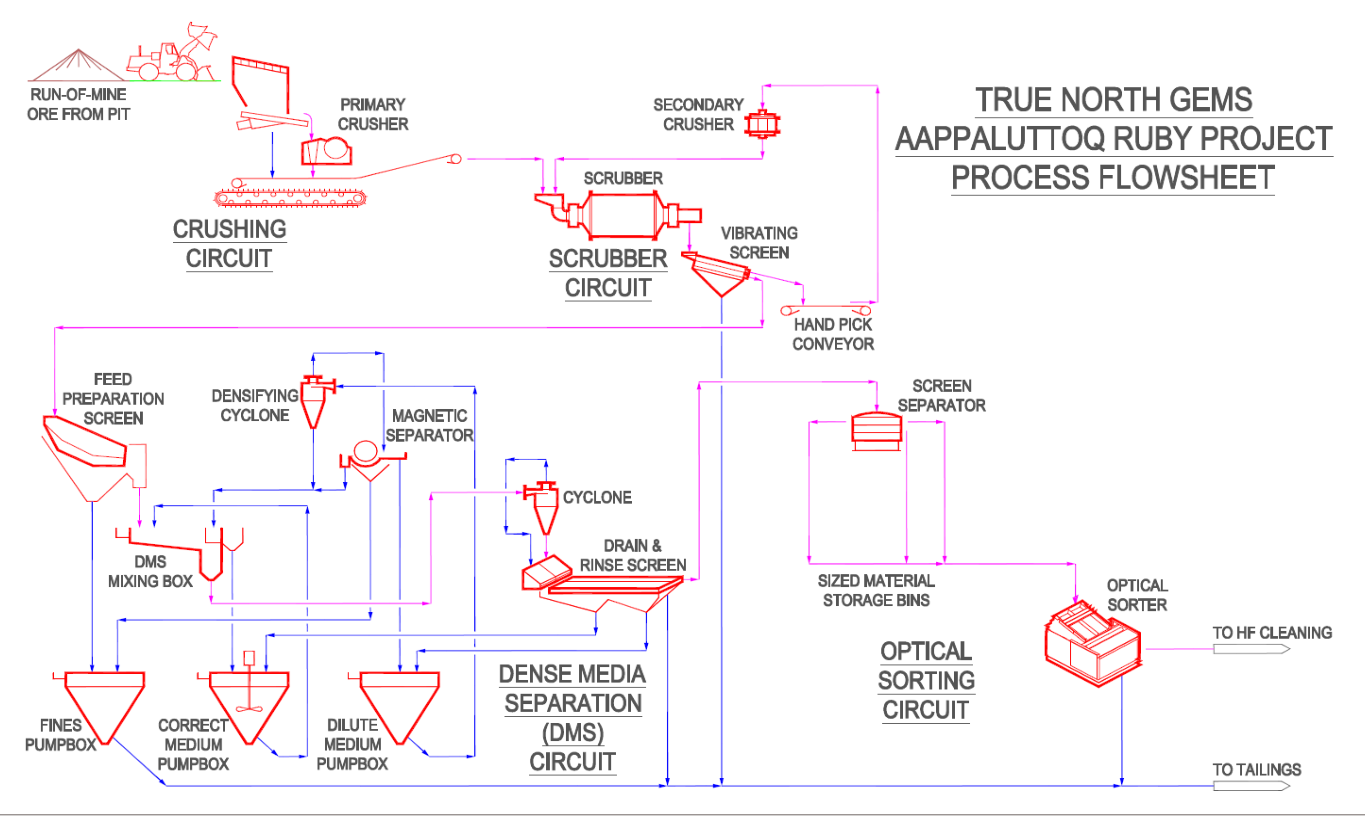
The 2015 updated pre-feasibility study for True North Gems' Aappaluttoq ruby project in Greenland describes a 111 t/d plant that crushes, scrubs, separates by density, dries, removes magnetic rock and sorts red corundum with cameras and air jets.
Aappaluttoq is a ruby project in Greenland. The NI 43-101 technical report is an updated pre-feasibility study (PFS) presented to True North Gems Inc. by Tetra Tech EBA, with an effective date of January 31, 2015 and a release date of March 17, 2015. The process information was provided to Tetra Tech by Novus Engineering, which was conducting engineering, procurement and construction management for the Aappaluttoq processing plant and the Nuuk hydrofluoric acid (HF) facility. Tetra Tech reviewed the engineering drawings, process recoveries and laboratory results and found them adequate for inclusion in the PFS. The plant is designed to make a rough corundum concentrate, predominantly corundum particles with minor host rock attachments, which is exported from site for further processing.
Critical Data
| Parameter | Value | Unit | Notes |
|---|---|---|---|
| Nominal throughput | 111 | t/d fresh feed | 83% utilization required |
| Design capacity | 11 | t/h fresh feed | 90% utilization allowed |
| Operating schedule | 224 | days per year | One 12 hour shift, April to November |
| ROM size | 550 | mm and below | Front-end loader feed |
| Jaw crusher product | 60 | mm and below | Primary crusher |
| Cone crusher product | 20 | mm and below | Secondary crusher |
| Scrubber screen cuts | Plus 20, minus 20 to plus 1.7, minus 1.7 | mm | Three decks |
| DMS medium | 2.7 to 3.3 | SG | Ferrosilicon slurry |
| Optical sorter size fractions | 3 | Not applicable | Plus 10, minus 10 to 4, minus 4 to plus 1.7 mm |
| Primary concentrate | 55 | % corundum | 24% of corundum, single pass |
| Secondary concentrate | 26 | % corundum | 76% of corundum, single pass |
| HF requirement, primary | 700 | g per kg concentrate | Estimated by SRC |
| HF requirement, secondary | 1,200 | g per kg corundum | Estimated by SRC |
| Connected power | 959 | kW | About 575 kW drawn |
Overview
The Aappaluttoq plant has no grinding. It uses crushing, scrubbing, dense media separation (DMS), drying, dry magnetic separation and optical sorting. All of it is housed in a single heated Process Building near the project maintenance facility and the open pit, together with the office, security and electrical and control facilities. Concentrate goes to True North Gems' HF cleaning facility in Nuuk, Greenland.
Key Process Stages
Crushing
A jaw crusher accepts run-of-mine ore, which is placed in the feed by a front-end loader at nominal sizes of 550 mm and below, and reduces it to 60 mm and below. A belt takes it to the scrubber feed bin. The secondary cone crusher takes the plus 20 mm oversize from the scrubber discharge screen and reduces it to 20 mm and below, and its product returns to the scrubber feed bin. The primary crusher is decoupled from the rest of the plant by a 100 t feed bin and runs a shorter shift of about two hours a day.
Scrubbing
The scrubber washes and cleans the crushed ore and delivers it to a three-deck horizontal vibrating screen. Plus 20 mm material passes a hand pick area, where staff can lift large lumps of corundum out of the stream before they reach the cone crusher, since crushing could destroy larger quality fragments. The minus 20 mm to plus 1.7 mm fraction goes to the DMS plant by conveyor. The minus 1.7 mm fraction goes to a pump box and is pumped as tailings to the tailings storage facility.
Dense media separation
The DMS plant is a wet process that separates corundum-bearing material from gangue by density. Milled or atomized ferrosilicon powder is mixed with process water into a slurry with a bulk density of about 2.7 to 3.3 SG and combined with the ore in a cyclone. Sinks, including corundum, report to the underflow, and floats to the overflow. Medium is recovered for reuse on a vibrating screen, then cleaned and densified through wet magnetic separation. Floats are discarded to the tailings storage facility.
Drying, magnetic separation and optical sorting
DMS sinks are dried in an infrared dryer and screened into three fractions: plus 10 mm, minus 10 to 4 mm, and minus 4 to plus 1.7 mm. Each is held in its own bin and treated separately. A dry magnetic separator with a head pulley sends magnetic material to tailings. The non-magnetic stream passes an optical sorter, whose cameras identify red potential corundum and fire a burst of compressed air to separate it. Through an external recycle, the sorter can make a reject stream, a secondary concentrate of particles showing 10% to 50% corundum, and a primary concentrate of particles showing more than 50%. The two concentrates are shipped separately to the Nuuk HF facility, and the rejects are stored on site for possible reprocessing.
Sorter test results
Optical sorting tests at Tomra in Germany showed 24% of the corundum reporting to primary concentrate and 76% to secondary concentrate in a single pass. The primary concentrate contained 55% corundum by weight, and the secondary 26%. The Saskatchewan Research Council in Saskatoon estimated the hydrofluoric acid needed to digest the concentrates at 700 g per kg of primary concentrate and 1,200 g per kg of secondary corundum.
Additional Interesting Data and Summary
Process water is pumped directly from the western lake basin, and electrical power comes from onsite diesel generators. The total equipment rated power is 959 kW, and the expected draw is 575 kW, or 60% of rated power. Instrument air comes from an air drier in the process plant, fed by compressed air stations.
Floats and fines from DMS and the scrubber are sent to the tailings storage facility, and the report refers to its tailings section for disposal details. The equipment list also notes some future items, including a DMS floats recrush crusher and floats oversize bins.
Key Processes
- Jaw and cone crushing with a hand pick station
- Scrubbing with three-way screening
- Dense media separation with ferrosilicon medium
- Infrared drying and size fractioning
- Dry magnetic separation
- Optical sorting with air jet ejection
- Hydrofluoric acid cleaning of concentrate at a separate facility in Nuuk
Source: Updated Pre-Feasibility Study on the Aappaluttoq Ruby Project, Greenland, March 17, 2015.
